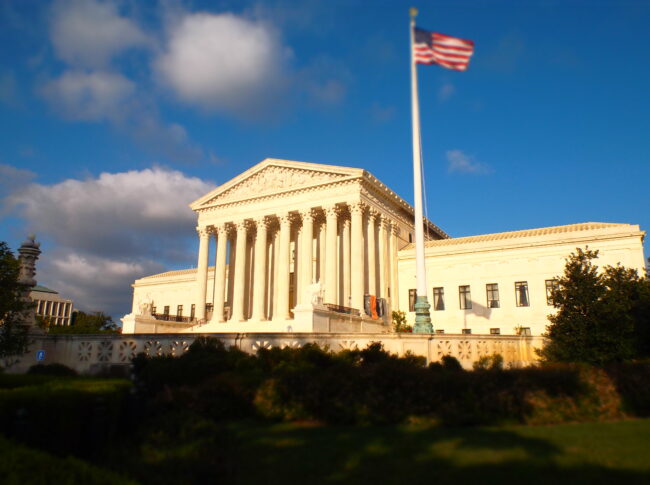
In Gould v. Interface, Inc., No. 23-12883 (Oct. 2, 2025), the U.S. Court of Appeals for the Eleventh Circuit was dealing with a claim for wrongful termination of a tech CEO.

So what’s the case doing here? Skip forward to page 12 of the slip opinion, where the court deals with an oft-occurring argument: the appellant “waived” (forfeited, actually) a claim by failing to pursue it below. The general rule is that a litigant can waive a claim, but not an argument.

Okay, got it. But again, why is this opinion posted here? Well, the example the court uses to illustrate the difference between a “claim” and an “argument” is the (in)famous takings case, Yee v. City of Escondido, 503 U.S. 519 (1992). Takings mavens know that Yee is often cited in support of the argument that things like rent control do not force property owners to allow

Continue Reading A Reminder From CA11: There’s Only A Single Claim For A Regulatory Taking (Although There May Be Several Arguments)

PXL_20221218_214724672.MP

Too busy writing those briefs and petitioning for those writs, so haven’t found the time to hit your local store or the interwebs and fulfill your seasonal duties? Or maybe you just have gifter’s block this holiday season about an appropriate present for the dirt lawyer in your life?

You want to be known as a a good gifter, not a grifter.

Fear not, friend. Here’s our annual Holiday Dirt Lawyer Gift Guide, with our suggestions for things that could make the DL in your life happy. Some serious, some cheeky. You figure out which applies.

Let’s go!

* * * *

Bespoke Property Rights Rickroll Mug.

We’ll start with a new entry, one that is sure to become a favorite. We’re not quite sure what to call it, so we’ve settled on “Property Rights Rickroll Mug.”

For those of you who remember, fondly or otherwise, the

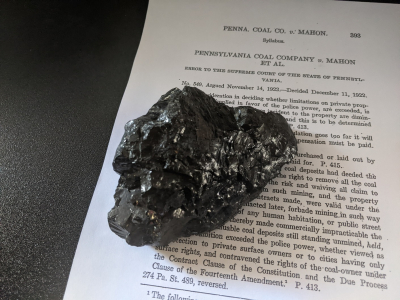
Continue Reading SCOTUS Origami Boulders, Bundles Of Sticks, Lumps Of (Pennsylvania) Coal, And Bags O’ Dirt: Presenting Your 2025 Dirt Lawyer Holiday Gift Guide (Including Last-Minute Entries)

The U.S. Court of Appeals for the Ninth Circuit’s opinion in Epic Games, Inc. v. Apple, Inc., No. 25-2935 (Dec. 11, 2025), isn’t one the typical readers of this outlet might notice.

After all, it’s mostly about a tech company beef, as the caption might indicate. And the opinion is about one aspect of that beef, where the district court ordered Apple to do something, and then … it didn’t. As the opinion summary details:

After a bench trial, the district court enjoined Apple from certain anticompetitive business practices related to its App Store, and this court affirmed the injunction. Apple claimed to comply with the injunction, but it instead prohibited App Store developers from using buttons, links, and other calls to action without paying a prohibitive commission to Apple, and it restricted the design of the developers’ links to make it difficult for customers to use them.

Slip

Continue Reading CA9: District Court’s Contempt Order Isn’t A Judicial Taking

Here’s the latest in a case we’ve been following (because it is a product of our shop: we represent the property owners/plaintiffs).

In this Order, the Florida Supreme Court declined to exercise jurisdiction to review the Third District Court of Appeals en banc opinion in Shands v. City of Marathon. So that decision stands.

This is the case in which the Shands Family, the owners of Shands Key — a small island in the City of Marathon (about 1/2 way down the Overseas Highway in the Florida Keys) — asserted that the City’s downzoning their property from a density that allowed residential development to a density that doesn’t (Shands Key is below the minimum lot size under the downzoning), is a Lucas taking.

The court of appeal rejected the City’s claim that beekeeping and overnight camping were possible uses of the property under the downzoning, thus exempting it

Continue Reading Fla SCT Declines Review: En Banc Court Of Appeal Decision That Downzoning Was A Lucas Taking (And Sale Of Property For Third-Party TDRs Is Not A “Use”), Stands

If you were creating a moot court problem, what topic would you pick? You’d want a question that is a hot topic. Unresolved by the Supreme Court. Controversial, interesting, and complex.

Well, we have just the issue for you: our favorite topic, takings.

That appears to be what the powers-that-be behind Harvard Law School’s moot court competition believed, because according to this report (Rachel Reed, “Harvard Law students battle for honors at the 2025 Ames Moot Court Competition,” Harvard Law Today (Nov. 19, 2025)), the student teams were confronted with a case where there was a clear taking (the commandeering and take-over of a hand sanitizer plant during Co-19), but the plant owner was denied a remedy because the defendant is the (fictional) State of Ames.

Ah yes, the question the Court dodged recently in DeVillier v. Texas, 601 U.S. 285 (2024): may an owner whose property

Continue Reading Harvard Law School’s Moot Court Problem This Year? Takings.

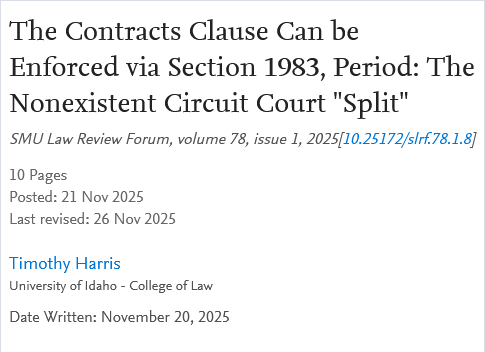
Check out a newly-published law review article by lawprof Timothy Harris, “The Contracts Clause Can be Enforced via Section 1983, Period: The Nonexistent Circuit Court ‘Split’,” 78 SMU L. Rev. Forum 106 (2025).

The article delves into the issue of whether 42 U.S.C. § 1983 is the cause of action to bring a Contracts Clause challenge. The Contracts Clause prohibits states from passing any law impairing the obligation of contracts, and the fundamental question to be answered is whether your Contracts Clause rights are “rights, privileges, or immunities secured by the Constitution and laws” as described in section 1983.

Here’s the Abstract:

The Federal Circuit Courts are apparently split on whether 42 U.S.C. § 1983—which provides a civil cause of action for constitutional deprivation of rights— applies to actions brought under the Contracts Clause in article 1 of the U.S. Constitution. The “split” has existed since

Continue Reading New Article: Timothy Harris, “The Contracts Clause Can be Enforced via Section 1983, Period: The Nonexistent Circuit Court ‘Split’,” 78 SMU L. Rev. Forum 106 (2025)

Here’s the latest in a case we’ve been following. [Disclosure: this is one of ours, so we won’t be commenting much at all.]

In Pung v. Isabella County, No. 25-95, the U.S. Supreme Court is considering these Questions Presented:

1. Whether taking and selling a home to satisfy a debt to the government, and keeping the surplus value as a windfall, violates the Takings Clause of the Fifth Amendment when the compensation is based on the artificially depressed auction sale price rather than the property’s fair market value?

2. Whether the forfeiture of real property worth far more than needed to satisfy a tax debt but sold for fraction of its real value constitutes an excessive fine under the Eighth Amendment, particularly when the debt was never actually owed?

(Here’s the cert petition.)

Today, the petitioner filed the merits brief, arguing that yes, “[w]hen

Continue Reading SCOTUS Merits Brief (Ours) In Just Comp/Excessive Fines Case

A quick one from the South Dakota Supreme Court. But it is well worth your time.

In City of Sioux Falls v. Johnson Properties, LLC, No. 30945 (Nov. 19, 2025), the court upheld a trial court’s award of attorney’s fees to a property owner in an eminent domain action. The final amount of compensation exceeded the 20% threshold under South Dakota law that triggers fee shifting, and the Supreme Court concluded that even though the amount of fees awarded exceeding the “lodestar” calculation, the owner was entitled to an enhancement.

Here’s the court’s description of the critical action and numbers in the trial court:

[¶6.] Shortly before trial, the City increased its offer of compensation to
$250,000. Johnson Properties rejected the offer and the case proceeded to a three-day jury trial on the issue of just compensation. At trial, Johnson Properties’
appraiser testified that, in his opinion, the

Continue Reading South Dakota: Eminent Domain “is a highly specialized area of law that requires skill and experience…” Meriting Attorney’s Fee Lodestar Enhancement

Check out this new (ish) cert petition which asks whether the “final decision” ripeness rule that currently governs regulatory takings cases is also applicable when the right alleged to have been violated is procedural due process.

The petition sets out how the lower federal courts have dealt with the question:

This case presents an important and recurring question that has divided the courts of appeals: whether procedural due process claims asserted in land-use disputes are subject to the same accrual rule as takings claims. Two circuits—the Second and Third—have held that they are. Five others—the Fifth, Sixth, Seventh, Ninth, and Tenth—have held they are not.

Pet. at 2. This case reverses the usual dynamic in takings cases (where generally, owners assert the claim is ripe because the government has made it clear what uses it will and won’t allow), because the Second Circuit held that the case was ripe a

Continue Reading New Cert Petition: Are Procedural Due Process Claims Subject To The Same Ripeness Rules As Takings Claims?

In Grand v. City of University Heights, No. 24-3876 (Nov. 13, 2026), the U.S. Court of Appeals for the Sixth Circuit held that a complaint alleging a RLUIPA claim and others was not ripe because they are “land use” claims subject to Williamson County‘s final decision requirement.

A neighbor was “displeased” that Grand was using his home to hold a “shul,” which “in Hebrew refers to a synagogue or a house where prayers are held.” Slip op. at 2. The city told him to stop because his use as “a place of religious assembly” violated the zoning code (his home is zoned U-1, which doesn’t allow such uses).

Grand applied for a Special Use Permit, which would allow him to make the use as a “house of worship.” The Planning Commission had a hearing, but didn’t make a decision. It “tabled the discussion, requesting more details

Continue Reading CA6: RLUIPA Claim Subject To Williamson County Final Decision Ripeness Because It’s A “Land Use” Issue