


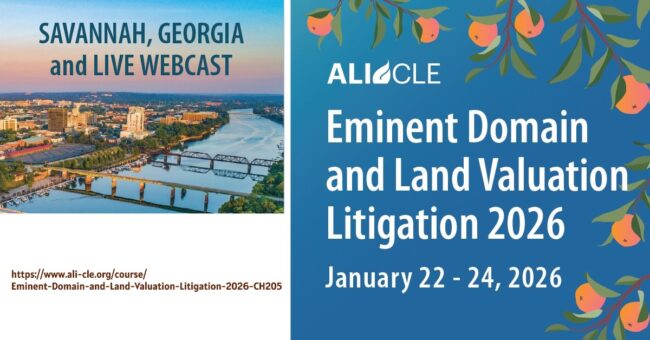
As we wrap up another year, it’s time to look ahead to the one event that always gets our eminent domain blood pumping: the annual ALI-CLE Eminent Domain and Land Valuation Litigation Conference. Details, including faculty list, a complete agenda, and registration information is posted here.

Now in its 43rd year, this flagship gathering remains the undisputed national hub for practitioners, academics, appraisers, and anyone else who lives and breathes property rights law. Mark your calendars for January 22-24, 2026, when we’ll convene at the JW Marriott Plant Riverside District in Savannah, Georgia. Think historic charm meets Southern hospitality, with moss-draped oaks, riverfront vibes, and enough ghost tours to inspire a dozen inverse condemnation hypotheticals. (For those of you who prefer pixels to palm trees, a live webcast option is available.)

What makes this conference indispensable? For starters, it’s the place to reconnect and talk shop with the

Continue Reading Savannah Bound: Don’t Miss The 43rd ALI-CLE Eminent Domain & Land Valuation Litigation Conference (Jan. 22-24, 2026)

Here at inversecondemnation.com we also cover eminent domain, regulatory takings, land use, and environmental issues. We even cover election law when it strikes our fancy.

But here’s one that’s in our core competency: in Frick v. City of Salina, No. 101,355 (July 9, 2010) the Kansas Supreme Court held that property owner-plaintiffs did not meet their summary judgment burden of opposing the city’s motion, and affirmed a judgment that the city did not inversely condemn their property by denying them the ability to construct driveways to access their land.

After the city condemned their property, the Fricks moved their businesses to another nearby site. The move, according to the Fricks, “was thwarted by the ‘inappropriate regulatory’ action of the City. Slip op. at 8. The regulatory actions complained of included:

(1) denial of reasonable access to the relocation site during the Project; (2) construction activities

Continue Reading Kansas: Inverse Condemnation Case Resolved By Summary Judgment Burdens

Oral arguments in Cienega Gardens v. United States (Fed. Cir. No. 06-5051, Apr. 2, 2007), a case involving the application of the Penn Central ad-hoc test for regulatory takings, have been posted in two parts on the Federal Circuit’s web site: part 1 (68mb mp3), and part 2 (7mb mp3).

Also posted is the oral argument in the related case, Chancellor Manor v. United States (Fed. Cir. No. 06-5052, Apr. 2, 2007) here (39mb mp3).Continue Reading ▪ Federal Circuit Arguments on the Penn Central Factors (mp3)

An interesting decision from the Kansas federal district court, Mount St. Scholastica, Inc. v. City of Atchison, No. 06-2208-CM (Mar. 12, 2007), contains a land use trifecta: historic preservation, religious objections to a denial of a permit, and regulatory takings.  (No link yet to opinion, which currently is only available via Westlaw; email me if you want a copy.  Update: Becket Fund for Religious Liberty has posted a copy of the opinion on its web site.)

Mount St. Scholastica, a “monastic community,” owns property that includes a building constructed in 1924 that has in the interim been used for classrooms, administration, and a community center.  By 1989, however, it had apparently outlived its usefulness to Mount St. Scholastica, which in 2005 sought a demolition permit from the city. 

The building itself apparently is not landmarked, but is near to historic properties, so under Kansas law, the owner needed a

Continue Reading ▪ Land Use Trifecta: Historic Preservation, Religious Uses, and Regulatory Takings