


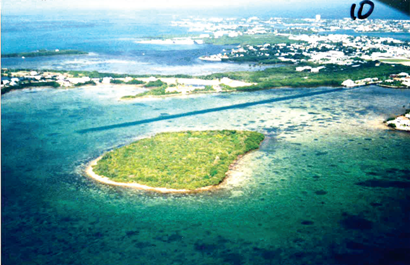
Here’s the latest in a case we’ve been following (because it is a product of our shop: we represent the property owners/plaintiffs).

In this Order, the Florida Supreme Court declined to exercise jurisdiction to review the Third District Court of Appeals en banc opinion in Shands v. City of Marathon. So that decision stands.

This is the case in which the Shands Family, the owners of Shands Key — a small island in the City of Marathon (about 1/2 way down the Overseas Highway in the Florida Keys) — asserted that the City’s downzoning their property from a density that allowed residential development to a density that doesn’t (Shands Key is below the minimum lot size under the downzoning), is a Lucas taking.

The court of appeal rejected the City’s claim that beekeeping and overnight camping were possible uses of the property under the downzoning, thus exempting it

Continue Reading Fla SCT Declines Review: En Banc Court Of Appeal Decision That Downzoning Was A Lucas Taking (And Sale Of Property For Third-Party TDRs Is Not A “Use”), Stands

Check this out: a significant and important decision from the U.S. Court of Appeals for the Eleventh Circuit in an issue we’ve been following.

In Alford v. Walton County, No. 2021-13999 (Nov. 17, 2025), the unanimous panel concluded that the county’s Co-19 restrictions, which closed all beaches (public and private) in the county, worked a physical taking of Alford’s private property rights.

In response to the outbreak of Co-19, which the opinion notes was “a novel virus from Wuhan, China,” slip op. at 3, Florida declared a state of emergency, and followed up with an executive order that limited beach access statewide to “no more than 10 persons,” imposed a six-foot separation, among other things. Two days later, the county adopted an ordinance closing all public beaches in the county.

The following month, after the governor issued further executive orders, the county temporarily closed “[a]ll beaches” in the

Continue Reading CA11: “[T]here is no COVID exception to the Takings Clause”

There’s not a lot of new territory forged in the U.S. Court of Appeals for the Ninth Circuit’s opinion in Pena v. City of Los Angeles, No. 24-2422 (Nov. 4, 2025), holding that the city could not be liable for a taking after SWAT officers severely damaged a home in the course of apprehending a suspect who had taken refuge there.

After all, the other federal courts which have addressed the issue of whether a local government’s damaging or destroying a home in the course of apprehending a criminal suspect is a taking have all concluded no, although for a variety of reasons. Some say there’s no absolute right to exclude, with the issue turning on whether the police are acting pursuant to a valid warrant, incorporating by reference Fourth Amendment property law. Some say the owner has no expectations of exclusion of the government as a

Continue Reading CA9: No Claim For A SWAT Taking Because There’s A Public Safety Exception To The Fifth Amendment

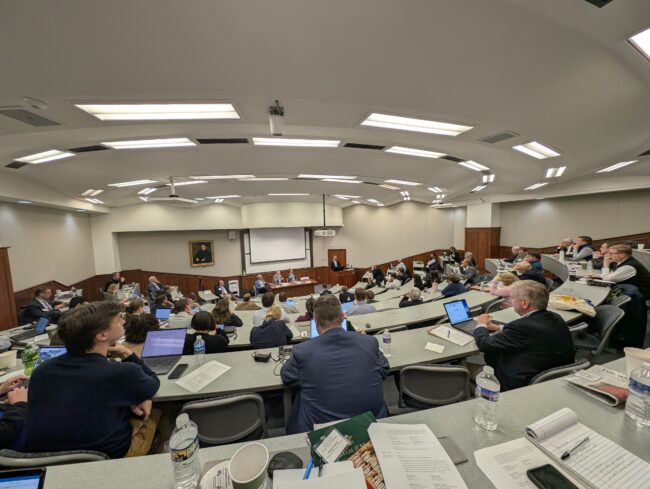
This past week we were busy with the 22d Brigham-Kanner Property Rights Conference at the William and Mary Law School.

Here’s the text of the remarks which I prepared for the session on “Public Safety, Private Property, and Just Compensation.” Note: because of time, I truncated what I planned on saying and kept it shorter.

* * * *

Public Safety, Private Property, and Just Compensation

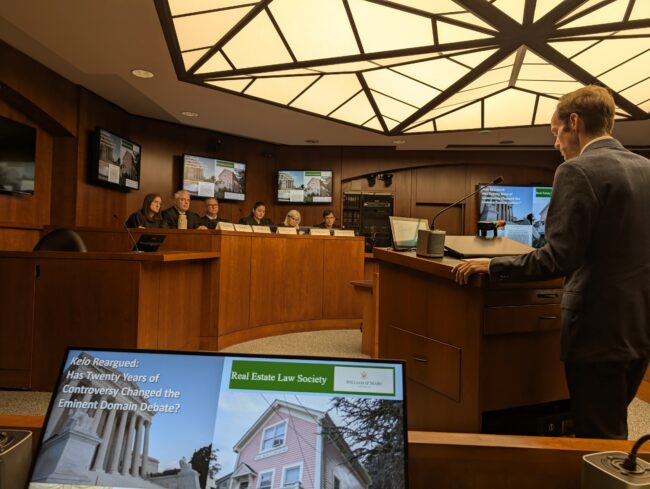
Before I begin, a prelude. As you learned earlier, yesterday the student Real Estate Law Society produced a reargument of Kelo.

Ms. Kelo won this time. Six-to-zero, adopting the rationale of Justice Thomas’s dissent in the original case, with one concurring opinion. (More about this event in a separate post.)

And for those of you in the audience who didn’t know, Ms. Kelo’s famous little pink house was saved, even though her property was not. The house was taken apart board-by-board

Continue Reading Salus Populi Est Suprema Lex: 2025 Brigham-Kanner Property Rights Conference Report

We have no idea what these cases might be about, or whether there is any substance behind the property owners’ objections, but these are headlines no condemnor could possibly like:

  • Bedford County Widow Sued (via wjactv.com) – “A Bedford County widow is being sued for trying to keep Columbia Gas Transmission off her property. The Texas-based company is using eminent domain to gain access to 67-year-old Mary Ellen McConnell’s 125-acre farm.”
  • Granny Vows To Fight For House (via wyff4.com) – “On the other side of Stenhouse Rd, 85-year-old Juanita Sullivan worries about eminent domain.”

Might as well say they’re trying to take property from cute, fluffy kittens.


Continue Reading Headlines No Condemnor Likes To See

Here at inversecondemnation.com we also cover eminent domain, regulatory takings, land use, and environmental issues. We even cover election law when it strikes our fancy.

But here’s one that’s in our core competency: in Frick v. City of Salina, No. 101,355 (July 9, 2010) the Kansas Supreme Court held that property owner-plaintiffs did not meet their summary judgment burden of opposing the city’s motion, and affirmed a judgment that the city did not inversely condemn their property by denying them the ability to construct driveways to access their land.

After the city condemned their property, the Fricks moved their businesses to another nearby site. The move, according to the Fricks, “was thwarted by the ‘inappropriate regulatory’ action of the City. Slip op. at 8. The regulatory actions complained of included:

(1) denial of reasonable access to the relocation site during the Project; (2) construction activities

Continue Reading Kansas: Inverse Condemnation Case Resolved By Summary Judgment Burdens

If you can figure out the syntax of this post’s headline, you’ve just figured out the rationale of the Wisconsin Supreme Court in E-L Enterprises, Inc v. Milwaukee Metropolitan Sewerage District, No. 2008AP921 (July 2, 2010). In that case, the court held that the removal of groundwater was not a compensable taking because the property owner did not seek compensation for the taken water, but for damage to its building which relied in part on the groundwater for support.

Many years ago, in the course of constructing a new pipeline, the local sewer company removed groundwater under a neighboring building. Removal of the water resulted in the wooden supports under the building rotting, which caused the building to settle. The cost to replace the wooden supports with concrete supports was approximately $300,000.

The property owner brought claims for negligence, nuisance and inverse condemnation because the sewer company “physically took

Continue Reading Wisconsin: Taking Groundwater Is Not A Taking Of A Building Damaged By The Taking Of The Groundwater

New Jersey Eminent Domain blog posts a good summary of the Robbins v. Wilkie case currently pending in the US Supreme Court:

The critical issue for Robbins and other property owners asserting their 5th amendment rights is whether they can do so without fear of retaliation by government officials. Many property owners affected by eminent domain are reluctant to speak out, fearing government retaliation, which may come in the form of code enforcement, health and safety inspections — all done with an objective to force them to give up their property rights for redevelopment before, or even resisting, the eminent domain process.

Very true.  Not all retaliation against property owners is as overt as what the BLM officials are alleged to have done to Mr. Wilkie, and government “payback” may take many forms.  When such behavior goes too far, the law should recognize that property owners may seek relief in

Continue Reading ▪ Retaliation for Asserting Constitutional Right of Property

Check out this AP photo and the accompanying story “China’s ‘stubborn nail’ stands firm” —

Reminds me of the Warner Bros. classic “Homeless Hare,” where Bugs Bunny objects to a developer’s efforts to evict him from his hole: “Hey ya big gorilla, didn’t you ever hear about the sanctity of the American home?”

Wu Ping owns a home in Chongqing and apparently doesn’t want to get out of the way for redevelopment:

A legal battle has raged since she rejected the compensation offer as she has maintained that she cannot be forced to move out.

A local court ordered her to allow the structure to be torn down by Thursday, although she continued to refuse and it was not immediately clear what steps authorities would take next.

Property disputes are rife in China, often involving illegal land grabs by developers in collusion the government.

The national parliament

Continue Reading ▪ The Eminent Domain “Holdout,” Graphically Illustrated