2008

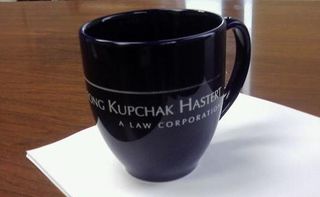
For those of you stuck in the office today, a contest: I’ll send to the first three people who email me today their very own “limited edition” of my firm’s just-released extra-large, cobalt blue coffee mug, shown below.

(Don’t forget to include your name and postal address in your email.)

A happy and safe holiday to all.

12190814351219081435a Continue Reading Office Swag Contest

In City and County of San Francisco v. Coyne, No. A118222 (Cal. Ct. App. 1st Dist. Dec. 5, 2008), the court held that in order to be compensated for goodwill under California law when a parcel is taken by eminent domain, the property owner must have a business on the parcel taken, and that Coyne did not.  The decision correctly noted that “historically, lost business goodwill was not recoverable [as just compensation] under eminent domain law.” Slip op. at 5. In response to the injustice of not compensating condemnees whose businesses were taken or diminished by the exercise of eminent domain, the California legislature enacted California Code of Civil Procedure § 12636.51, which was a statutory grant of compensation for goodwill to owners “of a business conducted on the property taken, or on the remainder if the property is part of a larger parcel.”

The court held that

Continue Reading Cal. Court of Appeals: No Ongoing Business On Parcel Taken, No Goodwill

Why does inversecondemnation.com, a blog about land use issues, care about Hawaii Insurers Council v. Lingle, No. 27840 (Haw. Dec. 18, 2008) enough to have posted about it, you ask?  The case involved whether the State of Hawaii Insurance Commissioner could collect fees from insurance companies, and whether the state legislature could thereafter transfer the money collected into the general fund. The short answer by the Hawaii Supreme Court is that the collection of the fees were proper “regulatory fees,” but that the legislative transfer was an unconstitutional violation of the separation of powers. Not exactly typical land use law fare.

But here’s the interesting part. The Hawaii Insurers case analyzed State v. Medeiros, 89 Haw. 361, 973 P.3d 736 (1999), which set forth the test for when a charge imposed by an administrative agency pursuant to the state’s police powers is valid, and when it crosses

Continue Reading Of Taxes, Exactions, User Fees, and Regulatory Fees

How often in an appellate opinion does the court use the term “glom?” 

[The Appellee] gloms onto the “police power” aspect of the definition [of regulatory fees] in arguing that “Medeiros plainly concern[ed] the ‘police power’ of ‘criminal investigative services,’ not a user fee as suggested by [the state].”

No matter what you may think of the phraseology of Hawaii Insurers Council v. Lingle, No. 27840 (Haw. Dec. 18, 2008), the decision is important because who can take your money,  how they go about doing it, and what happens to your money afterwards, matters. As Chief Justice John Marshall famously wrote in McCulloch v. Maryland, 17 U.S. (4 Wheat.) 316 (1819), “the power to tax is the power to destroy,” and that may be even more true today where the power to regulate and impose fees may be the same thing.

Under Hawaii law, only the state

Continue Reading HAWSCT: Separation of Powers Prohibits Legislative Transfer of Agency’s Regulatory Fees to General Fund

Today, on behalf of the Western Manufactured Housing Communities Association, we (me and my Damon Key colleagues Christi-Anne Kudo Chock and Matt Evans) filed an amicus brief brief urging the U.S. Supreme Court to accept for review the California Court of Appeal’s decision in Charles A. Pratt Const. Co. v. California Coastal Comm’n, 76 Cal. Rptr. 2d 466 (Cal. Ct. App. 2008) (slip opinion available here).  Our brief is posted here.

We blogged about the lower court decision here, the rehearing petition here, and the cert petition here.

The two Questions Presented by the cert petition involve whether the ad hoc Penn Central test for whether government action effects a regulatory taking of property can be reduced to bright-line rules, and whether, under the Williamson County ripeness rules, a property owner must continue to pursue a a development application when the reviewing agency

Continue Reading Our Amicus Brief in Pratt Construction Co. v. California Coastal Commission

The return trip of the “Hawaii Superferry” case, Sierra Club v. Dep’t of Trans., No. 29035 (visit our page with all resources on the case here), to the Hawaii Supreme Court at first gloss presents a somewhat metaphysical question: when is duly enacted legislation which on its surface appears to be of general applicability, really meant for a single beneficiary?

This has been the debate thus far on whether “Act 2,” the statute enacted after the Hawaii Supreme Court held in ————————–, that the State Department of Transportation’s exemption of the Hawaii Superferry from detailed environmental review violated the Hawaii Environmental Policy Act, Haw. Rev. Stat. ch. 343.  Continue Reading What’s Really At Stake in the Hawaii Superferry “Act 2” Appeal

Just in case you wanted even more to read tonight before tomorrow’s Hawaii Supreme Court oral arguments in the Hawaii Superferry appeal redux, posted below is a nearly complete set of briefs. Some are upwards of 2 MB, so you — and your internet service provider — have been duly warned.

Believe it or not, this is not a complete set of briefs (it’s somewhat ironic that “environmental litigation” can kill so many trees), but only those that seemed to us likely to be of interest when we scanned the files at the Clerk’s office. The case involves three major parties (Sierra Club, State of Hawaii Department of Transportation, and the Hawaii Superferry) and there are not only appeals, but cross-appeals, so yes, there are other briefs not included here.

For the Court’s summary of the issues in the case, go here. For a summary of what goes on

Continue Reading More Superferry Round 2 Briefs