January 2009

Mark your calendars for Thursday, February 12, 2009. That’s the date the Hawaii Federalist Society is sponsoring a debate on the ceded lands case, Hawaii v. Office of Hawaiian Affairs, No. 07-1372 (cert.granted Oct. 1, 2008),. The case is scheduled for oral argument before the U.S. Supreme Court on February 25, 2009. [Disclosure: we filed an amicus brief in the case, supporting the State’s argument.]

The debate is titled Hawaii v. OHA Debate – Ilya Shapiro vs. Carl Christensen – Did the Hawaii Supreme Court rewrite the terms by which Hawaii became the 50th state?

Details: Thursday, February 12, 2009, 12:45 – 2:00 pm; Classroom 2, U. Hawaii Law School, 2515 Dole Street, Honolulu. The event is open to the public, but if you are not a student at the U.H. Law School, please RSVP not later than February 10, 2009 by email to loren.tilley@gmail.com. A summary

Continue Reading Ceded Lands Case Debate – Feb. 12, 2009 – U Hawaii Law School

Smokey [Update: wildlandfire readers, see the bottom of the post.]

In a case we first analyzed here when the lawsuit was dismissed by the Court of Federal Claims, the U.S. Court of Appeals for the Federal Circuit in Cary v. United States, No. 2008-5022 (Jan. 16, 2009) held that the federal government was not liable in inverse condemnation for taking property damaged by Southern California wildfires in 2003.

The Federal Circuit affirmed the CFC’s judgment on the pleadings, holding that the owners of the damaged property did not allege — and could not show — that the government intended to invade a property interest when it failed to control the “Cedar Fire,” which began when “a deer hunter lost in the forest lit a signal fire to aid his rescue.” Slip op. at 2. It was a tragedy of immense proportions as fifteen people were killed, more than

Continue Reading Federal Circuit: No Taking For Forest Fire

In a lengthy (70 page) opinion, the California Court of Appeals (Sixth District), in Shaw v. County of Santa Cruz, No. H031108 (filed Dec. 19, 2008, ordered published Jan. 16, 2009), held that the government’s denial of a ministerial permit did not amount to a regulatory taking.

The opinion sets forth a long factual and procedural history of the case, so we won’t repeat it here. The discussion of takings begins on page 34 of the slip opinion, with a good short summary of regulatory takings law, and the various situations when the regulation of land will be deemed to have gone “too far” and requires the payment of just compensation. See slip op. at 34-39. Footnote 39 is particularly interesting, as it correctly notes that Lingle did not wipe out the Agins substantially advance test, but merely relocated it to due process:

The court’s holding [in Lingle

Continue Reading Cal. Court of Appeals Revisits (Sort of) Landgate: Of Regulatory Takings, Means-End Analysis, and Due Process

Worth reading: Government’s Promise: Taking Away Property?, commentary from U. Chicago lawprof Randy Picker on a NY Times editorial which argues “[t]he first step toward providing the [economic] relief is to include in the packagea measure to allow hard-pressed homeowners to have the terms of themortgages modified under bankruptcy court protection, an avenuecurrently denied them by an outdated and anti-consumer bent to the law.” Professor Picker suggests “the central question is whether the rights of themortgage holder are sufficiently property like that they are entitled toconstitutional protection from after-the-fact taking…”

In other words, can government simply rewrite long-established rules to wipe out an interest without being liable for a taking?  More hereContinue Reading Mortgage Modification As A Taking

To those who attended Thursday’s and Friday’s conference, thank you.  Here are the cases and other materials I mentioned in my portion:

  • No private right of action to enforce zoning – The Hawaii Intermediate Court of Appeals, in Pono v. Molokai Ranch, Ltd.,119 Haw. 163, 194 P.3d 1126 (2008), held that a private party had nostanding to enforce the state’s land use laws. The Hawaii Supreme Courtrejected certiorari review of the case.  Disclosure: we represent thelandowner. More here.
  • Maunalua Bay Beach Ohana 28 v. State of Hawaii, the appealnow pending in the Intermediate Court of Appeals.  The issue in thatcase is whether the state or littoral landowners are entitled toownership of accreted land. In “Act 73,” the legislature declared thatshoreline land naturally accreted belongs to the State of Hawaii and ispublic property.  The act overturned the age-old rule of shorelineaccretion and erosion, which held that beachfront owners lose ownershipof land when it erodes, but gain it when it accretes.  Instead of thesebalanced rules, Act 73 made the erosion/accretion equation one-sided:the State wins every time.  We filed an amicus brief in the appeal, acopy of which is available here.

The majority opinion by Justice Acoba, joined by Justices Nakayama and Duffy is posted here:

We hold that (1) a landowner in a condemnationaction is entitled to damages under HRS § 101-27 where the property atissue is not finally taken in the context of a particular condemnationproceeding, irrespective of whether the government attempts to take theland through subsequent condemnation proceedings; (2) abatement doesnot apply where the relief sought in two concurrent actions is not thesame; and (3) although our courts afford substantial deference to thegovernment’s asserted public purpose for a taking in a condemnationproceeding, where there is evidence that the asserted purpose ispretextual, courts should consider a landowner’s defense of pretext. Therefore, (1) automatic denial of statutory damages under HRS §101-27in Condemnation 1 is vacated and the case remanded for a determinationof damages, (2) the court’s conclusion that Condemnation 2 was notabated by Condemnation 2 is vacated and the case remanded for adetermination of whether the public purpose asserted in Condemnation 2was pretextual.

Slip op. at 5. Here’s the concurring and dissenting opinion by Chief Justice Moon joined by Justice Levinson. The briefs in the case are available here:  Opening Brief, Answering Brief of the County of Hawaii, Reply Brief. Disclosure: we represent the property owner.

  • Arrow of Time, Vested Rights, Zoning Estoppel, and Development Agreements in Hawaii’ (published by the U. Hawaii Law Review in Feb. 2006). Drop me an email, and I will email you a pdf, or send you a hard copy (tell me which).

Continue Reading Materials From Hawaii Land Use Law Conference

The California Coastal Commission has filed its Brief in Opposition to the cert petition in Charles A. Pratt Const. Co. v. California Coastal Comm’n, No. 08-668 (cert. petition filed Nov. 18, 2008) (SCOTUS docket report here).  The California Court of Appeal’s opinion, reported at 76 Cal. Rptr. 2d 466 (Cal. Ct. App. 2008) is available here). 

The issues presented involve the Penn Central ad-hoc test for regulatory takings, and the “final determination” prong of the Williamson County ripeness rule.

We filed an amicus brief in the case, available here. The cert petition and the other amici briefs supporting it are posted here.Continue Reading California Coastal Commission’s Brief In Opposition In Charles A. Pratt Construction Co. Cert Petition (Penn Central and Williamson County)

Here are links to the cases discussed on the conference call this morning:

The majority opinion by Justice Acoba, joined by Justices Nakayama and Duffy is posted here:

We hold that (1) a landowner in a condemnationaction is entitled to damages under HRS § 101-27 where the property atissue is not finally taken in the context of a particular condemnationproceeding, irrespective of whether the government attempts to take theland through subsequent condemnation proceedings; (2) abatement doesnot apply where the relief sought in two concurrent actions is not thesame; and (3) although our courts afford substantial deference to thegovernment’s asserted public purpose for a taking in a condemnationproceeding, where there is evidence that the asserted purpose ispretextual, courts should consider a landowner’s defense of pretext. Therefore, (1) automatic denial of statutory damages under HRS §101-27in Condemnation 1 is vacated and the case remanded for a determinationof damages, (2) the court’s conclusion that Condemnation 2 was notabated by Condemnation 2 is vacated and the case remanded for adetermination of whether the public purpose asserted in Condemnation 2was pretextual.

Slip op. at 5. Here’s the concurring and dissenting opinion by Chief Justice Moon joined by Justice Levinson. The briefs in the case are available here:  Opening Brief, Answering Brief of the County of Hawaii, Reply Brief. Disclosure: we represent the property owner.

      • The Ninth Circuit’s decision in West Linn Corporate Park, LLC v. City of West Linn, Nos. 05-36061, 05-46062 (9th Cir. July 28, 2008) (regulatory takings case removed to US District Court, Ninth Circuit certified questions to Oregon Supreme Court)

        Continue Reading State & Local Government Condemnation Committee Links

        DK_cap3 In the winter, everywhere else has “snow days.”

        But Hawaii — obviously — has not.  

        We have “windy days.” Very windy days.

        Today is one of those days. 

        Schools closed. Sporting events canceled. People evacuated. Even the state courts are shuttered.

        But we’re here, and through whatever today’s weather may bring, we’re blogging.

        As is our custom on days when it seems like no one else is working, we’re distributing some office swag.

        But you have to earn it.

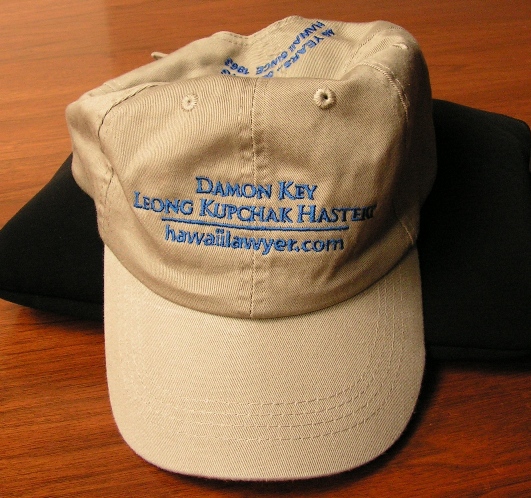
        For the first 3 people who email me today, I will send you a Damon Key | hawaiilawyer.com cap, as depicted above.  Be sure to include your mailing address in your email.

        Color: Island Sand. Sea Blue lettering. The back reads “45 Years – Serving Hawaii Since 1963.”  We have.

        100% cotton. One size fits all. We pay shipping.

        [A bonus tchotchke — a fine Damon Key writing

        Continue Reading A Blustery Day Office Swag Contest

        In 2008, we continued to castigate the Williamson County ripeness rules, culminating in December when we filed an amicus brief urging the Supreme Court to take a harder look at how the “final determination” aspect of the rule is being applied. The rule has two parts.

        First, the state-litigation rule requires a regulatory takings plaintiff to pursue — and lose — their claim in state court before asserting their federal constitutional claims in federal court. In San Remo Hotel, L.P. v. City & County of San Francisco,545 U.S. 323 (2005) four Justices agreed Williamson County produces absurd results and denies federalcourt review of federal constitutional rights, and argued that in an “appropriate case,” the Court should reconsider Williamson County. At least two cert petitions were filed suggesting they were the appropriate case. See Braun v. Ann Arbor Charter Township, No. 08-250 (cert. denied Dec. 1, 2008), and

        Continue Reading 2008 Land Use In Review: Ripeness Games In Regulatory Takings