January 2009

Here’s the latest in the “ceded lands” case, now being briefed in the U.S. Supreme Court. 

The Honolulu Advertiser writes that “OHA looks for some backup,” and has drafted a bill, to be considered by the Hawaii Legislature in its upcoming session, that appears to codify the Hawaii Supreme Court decision in Office of Hawaiian Affairs v. Housing and Community Dev. Corp. of Hawaii, 117 Haw. 174, 177 P.3d 884 (Jan. 31, 2008), now under review by SCOTUS:

OHA board Chairwoman Haunani Apoliona yesterday said she and hercolleagues will lobby lawmakers to pass a bill that would impose amoratorium on the sale of ceded lands until the “unrelinquished claims”of Native Hawaiians to those lands are settled.

Such a moratoriumwould mirror the language of a January 2008 Hawai’i Supreme Courtdecision that ordered the state not to sell or transfer ceded landsuntil claims by Hawaiians to those lands are

Continue Reading Latest Gambit In SCOTUS Ceded Lands Case

OCA_logo I’m honored to have been designated as the Hawaii member of the Owners’ Counsel of America. OCA is “a voluntary network of experienced eminent domain attorneys from every state of the nation, representing property owners facing condemnation or other infringement on their constitutional rights to own property, and dedicated to advancing the cause of property rights.”

OCA membership is byinvitation only and is open to only one attorney from every state.

I attended the OCA annual meeting this past weekend in conjuction with the ALI-ABA conference on Eminent Domain and Land Valuation Litigation, and the depth of knowledge and experience in the room was truly amazing.  Just about every major reported federal and state eminent domain and regulatory takings case or judgment had been litigated by OCA members or honorary members, and it is a real privilege to count them as my colleagues.

OCA also publishes a blog

Continue Reading Owners’ Counsel Of America

09.LULHI It’s not too late to register to attend the Hawaii Land Use Law Conference, taking place January 15 and 16, 2009, in Honolulu. 

Items on the agenda include eminent domain, environmental law, transit-oriented development, subdivision requirements, and cultural impact statements. The program co-chairs are Professor David Callies and land use lawyer Ben Kudo.

This conference takes place only once every two years, so this is your last chance for a while to learn of the latest information and updates, and what issues are on the horizon.

I’m on the faculty, presenting a session on Emerging Water Issues: Coastal Zone Management Permits, and Hawaii’s Floodway, Floodplain and Coastal Inundation Zone Requirements.  The complete agenda and faculty listing is posted here.

Hope you can attend, and if you do, please stop by and say hello.Continue Reading Upcoming: Hawaii Land Use Law Conference

Thanks to Professor Patty Salkin’s Law of the Land blog for letting us know that on January 14, 2009, the New York Court of Appeals (that state’s highest court) will be hearing oral arguments in Aspen Creek Estates, Ltd. v. Town of Brookhaven, a case challenging a municipality’s ability to take property.  Professor Salkin summarizes the issues in the case here

In the opinion now under review, the Appellate Divison approved a taking of private property to preserve it as farmland.  Thecourt’s majority held that the goal of preserving farmland generallyqualifies as a public use/purpose, and that there was no evidence ofpretext in the record demonstrating that the presumption of public useshould be questioned, even though the property owner asserted that theland would eventually be leased or sold to another private owner.

The property owner also asserted that because the taking was not part of a plan

Continue Reading New York Court Of Appeals To Hear Appeal Challenging Reason For Taking

In a development that began in November 2007 (2005 actually, if the starting point is seen as the U.S. Supreme Court’s decision in Lingle v. Chevron, U.S.A., Inc., 544 U.S 528 (2005)), the Ninth Circuit finally ditched Armendariz v. Penman,75 F.3d 1311 (9th Cir. 1996) (en banc), and recognized that property owners are not limited to regulatory takings claims when challenging land use regulation, and the government can violate substantive due process as well.  In 2008, the Ninth Circuit issued a number of decisions in which it recognized that Armendariz‘s forced election of a regulatory takings remedy has been truly overruled. 

Rather than plow through multiple posts, it would be easier to just download a recently published article I wrote on the subject, collecting all the cases, The Ninth Circuit Rediscovers Substantive Due Process In Land Use Cases (31 Zoning and Planning Law Report (Thomson | West

Continue Reading 2008 Land Use In Review: The Ninth Circuit Rediscovers Substantive Due Process

Currently at the annual conference on eminent domain law – as always, well worth attending.

In the morning’s session, Professor Kanner mentioned the recent decision in County of Hawaii v. C & J Coupe Family Limited Partnership, No. 28882 (Dec. 24, 2008), which has not yet been published in the official reporters.  The slip opinion is posted here. Continue Reading At The ALI-ABA Conference On Eminent Domain And Land Valuation

One of the bigger developments, at least in Hawaii law, came in the last week of the year. We’re talking about the Hawaii Supreme Court’s decision in County of Hawaii v. C & J Coupe Family Limited Partnership, No. 28882 (Dec. 24, 2008) (and we’re not just hailing the case because we’re the attorneys for the landowner).

Note: for those attending the Eminent Domain and Land Valuation Litigation conference, this is the case Professor Kanner mentioned in the morning session as being not reported yet.   See below for the link to the slip opinion.

The Court held that government, not property owners, bears the financial risk that a condemnation fails and, importantly, joins a number of courts in holding that the government’s proclamation that a taking is for public use is not immune from judicial inquiry. All five Justices agreed that under Haw. Rev. Stat. § 101-27(1993), the

Continue Reading 2008 Land Use In Review: Public Use And Pretext In Eminent Domain

Following up on this post, where we pointed out several errors in a headline and subheadline in a Honolulu Star-Bulletin story on the Hawaii Supreme Court’s landmark eminent domain decision in County of Hawaii v. C & J Coupe Family Limited Partnership, No. 28882 (Dec. 24, 2008), the Star-Bulletin has posted corrections and clarifications, here:

» A lawsuit remains active by members of the Coupe family in Kona,seeking to block county condemnation of part of their land for ahighway near the Hokulia development. A Page 4 headline in the Hawaiisection Saturday said the suit was dismissed by the state SupremeCourt. Also, future hearings on the case will not involve ethicalallegations, as was stated in a subheadline on the same story.

While still not 100% accurate — the County of Hawaii instituted the lawsuits against the property owners, not the other way around — it’s heartening to see

Continue Reading Thank You, Star-Bulletin: Corrections And Clarifications

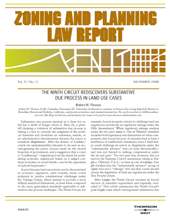
Zplr_p1 The Zoning and Planning Law Report (Thomson | West) has published my article about the post-Lingle developments in substantive due process in the Ninth Circuit. Download a pdf of the article here.

From the introduction:

Substantive due process asserted as a claim for relief has a whiff of danger about it. After all, a plaintiff claiming a violation of substantive due process is asking a court to override the judgment of the political branches and invalidate an ordinance, statute, or an administrative determination because the action is somehow illegitimate. After the demise of Lochner, courts are understandably reluctant to be seen as second-guessing the policy choices made by the elected branches of government, and a suggestion that a court is “Lochnering”—legislating from the bench by invalidating economic regulations based on a judge’s contrary economic or social beliefs—can be the equivalent of judicial kryptonite.

In

Continue Reading New Article: The Ninth Circuit Rediscovers Substantive Due Process In Land Use Cases