


2010

Yesterday, I had the pleasure of speaking to members of the Western Manufactured Housing Communities Association about some of the legal issues facing their businesses, and property owners in general. Here are the links I mentioned:

  • Guggenheim v. City of Goleta, 582 F.3d 996 (9th Cir. 2009) (en banc review ordered Mar. 12, 2010). This is the very important case regarding the city’s mobile home rent control ordinance, which the Ninth Circuit panel concluded worked a facial taking of property under Penn Central. We have the briefs which have been filed for en banc review, and will be posting them in the upcoming days. Most definitely a case to watch.
  • A recent opinion from the California Court of Appeal in another rent control


Continue Reading Links From WMA Presentation – Regulatory Takings, Rent Control, And Guggenheim
Today, on behalf of the National Association of Home Builders and the Wisconsin Building Association, we filed this brief amici curiae in  City of Milwaukee Post No. 2874 Veterans of Foreign Wars of the United States v. Redevelopment Agency of the City of Milwaukee, No. 09-1204 (cert. petition filed Apr. 2, 2010).

The brief argues that the “undivided fee rule,” as applied by the Wisconsin Supreme Court, violates the Fifth Amendment’s Just Compensation Clause because it  requires that the value of a leasehold interest which would be worth over $1 million if condemned separately be valued at zero. Most eminent domain attorneys know about the infamous undivided feerule (aka as the “unit rule” in some jurisdictions), a legal fictionwhich requires a trial courtto calculate valuation of property as if a single owner possessedeverything, even when it is held by more than one interest. Under therule, the condemnor is not

Continue Reading Home Builders’ Amicus Brief In SCOTUS Eminent Domain Case: Is Wisconsin’s Application Of The Undivided Fee Rule Unconstitutional?

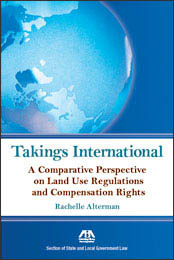
5330205_big My ABA State & Local Government Law colleague Andy Gowder has posted on his blog Grounded, a report and summary of the recent Miami panel discussion of Takings International: A Comparative Perspective on Land Use Regulations and Compensation Rights (Mar. 2010; $95 regular price; $75 for SLG members). 

Takings International is a comparative study of how 13 jurisdictions worldwide treat what we in the U.S. call “regulatory takings.” Visit this page for the Table of Contents and a pdf of Chapter I (scroll to the bottom of the page). Our book review is here.

I concur with Andy’s assessment that it was a fascinating and informative session (and I disclaim any bias resulting from the fact I served as moderator).

The panelists highlighted the issues discussed in the book, and Andy reports:

Professor Alterman began her remarks by pointing out that though no other country comes close to

Continue Reading “Takings International” Panel Report

Yesterday, we filed this motion for leave to file brief amicus curiae and a copy of the proposed brief in support of the application for writ of certiorari which asks the Hawaii Supreme Court to review the decision of the Intermediate Court of Appeals in Maunalua Bay Beach Ohana 28 v. State of Hawaii, 122 Haw. 34, 222 P.3d 441 (Haw. Ct. App. 2009).

In Maunalua Bay, the ICA held that “Act 73” (codifed here and here) was a taking. In the Act, the legislature declared that title to shoreline land naturally accreted cannot be registered by anyone except the State, and that only the State could quiet title to accreted land.

The ICA, however, held that the Act was a taking only of existing accreted land, but was not a taking of what the ICA called “future accretions.” The court held that because “future” accretion might

Continue Reading Amicus Brief In Hawaii Beach Taking Case: “Future” Accretion Is A Present Property Interest

We’re still on the road so haven’t had time to digest this eminent domain decision in more detail, but here’s a short summary.

In an unpublished opinion in Council of San Benito County Governments v. McNamee, No. H033989 (Apr. 27, 2010, the California Court of Appeal (Sixth District) rejected the property owners’ argument the trial court erroneously held they were not entitled to severance damages:

Defendants contend on appeal that the trial court erred in rejecting their claim that the taking of their property created a “substantial impairment” of access to the remainder parcel. They claim that the trial court’s statement of decision “demonstrates its failure to analyze correctly the issues and evidence in this case” and “shows that the trial court failed to consider the facts of this case.”

Slip op. at 4. The court noted that under Cal. Evid. Code § 402, the hearing on the

Continue Reading Cal Ct App: “Substantially Impaired” Access Does Not Mean Reduced Access

The property owners have filed an application for a writ of certiorari asking the Hawaii Supreme Court to review the decision of the Intermediate Court of Appeals in Maunalua Bay Beach Ohana 28 v. State of Hawaii, 122 Haw. 34, 222 P.3d 441 (Haw. Ct. App. 2009).

Disclosure: we filed an amicus brief supporting the property owners in the ICA, available here, and will be submitting a motion for leave to file an amicus brief urging the Supreme Court to accept the application for cert.

In its opinion, the ICA held that “Act 73” (codifed here and here) was a taking. In the Act, the legislature declared that title to shoreline land naturally accreted cannot be registered by anyone except the State, and that only the State could quiet title to accreted land. The ICA held that the Act was a taking of existing accreted land, but

Continue Reading Cert Application In Hawaii Beach Taking Case: Legislative Reassignment To The State Of The Right To Future Accretion Is A Taking

I’m on the road so haven’t had the opportunity to digest this one in more detail.

In an unpublished opinion in Community Redevelopment Agency of the City of Los Angeles v. Kramer Metals, No. B208726 (Apr. 23, 2010, the California Court of Appeal (Second District) held:

Kramer Metals, a California partnership, Stanley J. Kramer, as its general partner, and Stanley J. Kramer and Susan M. Kramer, husband and wife, as joint tenants, (collectively, Kramer) appeal from the judgment in condemnation following: (1) a court trial determining Kramer’s entitlement to just compensation from the Community Redevelopment Agency of the City of Los Angeles, California (CRA) for taking Kramer’s property (Kramer Property or 1000 Property); (2) a jury trial resulting in an award of $4,830,000 as just compensation; and (3) a jury trial resulting in a verdict that Kramer “suffered no loss of goodwill as a result of the taking.”

On

Continue Reading Latest Eminent Domain Ruling From The California Court of Appeal

The Solicitor General has filed the federal government’s Brief in Opposition in Sharp v. United States, No. 09-820 (cert. petition filed Jan. 7, 2010) (Supreme Court docket entry here).

In that case, the property owners are asking the U.S. Supreme Court to review the Ninth Circuit’s decision in United States v.  Milner, 583 F.3d 1174 (9th Cir. 2009), which held that a littoral owner was liable for trespass in waters held by the federal government for the benefit of the Lummi Nation, and for violation of the Rivers and Harbors Act formaintaining a “shore defense structure.” The structure was built onprivate fast (dry) land, but the shoreline eventually eroded up to it.

In the opinion, detailed in this post, the Ninth Circuit held that “both the tideland owner and the upland owner have a right to anambulatory boundary, and each has a vested right in the

Continue Reading Federal Government’s Brief In Opposition In Erosion Case: Is A Littoral Owner Trespassing When The Shoreline Erodes?

At its upcoming April 30, 2010 conference, the U.S. Supreme Court is considering the cert petition in a case we’ve been following since it was decided by the Court of Federal Claims. In Palmyra Pacific Seafoods, L.L.C. v. United States, No. 09-766 (cert. petition filed Dec. 28, 2009), the Court is presented with the following Questions Presented:

1.  Are private contracts property protected by the Takings Clause of the Fifth Amendment to the Constitution?

2.  Assuming that private contracts are property protected by the Takings Clause, is the federal government liable for regulatory as well as appropriative takings of private contracts?

The CFC and the Federal Circuit both rejected the claim that the Secretary of the Interior’s designation of the waters surrounding Palmyra and Kingman Reef as National Wildlife Refuges and attendant commercial fishing ban was a taking of Palmyra Pacific Seafood’s exclusive licenses to operate commercial fish processing

Continue Reading Was Ban On Palmyra Commercial Fishing A Taking Of The Right To Operate Seafood Processing Facilities?

According to this City Room blog post at the New York Times, Daniel Goldstein, the “last Atlantic Yards holdout” and the driving force behind Develop Don’t Destroy Brooklyn, has agreed to cease his objections to the taking of his family home in return for $3 million. For a statement from Mr. Goldstein, see here.

We say good for him.

Browse through some of the comments on the post, however, and you will note that others view this through more jaded lenses: “We knew it was all about the money in the end,” “I guess it was about money all along, eh?,” “Moral of the story: He who holds out longest, gets the biggest check. No good guys in this one.” Similar charges were leveled against Susette Kelo when she eventually settled her case.

These comments are unfair, and reflect a gross lack of understanding of what

Continue Reading Was It “All About The Money?” Hardly.