


2010

On Friday, April 30, 2010, as part of the Spring Meeting of the ABA’s Section of State and Local Government Law, I’ll be presenting a paper Recent Developments in Challenging the Right to Take in Eminent Domain (SSRN posting here) during the “Land Use Hot Topics” program.

If you are in South Florida, the in-person program will be at Holland & Knight, 701 Brickell Avenue, Miami, from 12:30 – 2:00pm. If you can’t be there in person, you can sign up for the “virtual” meeting (a teleconference and live audio webcast) here. Either way, hope you can join us.

The program will also cover such topics as Religious Land Use Update, Recent Developments in Comprehensive Planning, The Miami Beach Art Deco District, Official Immunity in Making Local Zoning Decisions, and Uses and Limits of the Fair Housing Act and the Americans With Disabilities Act. Registration also includes two

Continue Reading Upcoming: Land Use Hot Topics Program (In Person And Online)
A new opinion from the Indiana Supreme Court that reminds us somewhat of the “bizarre condemnation” case now awaiting decision in the New Jersey Supreme Court. In Murray v. City of Lawrenceburg, No. 15S04-0907-CV-310 (Apr. 20, 2010), the court held the claims of a property owner who asserted that the government wrongly occupied her land and leased it to another are subject to Indiana’s six year statute of limitations for inverse condemnation claims. 

Update: here’s another summary of the opinion from the Indiana Lawyer Daily.

The plaintiffs alleged they owned a 3/4 acre parcel in Lawrenceberg. In 1995, however, the Central Railroad Company gave the city an affidavit that it owned the property, and quitclaimed its interest to the city. The city then leased it to a casino. In 2005, the plaintiffs filed a lawsuit seeking to quiet title in the parcel to themselves, and

Continue Reading Indiana Supreme Court: Inverse Condemnation Remedy Exclusive When Government Seizes Land Without Condemnation

Kuilima Resort Company has asked the Hawaii Supreme Court to reconsider or clarify its opinion in the Turtle Bay/Kuilima EIS case (Unite Here! Local 5 v. City and County of Honolulu, No. 28602 (Apr. 8, 2010)), in which the court held that a supplemental environmental impact statement is required when a project’s context changes, even if the project itself has not. The motion is available here.

Under Rule 40 of the Hawaii Rules of Appellate Procedure, no response can be filed unless the court asks for it, and the court has 10 days to act on the motion. If the court does not act within the 10 days, the motion is automatically rejected.Continue Reading Kuilima’s Motion For Reconsideration Of HAWSCT’s Supplemental EIS Opinion

A fascinating case is now pending in Hawaii’s Intermediate Court of Appeals involving the nature of “Torrens” title and, in a broader sense, the nature of property rights themselves. 

Hawaii has had a dual system of land registration. One is your run-of-the-mill system of registering deeds (what we creatively call “Regular System”). The other is “Land Court” registration, a statutory Torrens scheme of title registration where the State guarantees indefeasible title to the rights and interests reflected in the register. Land Court registration insures that interests which are not reflected on title do not exist. Indeed, persons who are wrongfully deprived of land or their interest through registration or the act or omission of the registrar are entitled to be paid by an indemnity fund, and the State’s guarantee operates against all claims, including claims by the State itself. 

As background (for those of you who, like me, weren’t paying

Continue Reading Land Court, Schmand Court: State Disregards Torrens Title, Claiming Unstated, Preexisting Rights

What we’re reading today:

  • Curbing abuse of eminent domain – A Denver Post editorial on a new Colorado statute designed to limit the power of the government to declare farmland “blighted” (“The new law says land that has been classified by the county assessor as agricultural land cannot be condemned for urban renewal. However, it makes an exception for agricultural land that is an enclave within cities and has had development around it for at least three years. We will have to see how the law shakes out in the coming years, but that seems to be an awfully big exception. That’s exactly the kind of land that usually needs the most protection from government.”).


Continue Reading Sunday Eminent Domain Round-Up

In Cottage Emporium, Inc. v. Broadway Arts Center, L.L.C., No. A-0048-97T2 (Apr. 16, 2010) (per curiam), the New Jersey Superior Court (Appellate Division) struck down the city of Long Branch, New Jersey’s declaration that properties located in an area of the city known as the “Broadway Corridor” are blighted. The court held that the city must do more than recite the statutory criteria for blight and then assert the properties met the criteria.

The city determined the properties were in “poor” condition using only “cosmetic and superficial” criteria, and by visually inspecting the buildings’ exteriors. Nor did the city attempt “even in small part to establish what Gallenthin [Realty Development, Inc. v. Borough of Paulsboro, 191 N.J. 344 (2007)] requires, namely a degree of ‘deterioration or stagnation that negatively affects surrounding areas’ by promoting conditions that can develop into blight.” Slip op. at 36.

Although a city’s

Continue Reading New Jersey Appellate Division: For Property To Be Blighted, City Must Do More Than Say It Is Blighted

To paraphrase comedian Jeff Foxworthy, if you understand the title of this post…you might be a regulatory takings lawyer.

And when you hear the terms “RookerFeldman” and “San Remo,” you know you are knee deep in the often-bizarre procedural maze where a regulatory takings claim in federal court may be too early (ripeness), too late (preclusion and full faith and credit), or completely barred (RookerFeldman).

The RookerFeldman doctrine posits that federal district courts do not have jurisdiction to review the decisions of state supreme courts, where it is alleged that the state court’s judgment itself violates the plaintiff’s federal rights. San Remo Hotel, L.P. v. City and County of San Francisco, 545 U.S. 323 (2005) is the Supreme Court’s most recent “ripeness” decision, affirming that property owners do not have to bring their federal takings claims

Continue Reading 8th Circuit: Rooker-Feldman Not Applicable, But Federal Claims Precluded Under San Remo

U.S. Supreme Court Associate Justice John Paul Stevens recently announced that he’s retiring. In property law circles, he is most recently remembered for authoring the majority opinion in Kelo.

Here’s our collection of Stevens-related takings issues

  • David J. Breemer, . Abstract available here.

Continue Reading Justice Stevens, Takings, Kelo, And Williamson County

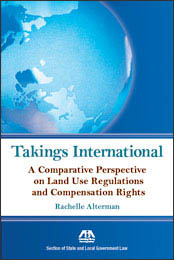
5330205_big I’ve finally had a chance to peruse the recently-published book Takings International: A Comparative Perspective on Land Use Regulations and Compensation Rights (ABA Section of State and Local Government Law 2010; $95 regular price; $75 for SLG members).

Takings International is about how 13 jurisdictions worldwide treat what we in the U.S. call “regulatory takings.” For those of us who have a keen interest in this area of law, this book is a goldmine of information about how the rest of the world deals with the issue. For those who may not be quite as interested, it is still a fascinating survey of how others treats the modern regulatory state’s impact on private property.

The book is headlined by Professor Rachelle Alterman (Technion-Israel Institute of Technology), and contains chapters authored by other experts on regulatory takings. It is divided up into several sections. In Part I, Professor Alterman provides an


Continue Reading Book Review: Takings International: A Comparative Perspective on Land Use Regulations and Compensation Rights