2010

New York State Senator Bill Perkins has filed an amicus brief in Tuck-It-Away, Inc. v. New York State Urban Dev. Corp., No. 10-402 (cert. petition filed Sep. 21, 2010), the case in which upper Manhattan property owners have asked the U.S. Supreme Court to review the decision of the New York Court of Appeals in the Columbia “blight” case, Kaur v. New York State Urban Development Corp., No. 125 (June 24, 2010)

This the case in which the Court of Appeals held that de novo judicial review of the factual record leading to an exercise of the eminent domain power was improper, and whether property can be taken because it allegedly is “substandard or insanitary” is a question for taking agencies, not courts. The record in that case contains fairly convincing evidence that the proffered public use for the takings were not the actual reason, and the Appellate

Continue Reading Another Amicus Brief In Columbia Eminent Domain Case: Redevelopment Takings “[D]isproportionately impact … racial and ethnic minorities.”

The Pacific Legal Foundation has filed an amicus brief in Tuck-It-Away, Inc. v. New York State Urban Dev. Corp., No. 10-402 (cert. petition filed Sep. 21, 2010), the case in which upper Manhattan property owners have asked the U.S. Supreme Court to review the decision of the New York Court of Appeals in the Columbia “blight” case, Kaur v. New York State Urban Development Corp., No. 125 (June 24, 2010).

This is the case in which the Court of Appeals held that de novo judicial review of the factual record leading to an exercise of the eminent domain power was improper, and whether property can be taken because it allegedly is “substandard or insanitary” is a question for taking agencies, not courts. The record in that case contains fairly convincing evidence that the proffered public use for the takings were not the actual reason, and the Appellate Division

Continue Reading Amicus Brief In Columbia Eminent Domain Case: What Level Of Scrutiny Does Kelo Require?

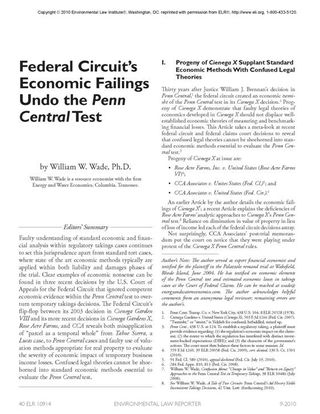
40.10914_Page_1 The first task under the Supreme Court’s three-part test for an ad hoc regulatory taking under Penn Central is to measure the “economic impact of the regulation.” Professor Steven Eagle wrote in the recent edition of his treatise Regulatory Takings that “[d]iscerning the correct measure of economic impact has been the subject of much dispute.”

Thanks to the folks at the Environmental Law Institute, who have allowed us to reprint an article from a recent Environmental Law Reporter which brings some clarity to the subject.

In Federal Circuit’s Economic Failings Undo the Penn Central Test, William W. Wade, Ph.D., a resource economist with the firm Energy and Water Economics (Columbia, Tennessee), argues:

Faulty understanding of standard economic and financial analysis within regulatory takings cases continues to set this jurisprudence apart from standard tort cases, where state of the art economic methods typically are applied within both liability and

Continue Reading The Federal Circuit’s Economic Failings Undo The Penn Central Test

Here are the slides that I used and links to the cases I discussed in “The Whacky and Wonderful World of Eminent Domain After Kelo.”

My presentation was entitled “Schlimmbesserung – Eminent Domain for Redevelopment.” Schlimmbesserung is one of those wonderful German compound words that have no direct translation into English, and means “worsening by improvement.” That term summed up for me how several of the more notorious efforts to use eminent domain in redevelopment efforts have fared (e.g., Poletown, Kelo). Professor Gideon Kanner recently posted some thoughts on “redevelopment blunders” here. The Owners’ Counsel of America’s blog has a summary of the seminar here.

Joining me on the panel was Andrew W. Schwartz, a partner in San Francisco’s Shute, Mihaly & Weinberger, who suggested that redevelopment was good, and that eminent domain was a necessary part of the process when market forces break

Continue Reading Materials And Links From The Webconference “Eminent Domain After Kelo”

Mass_blogBoston law firm Rackemann, Sawyer & Brewster has started the Massachusetts Land Use Monitor, which focuses on “court decisions and other developments in land use and real estate law, legislation and policy” from the Bay State.

Bob Foster, my colleague in the ABA’s State and Local Goverment Law section, is one of the authors and recently posted SJC [“Supreme Judicial Court,” for us non-Mass lawyers] on Regulatory Takings: That Word Does Not Mean What You Think It Means, a post about the court’s recent decision in Blair v. Dep’t of Conservation (Aug. 26, 2010). That case involved the question of whether use restrctions prohibiting a property owner from constructing a retaining wall and expanding a beach were a taking. Bob writes:

The main issue was whether the statute effected a regulatory taking.  This hinged on whether the regulation as applied to the Blairs’ property deprived them of

Continue Reading New Land Use Law Blog: Massachusetts Land Use Monitor

Eminent Domain NYC There was a time when eminent domain lawyers practiced in relative obscurity. Other than a select few, not many knew about condemnation or eminent domain law, or regulatory takings or inverse condemnation. 

But ever since the U.S. Supreme Court’s decision in Kelo v. City of New London545 U.S. 469 (2005), which permitted the taking of a nonblighted home for economic redevelopment (someone else might make more economically productive use of your property than you do), “eminent domain” has become a household word.

These days, it even inspires art.

Brooklyn artist Bettina Johae’s new project is “eminent domain: nyc.” Here is the artist’s description:

Bettina Johae’s project, “eminent domain, nyc” (2010), investigates the use of eminent domain—for public and for private use—in New York City over the past centuries: from the creation of Central Park and the forming of New York’s streets in the 19th century, via

Continue Reading Art Imitates Life In eminent domain: nyc

An opinion worth reading from the Missouri Court of Appeals on the relationship between an action in trespass and eminent domain. Sterbenz v. Kansas City Power and Light Co., No. WE71776 (Oct. 5, 2010) discusses the liability of a utility company for the installation of an underground utility line without an easement.

The Sterbenzes discovered that the utility company was installing a conduit on their land and informed the utility that it had no easement to do so. The utility offered to purchase an easement, but the Sterbenzes refused, and filed suit for trespass, among other claims. The utility countered by filing an eminent domain lawsuit against the Sterbenzes to condemn an easement. “The eminent domain action was stayed by agreement pending disposition of the Sterbenzes’ lawsuit. In fact, though not disclosed in the parties’ briefs, the record on appeal indicates that the parties stipulated to be bound by

Continue Reading Trespass And Eminent Domain Compared

On Friday, November 19, 2010, I’ll be on the faculty of “Integrating Water Law and Land Use Planning” in Honolulu. My session will cover “Water Rights, Property Rights and the Law of Settled Expectations.”

Other sessions include “Hawaiian Water Rights – Where Culture and the Law Merge,” “Amendments to the Instream Flow Standards in East and West Maui,” and “County of Hawaii Water Use and Development Plan.” The complete agenda is posted here.

Also on the faculty are my Damon Key colleague Christi-Anne Kudo Chock; Dr. Lawrence Miike, Commissioner on the State Commission on Water Resource Management; and Lawrence Beck, Civil Engineer with the County of Hawaii Department of Water Supply. Dr. Miike is a physician and attorney, and the author of Water and the Law in Hawaii (2004).

This seminar is usually held biannually, so this may be your last chance for a couple of years

Continue Reading November 19, 2010: Hawaii Water Law Conference

Banner_300x68 Mark your calendars: as a follow up to the panel discussion of Stop the Beach Renourishment, Inc. v. Florida Dept. of Environmental Protection, 130 S. Ct. 2592 (2010) at the ABA Annual Meeting in San Francisco in August, the ABA Section of Real Property, Trust and Estate Law is sponsoring (along with the Section on State & Local Government Law) a teleconference on the case and the issue of “judicial takings.”

In “Is There Such a Thing as a Judicial Taking? The Lessons of the Supreme Court’s Ruling in Stop the Beach Renourishment, Inc. v. Florida Department of Environmental Protection,” I will be moderating a panel of legal experts to discuss the case, and more importantly, where we might go from here. Here’s a description of the program:

This program will discuss the 2010 United States Supreme Court decision in Stop the Beach Renourishment v. Florida Dept.


Continue Reading October 20, 2010: ABA Teleconference On Judicial Takings And The Stop The Beach Renourishment Case

Yesterday, on behalf of the Land Use Research Foundation of Hawaii, we filed this brief amicus curiae in the U.S. Supreme Court in Maunalua Bay Beach Ohana 28 v. Hawaii, No. 10-331 (cert. petition filed Sep. 7, 2010). The Supreme Court’s docket entry on the case is here.

This is the case in which the Hawaii Intermediate Court of Appeals concluded that ownership of beachfront property includes only a partial right to accreted land. In Maunalua Bay Beach Ohana 28 v. State of Hawaii, 122 Haw. 34, 222 P.3d 441 (Haw. Ct. App. 2009), the ICA held that held that “Act 73” (codifed here and here), the statute in which the legislature redefined accretion as public property was a taking of existing accreted land, but held that Act 73 did not affect a taking of what it called “future” accretion, because the right is simply a contingent future interest. The cert petition is available here.

The Cato Institute and Pacific Legal Foundation also filed an amicus brief urging the Court to review the case. See If Only Hawaii’s Government Were as Beautiful as Its Beaches.

The LURF amicus brief poses this Question Presented:

In 2003, the Hawaii legislature adopted Act 73, which declared that the private right to own accretion on beachfront parcels was public property. The statute did not provide for compensation, and upon challenge by the Petitioners, a state trial court invalidated Act 73 as a regulatory taking.

The Intermediate Court of Appeals of Hawaii partially affirmed, concluding that Act 73 was a taking of accreted land in existence in 2003 when the Act became effective. It also concluded, however, that the statute was not a taking of “future accretion,” or land that might be accreted after 2003, because there was no certainty that accretion would occur, and littoral owners’ right to accretion was therefore not “vested.” The court concluded the legislature was free to recharacterize the private right to accretion as state property without compensation because Petitioners never owned it. In other words, the right to accretion is not “property” as that term is used in the Fifth and Fourteenth Amendments.

The question presented is whether the right to accretion is property within the meaning of the Fifth and Fourteenth Amendments, and therefore protected from ipse dixit redefinition into public property.

Here’s a summary of the brief:

To rescue Act 73 from total invalidity under the Takings Clause, the court below created a distinction never before recognized in Hawaii law between “vested existing accretions” which are constitutionally protected property, and “unvested future accretions,” which are not. The latter, the court concluded, could be transformed ipse dixit by the Hawaii legislature into public property without compensation. After all, how could a littoral owner possess a property interest in land that had not yet accreted?

The supposed distinction between “existing” and “future” accreted land is illusory, however, and overlooks the critical private property interest which Act 73 redefined as public property. Hawaii law had for over a century recognized that littoral owners possessed the right to accretion. That right was a present right, was “vested,” and, as surely as interest follows principal, cannot be transformed by the stroke of the legislature’s pen into public property. The Constitution – in addition to recognizing as property the accreted land in existence at the time of the adoption of Act 73 in 2003 – also protects the right to all accretion. Thus, when Act 73 declared that accretion belonged to the state, it confiscated private property without due process or condemnation, and violated the Fifth and the Fourteenth Amendments.

This brief focuses on two issues. First, the right to accretion is a present property interest protected by the Fifth and Fourteenth Amendments from uncompensated legislative redefinition as public property. This right is not limited merely as accreted land in existence on the day the legislature adopted Act 73, and the court below strayed far afield from this Court’s established precedents when it concluded that the only property interest protected by the Constitution was the land already accreted. Second, to provide context to the lower court’s decision and how it reached its conclusion, this brief summarizes the decades-long experiences of Hawaii’s property owners who have seen their established common law property rights eroded into public property. The case at bar is only the latest example.

Brief at 3-4 (emphasis original) (footnote omitted).

The State of Hawaii has waived its right to file a brief in opposition (unless the Court orders a BIO be filed), and the case will be considered at the Court’s conference on October 29, 2010.

More to follow.

Continue Reading Amicus Brief In Hawaii Beach Takings Case: Is The Right To Accretion A “Property” Interest?