August 2011

Today, we filed the Reply Brief (also available below) in the case that asks: after Kelo, when is eminent domain pretextual? 

Last month, we filed a cert petition asking the Supreme Court to review the Hawaii Supreme Court’s decision in County of Hawaii v. C&J Coupe Family Ltd. P’ship, 242 P.3d 1136 (Haw. 2010). In that case, the Hawaii court upheld the taking of land on the Big Island, holding that the asserted public use was not a pretext to the overwhelming private benefit to the developer of the luxury Hokulia project.

On August 17, 2011, the developer and the County filed their joint brief in opposition. Our brief responds:

After reviewing the Oceanside/County brief, it would be easy to forget why this case is here: they argue the Hawaii Supreme Court correctly applied the rational basis standard for pretext established in Kelo v. City of

Continue Reading Final Cert Brief In Eminent Domain Pretext Case
You have to like any sport that the New York Times describes as “like driving full speed through an endless loop of red lights. Luck often expires in a cloudburst of steam and scattered auto parts.” That’s how the Times described “figure 8 car racing.”

But not everyone likes figure 8 racing or related activities, it seems. After a property owner stored several of his race cars on his land and annoyed some residents of Indianola, Iowa, the city adopted an ordinance requiring land on which figure 8 cars (and others) are stored to be enclosed by a fence if two or more cars are present. The property owner sued the city in state court alleging a regulatory taking and the city removed the case to federal court. After a bench trial, the district court held that the ordinance was not a taking.

In Iowa Assuarnce Corp.

Continue Reading Eighth Circuit: No Physical Take For Fence Requirement

cert petition has been filed by the property owners in a case we’ve been following about what the takings ripeness doctrine of Williamson County Regional Planning Comm’n v. Hamilton Bank of Johnson City, 473 U.S. 172 (1985) requires.

In Downing/Salt Pond Partners v. Rhode Island, 643 F.3d 16 (1st Cir. 2011), the U.S. Court of Appeals for the First Circuit concluded that because Rhode Island state law might allow an inverse condemnation remedy andthe burden is on the property owner to show that the remedy is unavailable, and thus the case was not ripe for review in federal court.

The petition poses these Questions Presented:

Does the ripeness doctrine of Williamson County Reg’l Planning Comm’n v. Hamilton Bank of Johnson City, 473 U.S. 172, 194 (1985), require a property owner to litigate in state court to show a taking of property is “without just compensation,” and

Continue Reading New Cert Petition: Why Can’t A Federal Court Determine The State Has Not Provided Compensation?

Today, the Honolulu Star-Advertiser filed a Complaint asking the circuit court to order the Governor to publicly release the list of judicial nominees presented to him by the Judicial Selection Commission, now that the Hawaii Senate has consented to the Governor’s appointment of Justice McKenna. The Governor has refused the Star-Advertiser‘s multiple requests, notwithstanding the Office of Information Practices’ opinion that the list must be disclosed because any justification for withholding “would end once a nominee is confirmed by the Senate.”

Read the story in the Star-Advertiser here.

We won’t add more since we represent the paper, but here’s the Complaint (Exhibits A – N referenced in the complaint are here):

Complaint, Star-Advertiser v Abercrombie, Civ No 11-1-1871-08 (filed 8-23-2011)Continue Reading New Complaint: Governor Must Release JSC List

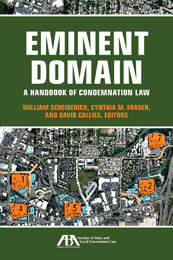
5330215_big The American Bar Association’s Section of State & Local Government Law has just published a new book on eminent domain fundamentals: Eminent Domain – A Handbook of Condemnation Law (available for preorder here).

I was privileged to author two chapters (Prelitigation Process and Flooding & Erosion), and my Damon Key colleagues Mark Murakami and Christi-Anne Kudo Chock co-authored the chapter Damages Resulting from a Taking: An Overview.   

The price is $89.95 with the price of $69.95 for members of the Section of State and Local Government Law (discounts on books and CLE: another good reason to join the Section). There are also discounts for purchase of multiple copies. More details here.

Here’s what the book offers, from the Introduction by my colleague Dan Dalton:

Eminent domain has a long and distinguished legal history, dating from the first limits on sovereign power in the Magna

Continue Reading New Book: Eminent Domain – A Handbook of Condemnation Law (ABA 2011)

Last week the developer and the County of Hawaii filed their joint Brief in Opposition in C & J Coupe Family Limited Partnership v. County of Hawaii, No. 11-75 (cert. petition filed July 14, 2011), responding to the cert petition we filed earlier, that poses this Question Presented:

The Hawaii Supreme Court held that a one-to-one transfer of property to a private developer by eminent domain, instituted outside the confines of an integrated development plan, and while the condemnor was threatened by breach of a contract in which it promised to condemn the land for the developer, was not subject to a presumption of invalidity or even heightened scrutiny under the Fifth Amendment’s Public Use Clause. The court concluded that even when “a contract that delegates a county’s eminent domain powers raises well founded concerns that a private purpose is afoot” under Kelo v. City of New London,

Continue Reading Developer & County’s BIO In Eminent Domain Pretext Case

Battle for Brooklyn film posterWe reviewed the docfilm Battle for Brooklyn after it made its public debut a few months ago (the filmmakers presented a rough cut preview at the annual ALI-ABA eminent domain program), and we recommended it. We even sat down for a few minutes with director Michael Galinsky for a short interview.

Battle For Brooklyn made its premiere in Brooklyn, naturally, and it has been playing in the New York area on an extended run. Unfortunately, there’s only one print of the final film because prints are very expensive, about $7,500 apiece, so it has not been more widely shown. But for the next week, the film will be in Southern California at the Laemelle Theatre in Beverly Hills.

Those of you in the area really should check it out. Our colleagues at the California Eminent Domain Report agree (“If you’re in the right of way industry, this is a

Continue Reading “Battle For Brooklyn” Comes West

Yosemite_conference

Mark your calendars for October 20 – 23, 2011. That’s when the State Bar of California will present its 20th Anniversary Environmental Law Conference at Yosemite® (yes, it is trademarked), at the Tenaya Lodge in Fish Camp, California.

Along with U.C. Berkeley law professor Joseph Sax and Deputy California Attorney General Daniel L. Siegel, I will be speaking about “Regulatory Takings: Looking Back and Looking Forward.”

We will be discussing the seminal regulatory takings cases from the past 20 years. “The panelists, who have been involved in several of the most significant takings cases since even before the founding of the annual Yosemite Environmental Law Conference twenty years ago, will highlight key decisions, offer their views on the evolution of takings law, and discuss cutting-edge issues raised by more recent court decisions.”  E. Clement Shute will moderate the panel discussion.

The Yosemite program, sponsored by the CSB’s

Continue Reading “Regulatory Takings: Looking Back and Looking Forward” At The Cal Bar’s Yosemite Conference

Many of the cases we cover on this blog present unusual fact patterns and cutting-edge legal claims. But they may not present an accurate view of the typical cases that cross the desk of lawyers who have chosen this line of work, as much of the work of eminent domain and property lawyers involves issues such as access, street widening, parking, and the like.

For an example of that, look no further than today’s short opinion by the South Carolina Supreme Court holding that the loss of left turn access to the plaintiff’s property as a result of the State’s widening of a highway did not result in an inverse condemnation of property. Hilton Head Automotive LLC v. S.C. Dep’t of Transportation, No. 27026 (Aug. 15, 2011). The property owner claimed a physical take of its access easement.

The court concluded:

The gravamen of HHA’s claim is that its

Continue Reading South Carolina: No Taking By Cutting Off Left Turns, Because Property Is Still Accessible By Right Turns And U Turns