August 2011

Here’s what we’re reading this fine summer Monday:

  • Land Use Institute – Although we won’t be able to attend the upcoming annual ALI-ABA program in Boston due to a scheduling conflict, we have attended several times in the recent past, and can highly recommend it. The faculty, as usual, is stellar, and includes colleagues Michael Berger,  Amy Brigham Boulris, Bob Foster, Patricia Salkin, Julie Tappendorf, and Gideon Kanner. 
  • 2011 Takings Conference – Another law conference (November 19, 2011), this one devoted (mostly) to how to defeat regulatory


Continue Reading Monday Round-Up: Vested Rights, Land Use Institute, And More
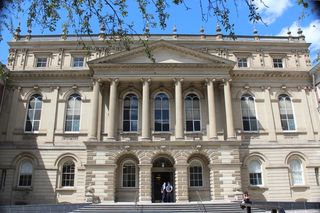
Osgoode_front
Osgoode Hall, home of the Ontario Court of Appeal
and the Law Society of Upper Canada

When we’re away from the home office, we actually do the tourist thing at court houses. We’ve visited everything from space-age California courthouses to rural county courts in the Mississippi Delta. Yes, we admit it: we’re law nerds.

So when we were in Toronto recently for the ABA Annual Meeting, we had to pay a visit to the storied Osgoode Hall, a downtown courthouse and bar association rolled into a single building. As the name reflects, it also once housed the law school. There’s a free tour sponsored by the law society that starts at 1:15 p.m. Ours was conducted by a delightful local lawyer, who gave us an insider’s look at the building and the inner workings of the court.  For more, visit Osgoode Hall’s website, or better yet, visit in person next time you find yourself in Toronto. It’s well worth the time.

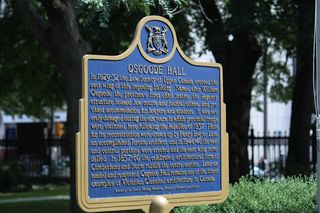
Osgoode_sign_en

 The historical details.

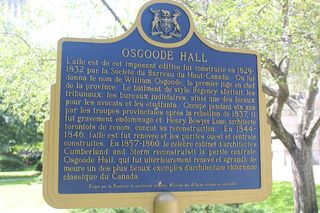
Osgoode_fr

 This being Canada, the historical details en français.

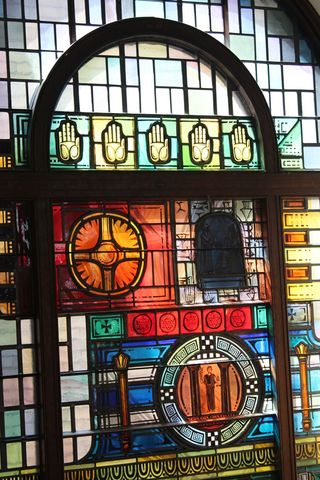
 IMG_1496
Why we like traditional courthouses: stained glass.


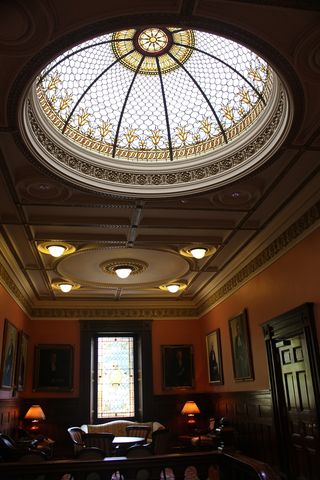
Bencherslounge

Lots of stained glass.

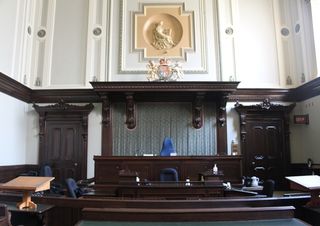
Appealscourt

 Appeals Court.

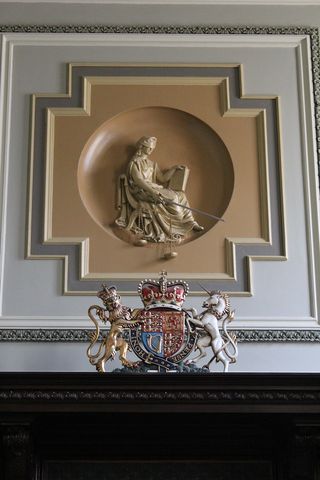
Osgoode_seal

 One thing you won’t see in U.S. courtrooms.


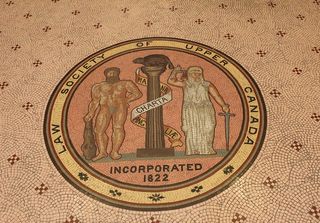
Seal

“Law Society” beats “bar association” any day.

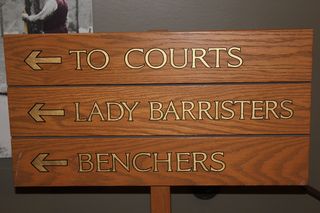
Lady_barristers

Their words, not ours. Send your complaints here.

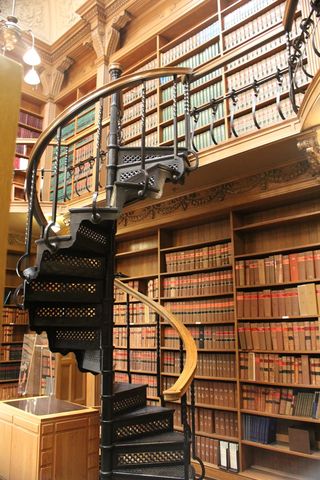
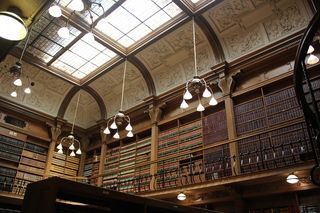
Osgoode_american_library

Who could not happily dig into the law books in this library?
Home of the American collection.

IMG_1407

Makes you almost want to do some legal research, doesn’t it?

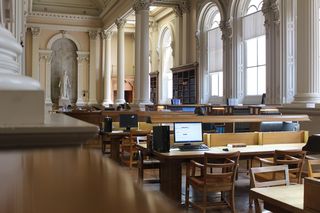
Osgoode_library

Corinthian columns and flat panel LCDs:
the old and the new blended in the Great Library.

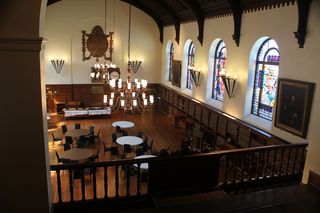
Osgoode_convocation_hall

We like any court house with a restaurant
(open September through June; sadly not in August).

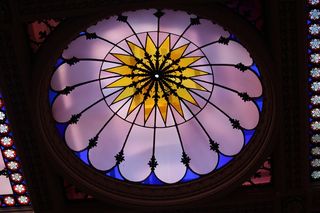
Osgoode_talktothehand

They say that these stained glass panels contain symbols of the law.
All we saw was “talk to the hand.”


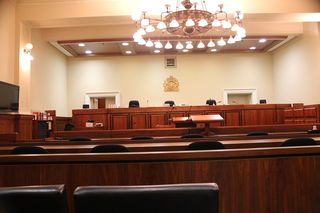
Osgoodecourt

Just so you don’t think it’s all stodgy wood paneling and old leather,
one of the modern courtrooms.

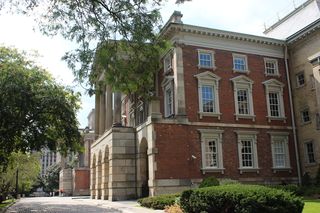
 Osgoode_outside
One more, from the well-tended grounds.


Continue Reading Another Visit To A Temple Of Justice

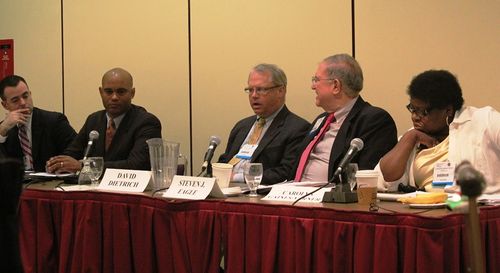
IMG_0818
The speakers (L to R): Kieran Marion, Professor Thomas Mitchell,
David Dietrich, Professor Steven Eagle, and Carolyn Gaines-Varner, 

“Property rights” are sometimes portrayed as belonging only to the rich and powerful, and protecting the politically connected. But a more realistic view was presented by the panel of speakers at a CLE presentation produced by the State & Local Government Law Section at the ABA Annual Meeting in Toronto.

Protecting Heirs Property: Uniform Laws and Social Justice detailed the new Uniform Partition of Heirs Property Act, a model statute addressing the problem of fractional land ownership by extended families. Here’s a summary of the issue from the ABA Journal:

Heirs’ property results in descendants who inherit real property as tenants in common, with each owner having an undivided interest in the land. For the descendants, heirs’ property also creates a problem—anyone who inherits

Continue Reading Seminar Report: Heirs Property CLE At ABA Annual Meeting – A Slightly Different Perspective On Property Rights

Another drive-by blog post today because we’re still at the ABA Annual Meeting in Toronto, and between meetings of the State and Local Goverment Law Section and scooping up as many CLE credits as possible, haven’t had much down time to detail the latest cases. But here’s one that’s worth reviewing on your own, if only because it was authored by Judge Jay Bybee, who is becoming quite the takings maven on the Ninth Circuit.

The Takings Clause, as the Supreme Court has reminded, is “self-executing,” which means that the obligation to pay compensation for a taking is not completeley dependent on an enabling statute, nor is it subject to every claim of sovereign immunity.

That thought played central role in Jachetta v. United States, No. 10-35175 (Aug. 1, 2011), in which a three-judge panel of the Ninth Circuit held that a property owner’s inverse condemnation claim

Continue Reading Ninth Circuit: Takings Claims Must Have A Forum … Somewhere

Barista’s note: We’re on the road today at the ABA Annual Meeting, so don’t have the time to set this one out in detail. But a quick review of a rather longish opinion (65 pages) makes it seem interesting enough.

In Dep’t of Fish and Game v. Superior Court, No. C066158 (Aug. 2, 2011), the California Court of Appeal (Third District) held that a case in which property owners challenged DFG’s efforts to eradicate the invasive northern pike from lakes in the Sierra Nevada should not have been certified as a class action. The property owners sued under an inverse condemnation theory (among other things). The court held:

In their inverse condemnation claim, plaintiffs allege defendants’ conduct “in attempting to eradicate the Northern Pike for a public purpose has caused a substantial impairment to Plaintiffs’ property rights and Plaintiffs were denied all economically beneficial uses of their property

Continue Reading Cal App: Inverse Condemnation And Class Actions

Not the California Court of Appeals, Second District. Edna Valley Watch v. County of San Luis Obispo, No. B223653 (Aug 2, 2011), slip op. at 2, n.2 .

Oh yeah, the holding: administrative proceedings are “actions” thus entitling parties — opponents of the building of a church — who participated in those proceedings and in the subsequent lawsuit to attorney’s fees. Continue Reading “The numbers are from [the appellants’] motion for attorney’s fees. Their mathematics appears to be incorrect. But who is going to care about a few dollars?”