2012

Today’s American Banker has a story on the latest development in the let’s-use-eminent-domain-to-take-underwater-mortgages scheme: the Federal Housing Finance Agency has sent a strong shot across the bow of local governments contemplating such a move (e.g., San Bernadino, Chicago, even Berkeley):

Uh, don’t.

Full statement here, or below. The American Banker story is unfortunately behind a paywall, so we can’t bring it to you here, but we do have the highlights from a trio of Owners’ Counsel of America commentators who are quoted, us included:

“San Bernardino County cannot condemn federal property,” said Gideon Kanner, professor of law emeritus at Loyola Law School in Los Angeles and a longtime eminent domain expert. The FHFA is “a federal agency and the Feds can take the property of a state or city but the state or a local entity cannot take federal property.”

Robert Thomas, an attorney at the
Continue Reading “Hey Look, Free Money!” Fed Agency Has Problems With The Plan To Take Underwater Mortgages

DK_Film_banner_re3

Check this out, our latest law-related fun project.

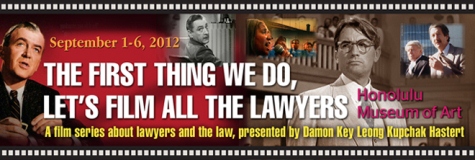
Our firm is sponsoring (along with the Honolulu Museum of Art) a legal film series in September. We’re showing six legal films: Crime After Crime, To Kill a Mockingbird, The Castle (for that eminent domain connection, naturally), Counsellor at Law, and Anatomy of a Murder. Each film will be introduced by one of our colleagues, who will lead a discussion of the issues raised following the movies.

Find out more at the series’ web site www.lawinfilm.com with screening dates and times and all the details, including trailers and reviews. If you are in Honolulu on any of the screening dates, be sure to join us.Continue Reading “The First Thing We Do, Let’s Film All The Lawyers”

For those of you sticking around Chicago after the ABA Annual Meeting, there’s the opportunity for even more land use, zoning, takings, and condemnation programming. ALI-CLE (fka ALI-ABA) is putting on it’s annual Land Use Institute later this week. It looks like Planning Co-Chairs Gideon Kanner and Frank Schnidman have put together a wide-ranging agenda, and stellar faculty, as usual. 

Details, including registration information, here.Continue Reading Chicago Part II: Land Use Institute

This past week was the ABA Annual Meeting in Chicago. These things can often be endurance contests where you’re rushing from one meeting to another (is this the Executive Committee meeting or the Council meeting?), and it’s often hard to tell the players without a scorecard.

Sprinkled among these unexciting-but-productive sessions are the real meat of the Annual Meeting, the CLE sessions. Some are interesting and fun (but pretty useless as CLE). Others are timely. Some are just plain weird. But never let it be said that the State and Local Government Law Section (the one that we are active in) doesn’t put on relevant programming: two of the featured CLE’s this past week were of particular interest to our readers, one about eminent domain, and the other about the takings case currently pending before the U.S. Supreme Court (which will be argued on October 3, 2012).

Continue Reading Summary Of Flood Takings CLE – Lawprofs And Lawyers Discuss Pending SCOTUS Case

20120803_134704
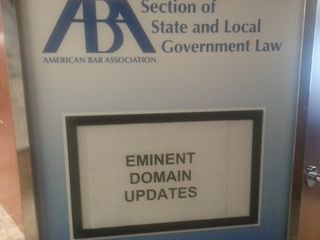
Here are the cases and links that I discussed at today’s ABA session on eminent domain:

  • Kelo – Remember the holding of the case: the Court majority rejected the petitioners’ call to adopt a blanket rule that all takings supported only by claims of economic development violate the Public Use Clause of the Fifth Amendment. In declining to adopt the rule, the Court left open challenges based on lack of a comprehensive plan, claims that the advanced public use is a pretext to hide a predominant private purpose, and the old “A-to-B” private taking.
  • City of Stockton v. Marina Towers LLC (Cal. Ct. App. 2009) – The case in which the court held that the city’s resolution of necessity was so “nondescript [and] amorphous,” and “so vague, uncertain and sweeping in scope that it failed to specific the ‘public use’ for City sought acquisition of the property.”


Continue Reading Resources From Today’s ABA Eminent Domain Session

We are at the ABA Annual meeting this week, so don’t have a lot of time to keep up a long-distance practice and write up comprehensive blog posts, so we’re going to keep it short.

Here’s the latest takings decision from the Federal Circuit in a case we’ve been following, Estate of Hage v. United States, No. 2011-5001 (Fed. Cir. July 26, 2012). The property owners filed their case in 1991 in the Court of Federal Claims seeking compensation for the federal government’s taking of water rights in Nevada. In 2008, the CFC ruled in favor of the property owners, but the Federal Circuit reversed on Williamson County grounds because the case wasn’t administratively ripe. The federal agency, you see, has not reached a final decision on what the property owners might do with the land, and just might issue a permit (even if other similar permit applications

Continue Reading Federal Circuit: 22-Year Old Takings Case In Which The Landowner Is Already Dead Is Not Ripe

On Thursday, August 2, 2012, at 3:30 p.m., as part of the ABA Annual Meeting, the ABA and the State & Local Government Law Section is sponsoring a free screening of “ Crime After Crime,” the award-winning documentary from director Yoav Potash chronicling two San Francisco Bay Area land use lawyers who volunteer to provide their services to try and help free a woman who has been imprisoned for 20 years. We saw the film last year, and loved it. It was one of the best we have seen in a while:

“Crime” and “land use lawyers” are phrases not usually heard together; in most cases, the worlds of criminal law and land use never intersect, and lawyers for developers and property owners don’t have much occasion to visit the “Attorney’s Room” at the state pen. But in the documentary film Crime After Crime, two land use lawyers including our State and Local Government Law Section colleague Nadia Costa (Vice-Chair of the Section’s Land Use Committee), plunge into that unfamiliar milieu.

In 1983, Deborah Peagler, a woman brutally abused by her boyfriend, was sentenced to 25 years-to-life for her connection to his murder. Twenty years later, as she languished in prison, a California law allowing incarcerated domestic-violence survivors to reopen their cases was passed. Enter a pair of rookie land-use attorneys convinced that with the incontrovertible evidence that existed, they could free Deborah in a matter of months.

More details on the case here. Read my complete review here. Here are the details of the screening:

Location: DePaul University College of Law, 25 E. Jackson Blvd, Chicago, Room 241.

Cost: Free.

CLE Credits: Following the screening, we will be presenting a CLE on “The Cost of Wrongful Convictions” featuring Director Potash, Nadia Costa (one of the lawyers featured in “Crime After Crime”), Craig Watkins (District Attorney, Dallas), and Emily Miller (Better Government Association, Chicago). The panel will be moderated by our SLG Section colleague Donna Frazier.

Hope you can join us if you are attending the Annual Meeting, or are just in Chicago.
Continue Reading ABA Annual Meeting, Chicago: Free Screening Of “Crime After Crime”

In a case that was probably doomed from the start because of an earlier precedential ruling, the Federal Circuit concluded that the government’s temporary seizure of the plaintiff’s computer “for review” at a border stop and the subsequent destruction of the computer hard drive and resulting loss of data was not a taking because the seizure was an exercise of the government’s power to control the border.

We’ve been down the road of Kam-Almaz v. United States, No. 2011-5059 (June 30, 2012) before, in AmeriSource, for example, where the government seized the plaintiff’s property as evidence in order to prosecute a third party, and by the time the government returned the property to its owner, it was worthless. In Kam-Almaz, the ICE agents took the laptop because Kam-Almaz was a “person of interest,” promising to return it shortly. However, during the time ICE had it, the

Continue Reading Federal Circuit: Taking As A Result Of Police Power Isn’t A Taking