


November 2013

Worth reading: a new working paper on exactions and Koontz by a Pacific Legal Foundtion Fellow (PLF represented the prevailing property owner in Koontz).

The article, “Nollan and Dolan and Koontz – Oh My! The Exactions Trilogy Requires Developers to Cover the Full Social Costs of Their Projects, But No More,” by Christina Martin,

argues that, contrary to appalled assertions of some observers, the U.S. Supreme Court’s decision in Koontz v. St. Johns River Water Management District is a straightforward application of Nollan v. California Coastal Commission and Dolan v. City of Tigard. Nollan and Dolan established that when government requires a permit applicant to give up property in exchange for a permit, the demand must be closely related and roughly proportional to the development’s social cost. Anything that exceeds those bounds violates the unconstitutional conditions doctrine by burdening the right to just compensation for a taking. Koontz
Continue Reading New Article On Nollan-Dolan-Koontz

Today, the Hawaii Supreme Court rejected certiorari (remember that under our procedures, you “apply” for cert which is “accepted” or “rejected”), and declined to review the Intermediate Court of Appeals’ decision in In re Campbell, No. 30006 (June 13, 2013), the case involving Land Court registration (Torrens title) and mineral and metallic mining rights.

The ICA held than an encumbrance does not exist if it does not appear on a Land Court registered title. In this case, the encumbrance was mineral and metallic mining rights, which the Territory of Hawaii claimed it reserved in a Royal Patent. The ICA concluded that if the Territory did so, its rights were extinguished when in 1938 it appeared in the Land Court to assert its other rights, but failed to raise the mining claims:

We hold that the Original [1938] Decree and the Original Certificate of Title extinguished the express government reservations

Continue Reading HAWSCT Rejects Cert In Land Court Registration Case

Cornell lawprof Robert Hockett, the guy who by all accounts thought up of the idea of using eminent domain to take “blighted” (underwater, but mostly performing) mortgages, was interviewed on “Air Occupy” about the scheme yesterday. Here’s the podcast (we originally embedded the podcast below, but the darn thing was set to play automatically and it was just supremely irritating, so we deleted it and provided the link instead).

He goes into his thoughts on the motive of the opponents, among other things.

One thing we can’t figure: how an organization (although perhaps “decentralized, hacktivist collective” would be more acceptable to the group), can get within five feet of supporting a plan that was proposed, funded, and pushed by a bunch of the same “Wall Street” types who supposedly caused the problem. Anarchy breeds strange bedfellows?Continue Reading Cornell Lawprof Talks About His Plan To Take Underwater Mortgages

DSCF1269

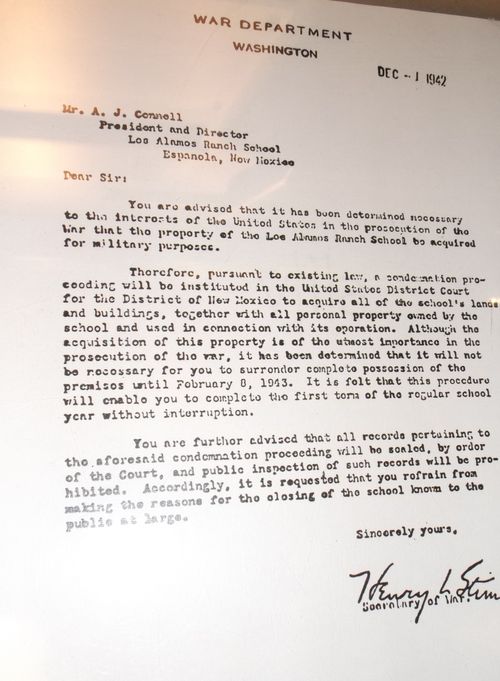
During a break at the recent ABA State and Local Government Law Fall meeting in Santa Fe, New Mexico, we took a short ride up to the town of Los Alamos for a little “nuclear tourism” at the site of the current National Lab, and, of course, the place where the first two atomic bombs were designed and build in World War II. Los Alamos was chosen as the site because it was remote, away from the prying eyes of foreign spies and the American public. That’s still probably true.

So we’re at the Bradbury Science Museum, when colleague Dwight Merriam pointed out the above letter, which tells us how the U.S. Government acquired the land it needed for the Manhattan Project. In case you can’t read the photo, here’s a transcription of the letter:

War Department

Washington

DEC — 1 1942

Mr. A.J. Connell
President and Director

Continue Reading The Eminent Domain Angle In Nuclear Tourism

The Honolulu City Council has proposed a charter amendment that asks the voters to approve eliminating the Mayor’s current veto power over the Council’s eminent domain resolutions.

The Resolution doesn’t directly say that, of course, but what it does command is that after the Council adopts a resolution to take property, the city administration must within 90 days start the condemnation action. In other words, no mayoral veto. Currently under the Charter, the Mayor may veto resolutions of taking:

Resolutions authorizing proceedings in eminent domain shall not be acted upon on the date of introduction, but shall be laid over for at least one week before adoption. Such resolutions shall be advertised once in a daily newspaper of general circulation and may be advertised, as deemed helpful, in other newspapers at least three days before adoption by the council. Not less than three copies of such resolutions shall be filed

Continue Reading Should The Honolulu Charter Eliminate The Already Minimal Check Of A Mayoral Veto On Eminent Domain Resolutions?

Here’s the State’s Reply Brief supporting its application for cert and responding to the landowner’s BIO in the land court registration case, In re Campbell. The brief argues that “[t]his is no minor land dispute,” and “that the State is very concerned about the ICA Opinion.”

What’s so important about the State’s claimed reservation of mineral and metallic mines that had made it put up this kind of resistance? It’s not like there’s a whole lot of mining potential on Oahu’s north shore (unless its big waves they’re after). Scroll down to page 4 to get to what we suspect is the real gold that’s at stake here: geothermal rights (something Hawaii probably has in abundance):

If this Court grants the State’s application for writ of certiorari, it will have to consider whether minerals and metallic mines were ever part of the “bundle of sticks” conveyed by a

Continue Reading Final Brief In Land Court Registration Case