2013

On Tuesday, February 26, 2013 from 7:15 – 8:309 p.m. in Classroom #2, the University of Hawaii Law School is sponsoring a talk about “The PLDC and Property Rights in Hawaii,” which will feature our Damon Key colleague Mark M. Murakami.

PLDC refers to the Public Land Development Corporation, a state agency created in 2011 to develop state-owned lands, primarily in concert with private entities. As Honolulu Civil Beat‘s information page on PLDC notes:

The corporation has broad powers for entering into private partnerships and establishing its own governing objectives and policies. It also is tasked with identifying state lands under DLNR that are suitable for development. The Board of Land and Natural Resources must approve all land transfers.

The corporation, with the approval of the governor, can also issue revenue bonds for constructing, acquiring and renovating public facilities, as well as for the acquisition

Continue Reading Upcoming Event: The PLDC and Property Rights in Hawaii
Bulldozersatyourdoorstep

Our Owners’ Counsel of America colleague Michael Rikon and his law firm have launched a new blog, “Bulldozers at Your Doorstep – A National Blog on Eminent Domain.”

The blog will give us Michael’s and his colleagues’ view of eminent domain and condemnation issues from their unique New York perspective, from lawyers who specialize in eminent domain defense.

Recent posts include a discussion of corridor valuation, the introduction of a bill in North Carolina to limit Kelo‘s impact, and how the U.S.’s energy independence may result in an upswing in the exercise of eminent domain.

Definitely worth following. Continue Reading New Eminent Domain Blog – “Bulldozers at Your Doorstep”

Here are the opinions, briefs, and links from the three Supreme Court cases involving Fifth Amendment takings this term, Arkansas Game & Fish (flooding), Koontz (monetary exactions), and Horne (takings as a defense):

Arkansas Game and Fish Comm’n v. United States, No. 11-597 (Dec. 4, 2012)

  • Opinion of the Court (unanimous decision holding that government-induced flooding could be a taking, even if temporary).
  • The petitioner’s merits brief is here. The federal government’s merits brief here. Petitioner’s reply brief here. Amicus brief of Owners’ Counsel of America here. IMLA’s amicus brief here.

Koontz v. St Johns River Water Mgmt Dist., No. 11-1447 (cert. granted Oct. 5, 2012)


Continue Reading Takings Three: Briefs And Links From The Supreme Court’s 2013 Takings Trilogy

Here’s the amicus brief filed today on behalf of the International Municipal Lawyers Association in Horne v. United States Dep’t of Agriculture, No. 12-123 (cert. granted Nov. 20, 2012). The brief argues:

Petitioners have needlessly complicated the vindication of their asserted rights under the Takings Clause of the Fifth Amendment by failing to file a straightforward claim for just compensation in the U.S. Court of Federal Claims. Petitioners have long participated in the raisin industry marketing program which they now believe results in a taking. Thus, they could easily have filed a claim for just compensation in the U.S. Court of Federal Claims based on this asserted taking. Instead, petitioners decided to disregard federal law requiring that they participate in the program and now seek to invoke the Takings Clause to defend against the sanctions imposed as a result of their illegal action.

This effort should fail for three

Continue Reading IMLA Amicus Brief In California Raisin Takings Case: Tucker Act Is Exclusive Method Of Raising Takings Arguments

Here’s what we’re reading on this Tuesday-after-a-long-weekend:

  • Economic Impact in Regulatory Takings Law,” a forthcoming article by lawprof Steven J. Eagle about one of the prongs of the Penn Central takings test. Professor Eagle “concludes that unresolved issues and complexities in adjudicating the ‘economic impact of the regulation on the claimant’ test provide an additional reason why the conceptually incoherent Penn Central doctrine must be replaced.”
  • NY Fed report sees cracks in eminent domain proposals” – “… a new blog from researchers at the Federal Reserve Bank of New York suggests such a plan would have proved to be ineffective anyway. Their reasoning for this conclusion is that many of the targeted borrowers have already benefited from either falling interest


Continue Reading Tuesday Tidbits

Mark your calendars: on Thursday, February 21, 2013, James Burling, director of the Pacific LegalFoundation and principal attorney at PLF’s Property Rights practice group and U. Hawaii lawprof Maxine Burkett willdiscuss “Do Property Rights Matter When The Environment IsGoing To Hell In A Handbasket?

The forum — presented by the EnvironmentalLaw Program and the Federalist Society — will beginat 12:15 p.m. in CR1. Light refreshments will be served. Please RSVP to elp@hawaii.edu.

More below.

Do Property Rights Matter When the Environment is Going to Hell in a Handbasket?


Continue Reading PLF’s Jim Burling To Discuss Property Rights And The Environment At U.H. Law School

You may remember the opinion of the New York Appellate Division in 49 Wb, LLC v. Village of Haverstraw, 839 N.Y.S.2d 127 (N.Y. App. Div. 2007), in which the court held that a taking of private property for affordable housing was an improper use of eminent domain because “the Village invoked its power of condemnation for the sole purpose of benefitting private, and not public, interests,” and the “Village’s sole purpose [was] assisting private entities by means of condemnation.” In other words, the taking was irrational. The court concluded “[t]he Village’s justification for the condemnation, that it serves a public use, benefit, or purpose, is merely pretextual, and hence, improper.”

Based in part on that finding, the property owner went to federal court on a substantive due process claim (the government treated me irrationally). The District Court denied the owner’s motion for summary judgment and granted the Village’s cross

Continue Reading 2d Cir: Irrational Taking Is Not Irrational Or Outrageous Government Action

Here’s the SG’s merits brief in Horne v. United States Dep’t of Agriculture, No. 12-123 (cert. granted Nov. 20, 2012),

In Horne, the question is whether farmers who assert that an agricultural regulations known as “marketing orders,” by which they are forced to surrender large percentages of their raisin crops to the USDA without payment or else face massive fines, can raise the argument that to do so would be a taking when defending against the fine, or if their only option is to pay the fine and file a lawsuit in the Court of Federal Claims to recover just compensation. The Ninth Circuit held the District Court had no jurisdiction to hear the takings defense, and the only option was new litigation instituted by the Hornes in the CFC to get the fine back.

The SG’s brief argues the Hornes do not have standing to assert a

Continue Reading Government Brief In California Raisin Takings Case

Dmerriamportland

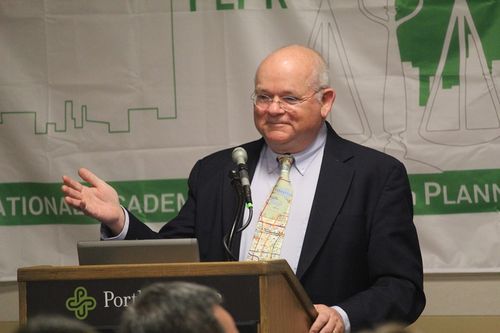
Yesterday, our ABA and Owners’ Counsel of America colleague Dwight Merriam gave the keynote address at the 7th International Conference of the Academic Association on Planning, Law, and Property Rights, in Portland, Oregon.  Dwight’s presentation, “Getting Past “Yes or No” – Linking Police Power Decision-making with Just Compensation,” centered on the idea that many of the frustrations in land use and environmental law might be avoided by the establishment of a compensation fund which would be drawn upon to offset the negative externalities of development proposals that otherwise might draw fire. So instead of objecting, landowners who suffer losses because of a project that will benefit the public — a nearby wind farm, for example — could obtain compensation.

Here’s a summary of his presentation:

Land-use and environmental decision-making under the police power is usually a zero-sum game. When neighbors complain about the negative externalities of a

Continue Reading Getting Past No In Land Use Disputes

Jim_Burling_Eagle

At the recent annual meeting of Owners’ Counsel of America, OCA presented Pacific Legal Foundation attorney Jim Burling with the Crystal Eagle Award, bestowed on “individuals who have made a substantial contribution toward protectingthe civil right of private property ownership.”

I was pleased to offer introductory remarks, which I post here in a slightly edited format.

Jim Burling is Pacific Legal Foundation’s Director of Litigation, and a principal attorney in PLF’s Property Rights Practice Group. He’s been with PLF since 1983, and his cases involve regulatory takings, environmental and land use regulations,eminent domain, and Indian law.

He’s been to the highest court — in 2001 he successfully argued a case we’re all intimately familiar with, Palazzolo v. Rhode Island [533 U.S. 606 (2001)], convincing the U.S. Supreme Court that our clients still retain their property rights even after the government adoptsrestrictive land use regulations.

Jim is a frequent

Continue Reading Jim Burling Recognized