


2014

If you, like us, went to law school to avoid things like this:
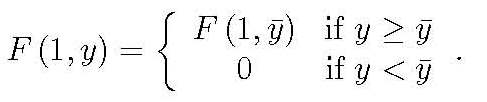
Untitled Extract Pages

then perhaps this recently-published paper is not going to be your cup of tea.

But seriously, folks, this one might be worth your time, even if you are numbers-challenged, because it is a look at the “holdout” issue from the standpoint of economists.

In “Private Takings,” the authors “examine[] the implications associated with a recent Supreme Court ruling, Kelo v. City of New London.” From the Introduction:

This paper examines the implications associated with a recent Supreme Court ruling, Kelo v. City of New London. Kelo can be interpreted as supporting eminent domain as a means of transferring property rights from one set of private agents — landowners — to another private agent — a developer. Under voluntary exchange, where the developer sequentially acquires property rights from landowners via bargaining, a holdout problem arises.

Continue Reading New Article: “Private Takings” (via Fed Reserve Bank of Chicago)

In Finch v. Carroll Cnty., No. CV-14-251 (Oct. 22, 2014), the local county judge asked the property owners to donate gravel. That’s gravel, not “gavel,” for those of you, like us, who were wondering. (We have no idea why, or whether this is common. But there it is.)

But in removing the “several hundred truck loads of gravel,” the county left behind debris, which several weeks later ended up damming the creek, and coupled with a lot of rain, flooded the owners’ property, damaging “their cattle, chickens, trees, and the chicken structures that were near the creek.” Slip op. at 1. They sued the county and the judge for negligence and inverse condemnation.

The court of appeals upheld the trial court’s grant of summary judgment for the defendants. on both claims. A county is immune from tort liability for its negligence under Arkansas law (and pretty much the

Continue Reading Arkansas App: One Flood Not Enough For Inverse Condemnation Liability (But What About Arkansas Game & Fish?)

The first time the government tried to take the property, it screwed up: the ordinance authorizing the taking failed to state that the property was necessary, and failed to adequately describe the property to be taken. The trial court dismissed the case.

As we all know, in most cases that means the government just reboots and tries again. Which it did. It adopted another ordinance in which it attempted to cure the problems that led to the first dismissal. When negotations between the agency and the property owner could not be concluded successfully, the agency filed a second condemnation action.

The owner asserted res judicata, arguing that the two eminent domain actions were the same, and thus the agency could not get a second bite of the apple. 

In Rock River Reclamation District v. Sanctuary Condominiums of Rock Cut, No. 2-13-0813 (Dec. 11, 2014), the Illinois Court of Appeals

Continue Reading Ill App: First Condemnation Was Not Res Judicata To Second

Here’s one of the decisions we’ve been meaning to post for a while.

In Schmude Oil Co., Inc. v. Dep’t of Envt’l Quality, No. 313475 (July 1, 2014), the Michigan Court of Appeals held that there was no wipeout per se taking, nor was there a Penn Central taking, when the DEQ refused to permit the plaintiff to drill for shale oil on its private property.

The plaintiffs’ land was partially in a “nondevelopment region” which absolutely banned drilling, while the other portion was in a “limited development region” in which “drilling could occur, subject to certain limitations.” The plaintiffs requested the DEQ issue 8 permits for the nondevelopment region, and 3 permits for the limited region. The DEQ denied all the applications. 

The court of appeals determined that within the nondevelopment region, the DEQ was required to have rejected the drilling requests (nondevelopment means no drilling), and that

Continue Reading Mich App: Denial Of Shale Oil Drill Permits Not A Taking

The Texas Supreme Court is generally pretty good about property rights. See this opinionthis one, and this one, for examples.

So when the legal analysis in one of its regulatory takings/inverse condemnation opinions has the following language — especially in a case where a municipal government has treated the plaintiffs/property owners very badly — it would be understandable if you predicted the court was coming down on the side of the property owners:

The right to acquire and maintain private property is among our most cherished liberties. As Locke explained, the value of private property lies not only in its objective utility, but also in any personal investment therein. See John Locke, Two Treatises of Government 134 (Thomas I. Cook ed., Hafner Press 1947) (1689). Accordingly, the right to undisturbed enjoyment of residential property is all the more sacred. The unique importance of the home is reflected in our Bill of

Continue Reading Texas (Reluctantly) Finds No Regulatory Takings Claim

Back in February, we blogged about an opinion from the Maine Supreme Court involving littoral property (that’s beachfront property to all you non-lawyers and Navy people), in which the court concluded that those who were asserting a prescriptive easement over the plaintiffs’ beachfront property– the Town  and several neighbors — had not rebutted Maine’s presumption of permissive recreational use of open land, when they introduced evidence that people generally made recreational use of the beach in front of the plaintiffs’ properties, without showing specifically where. Which meant that the public did not have a right of access over the plaintiffs’ beachfront land. The court also held that Maine does not recognize an “easement by custom.” 

Maine apparently allows a party who is disappointed with the court’s ruling to ask for reargument. Similar rules for reconsideration also are present in other courts, but with rare exception in our experience, those

Continue Reading Maine: On Second Thought, We Were Right When We Said That Beach Property Is Not Subject To Special Rules

Here’s the Verified Complaint in a case recently filed in U.S. District Court in New Jersey:

Plaintiffs Jenkinson’s Pavilion, a corporation of the State of New Jersey and Jenkinson’s South, Inc., a corporation of the State of New Jersey, (collectively “Plaintiffs”), bring this action, inter alia, (a) for a declaration as a matter of law that the United States Army Corps of Engineers (“USACOE”) has not required, and does not require, for purposes of the “Manasquan Inlet to Barnegat Inlet Storm Damage Reduction Project,” the acquisition of perpetual rights in privateproperty for purposes of establishing recreational public beaches landward of the area already subject to public ownership and rights of public user pursuant to the New Jersey Public Trust Doctrine, and (b) enjoining the Defendants from taking actions in furtherance of the “Manasquan Inlet to Barnegat Inlet Storm Damage Reduction Project,” in advance of a determination on the relief

Continue Reading Federal Court Challenge To NJ’s Beach Replenishment Plan

Get ready. With the end of the year nearly upon us, and our “For The Blog” folder brimming with opinions and items that we just haven’t had time to post, in the next couple of weeks we’ll be putting up a lot of these 2014 cases so we can start the new year afresh.

This means that we won’t be digesting the cases in much detail. Just enough so you get the drift of why we thought they are important for you to know about. Stay tuned. 

Continue Reading Programming Note: Get Ready For The 2014 Year-End Opinion Dump

Remember that case we posted about here, when it was set for oral arguments in the Hawaii Supreme Court a few months ago, where the plaintiff was asserting that the County of Hawaii Planning Department was liable for negligence for not maintaining its subdivision files accurately?

Last month, the Hawaii Supreme Court issued a unanimous opinion which declined to impose a duty of reasonable care on the Planning Department.

The opinion noted that “policy considerations counsel against the judicial creation of such a legal duty under the common law, and also hold that there is no basis under [Hawaii’s open records statute or the Planning Department’s rules of procedure], to impose negligence liability upon the Planning Department based on the temporary absence of a government record from its files. Slip op. at 2. Rebecca Copeland has more background on the case (including the briefs) here at her Record on

Continue Reading HAWSCT: Agencies Have No Duty To Keep Their Records Accurately

Under Virginia’s condemnation procedures, as a prerequisite to a court exercising jurisdiction over an eminent domain action, a state condemning agency must as an initial step present to the property owner a statement of “the amount which [the condemnor] believes to be just compensation,” and must include an appraisal if an appraisal is required:

The state agency concerned shall provide the owner of real property to be acquired with a written statement of, and summary of the basis for, the amount it established as just compensation, and, if an appraisal is required or obtained, such written statement and summary shall include a complete copy of all appraisals of the real property to be acquired that the state agency obtained prior to making an offer to acquire or initiating negotiations for the real property.

Virginia Code § 25.1-204(E)(1)

In a case we posted about briefly here, a Virginia trial

Continue Reading Amicus Brief: Eminent Domain Jury Can’t Be Kept In The Dark About The Condemnor’s Initial Valuation