2014

Biafora v. United States, No, 2013-5130 (Dec. 10, 2014), is one of those opinions that you don’t really look forward to reading. Something about the Federal Circuit seems to attract these type of takings cases, where the parties are many, the alphabet-soup regulatory environment is byzantine, and the effort of understanding the context often takes more time than figuring out what the court did, and why. 

But fret not, that’s why we’re here with the high points, so you don’t have to. 

This is another case involving the federal government’s legislative efforts to encourage private developers to build and manage low-income housing projects (see this post for an earlier iteration). Congress adopted statutes insuring mortgages on these projects in return for “a 40-year mortgage term, an agreement to maintain affordability restrictions on the housing for the duration of the mortgage, and prepayment limiations or prohibitions on the mortgage.” Slip

Continue Reading Federal Circuit On Williamson County Ripeness And Other Takings … Stuff

We bring you the latest guest post by colleague Paul Schwind, who has been tracking the issues and arguments that recently led the Hawaii Supreme Court to conclude, in DW Aina Lea Development, LLC v. Bridge Aina Lea, LLC, No. SCAP-13-0000091 (Nov. 25, 2014), that the Hawaii Land Use Commission wrongfully rescinded an earlier reclassification of land (read: “rezoning” to all you non-Hawaii land users).

The oral argument recording is posted above.

We’ll post up our thoughts on the decision in a separate post. 

—————————————————————-

Hawaii Supreme Court In Aina Lea: The Rationales Behind The Opinion

by Paul J. Schwind*

Robert has asked me to summarize the rationales behind the holdings in the Hawaii Supreme Court’s recent opinion in DW Aina Lea Development, LLC v. Bridge Aina Lea, LLC, No. SCAP-13-0000091 (Nov. 25, 2014), which he summarized the following day, outlining the litigation history of the

Continue Reading Guest Post – Hawaii SCT In Aina Lea Case: The Rationales Behind The Opinion

2015 Hawaii Land Use Law Conference Banner - Credits

Registration is now open for the 2015 Hawaii Land Use Law Conference, to be held in downtown Honolulu on Thursday-Friday, January 15-16, 2015.

This is the bi-annual conference, co-chaired by U. Hawaii lawprof David Callies and land use lawyer Ben Kudo, that brings together the big names in our area of law. In other words, the one conference you don’t want to miss if you are a Hawaii land use or property lawyer, in-house counsel, a planner, an appraiser, a property owner or manager, or a law student interested in these topics. 

Download the full brochure here, or view it below. 

The keynote speaker this year is lawprof Richard Epstein, addressing “Stealth Takings: Exactions, Impact Fees and More.” Immediately following his talk, I will be moderating a panel on “Impact Fees and Exactions After Koontz,” with colleagues Bruce Voss and David Brittin. The rest

Continue Reading Registration Open: 2015 Hawaii Land Use Law Conference, Jan. 15-16, 2015

On one hand, the U.S. Court of Appeals’ opinion in Hutto v. South Carolina Retirement System, No. 13-1523 (Dec. 5, 2014) is old hat: the court concluded that a plaintiff alleging a federal takings claim could not bring that claim in federal court. But this case is different because it — unlike those where Williamson County ripeness is invoked to (in theory) merely delay federal court jurisdiction — resulted in a permanent bar.

The difference here is that the plaintiffs were suing the state retirement system and state officers in the their official capacities, claiming that a 2005 amendment to South Carolina’s state employee retirement system which required those who retire and then return to work to make the same contributions to state-created pension plans as pre-retirement employees but without receiving further pension benefits, was a taking. They filed their complaint in federal court, and the defendants raised the Eleventh

Continue Reading 4th Cir: Takings Claim Against State Can’t Be Brought In Federal Court – State Immune Under The 11th Amendment

This opinion from the Maryland Court of Appeals may be too land-usey for you takings mavens, but it starts off with an attention-getter:

Few cases inflame such deep passions as a dispute involving individual property rights. The belief that fundamental concepts of liberty entailed strong property rights informed and influenced the Founders as they undertook the epochal task of drafting our Constitution. See Sharon A. Rose, Kelo v. City of New London: A Perspective on Economic Freedoms, 40 U.C. Davis L. Rev, 1997, 2002 (2007). Infringers of these cherished rights should beware for “nothing is better calculated to arouse the evil passions of men than a wanton and unredressed invasion of their . . . property rights.” Cameron v. Chi., Milwaukee & St. Paul Ry. Co., 65 N.W. 652, 655 (Minn. 1896).

Appellant, Marquis McClure, seeks our review of the decision of the Circuit Court for Montgomery

Continue Reading Md App Waxes Poetic In A Land Use Opinion

Here’s the Opening Brief on the Merits, filed by the State of California in Property Reserve, Inc. v. California, No. s217738 (Sep. 26, 2014).

That’s the case in which the California Supreme Court is reviewing a court of appeal decision which invalidated California’s entry statute (Cal. Civ. Pro. Code § 1245.010 et seq.), concluding it was unconstitutional because it allowed an uncompensated taking. We summarized the court of appeal opinion here.

The property owner’s answering brief is due to be filed shortly, and amici briefs will be filed thereafter. Disclosure: we are authoring an amici brief in the case in support of the property owner. 

Opening Brief on the Merits, Property Reserve, Inc. v. California, No. S217738 (Sep. 26, 2014)

Continue Reading Opening Brief In Property Reserve: Eminent Domain Is Such A Bother

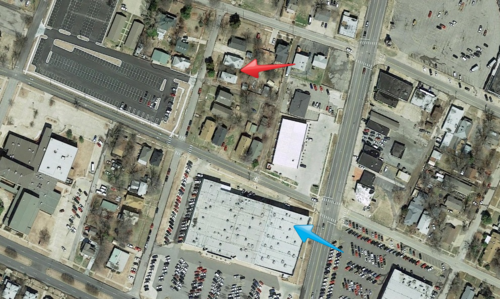
Muskogee-map

A must-read from the Oklahoma Court of Appeals. In City of Muskogee v. Phillips, No. 111,501 (Nov. 21, 2014), the court invalidated a taking, concluding that it was not a public use under the Oklahoma Constitution for a city to condemn private property for a parking lot when the primary apparent beneficiary of the parking lot would likely be the owner of a nearby office building whose tenants were responsible for an increase in on-street parking in the neighborhood.

Quick background: the federal government leased a privately-owned office building for a call center (the blue arrow on the above map). Employees of the call center parked on the street in the neighborhood. The city decided to build a parking lot and parking structure “for the health and safety of the Citizen’s [sic] of Muskogee by reducing the volume of on-street parking in the areas near and surrounding” the call

Continue Reading OK App: Taking A Home For A Parking Lot, When Primary Beneficiary Is Private, Is Not A Public Use

Here are all of the amici briefs in support of the property owners/petitioners in Kurtz v. Verizon New York, Inc., No. 14-439 (cert. petition filed Oct. 14, 2014).

That’s the case in which the Second Circuit threw out a complaint on Williamson County ripeness grounds. Odd thing was that the court held that a procedural due process claim was not ripe under Williamson County‘s exhaustion of state remedies prong. But as we wrote here (and in our amicus brief for NFIB Small Business Legal Center), Williamson County is built on a takings-specific rationale: a federal takings claim is not ripe for federal court review until just compensation has been denied by the state (including a state court).


Continue Reading Amici Briefs In SCOTUS Due Process Ripeness Case – The End For Williamson County?

We’ve been over this territory before:

And now, in an effort to convince New York City to go down the lets-take-underwater-mortgages-by-eminent-domain path, Cornell lawprof Robert Hockett, whose brainchild this is, has published “‘We Don’t Follow, We Lead’: How New York City Will Save Mortgage Loans by Condemning Them” (Nov. 29, 2014) in the Yale Law Journal Forum. From the piece’s Introduction:

Many cities across the nation have begun to consider exercising their eminent

Continue Reading Yet Another Effort To Justify Taking Mortgages By Eminent Domain

Here’s another one of those police power vs. takings cases, again involving governmental liability for destroying property supposedly in order to save it. We think the Alaska Supreme Court’s decision in Brewer v. Alaska, No. 14-916 (Nov. 28, 2014) got the analysis right, and properly shifted the focus in these cases from the government’s police power reasons for taking the actions which it did, to whether those actions were within the scope of the necessity doctrine.

Like others, Brewer involved landowners suing the government for setting fires on their land to stop or prevent wildfires (such as this case from the Federal Circuit). In Brewer, the land was designated for “aggressive initial attack” in the event of a fire. In 2009, the “Railbelt Complex” wildfire approached the properties, at which point, the state set fire to vegetation around the owners’ homes to deprive the fire of fuel. When the

Continue Reading Alaska: Police Power Not A Blanket Exception To Takings Liability – State May Be Liable For Backfires