
text
Gurrobat v. HTH Corp., No. SCAP-12-0000764 (Haw. Mar. 27, 2015)


The short answer: taxes.
[Update #1: a report from last night’s community meeting, “Railing Against Honolulu’s $6 Billion Rail Project” (“Honolulu Mayor Kirk Caldwell and his top transit official took their licks from a decidedly anti-rail crowd during a boisterous town hall meeting at Washington Middle School on Wednesday.”
Update #2: “A Hawaii Senate committee passes a bill to extend the GET rail surcharge another give years, but makes clear the money should only be used to build the rail line” (4/8/2015, via Civil Beat).]
There’s been a lot of breathless reporting over the past couple of weeks about the skyrocketing cost of the 20-mile, 21-station Honolulu rail project. Cost estimates to build the line from Ewa to Ala Moana Center started off in the range of $3.5 billion, but anyone who was paying attention knew this wasn’t anywhere in the ballpark.
Continue Reading How Are They (I Mean *We*) Going To Pay For Honolulu’s Rail?

The cover story in Pacific Business News‘ recent edition, “Honolulu rail transit’s eminent domain” is worth reading. Most importantly, the PBN staff created maps which show how much property is targeted for acquisition, and where it is located, precisely. Yes, the full story is behind a partial paywall, but as we said last week, if you are in Honolulu you really should be a PBN subscriber. Plus, there are a few quotes from our side in the piece:
Continue Reading Pacific Business News Details The Rail’s Impact On Honolulu Property
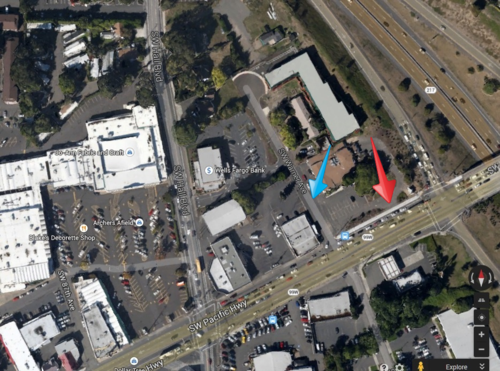
Here’s the amici brief on behalf of Central Oregon Builders Association, Oregonians in Action, and Owners’ Counsel of America in a case being considered by the Oregon Supreme Court, State of Oregon v. Alderwoods (Oregon), Inc., No. S062766.
In an eminent domain action to improve Highway 99W in Tigard, Oregon, the DOT condemned Alderwoods’ two driveways, which had been in place since the 1930’s, which provided direct access to and from the property to the highway (approximate location red arrow). After it filed the action, however, the DOT purported to administratively eliminate the driveways because they were too close to the 99W/217 intersection to be safe. The trial court agreed with the DOT that the post-condemnation elimination meant that Alderwoods did not have a property interest in the two direct access driveways. The court prohibited Alderwoods from presenting evidence to the jury of the loss of value to its
In Gallenthin [Realty Development, Inc. v. Borough of Paulsboro, 191 N.J. 344 (2007)] requires, namely a degree of ‘deterioration or stagnation that negatively affects surrounding areas’ by promoting conditions that can develop into blight.
nn Download A19136264MainStreetvHackensack, No.
62-64 Main Street, LLC v. Mayor and City of Hackensack, No. 072699 (N.J. Marc. 23, 2015)
Continue Reading NJ Retreats From Curtailed “Blight” Takings Standard
In Kirby v North Carolina Dep’t of Transportation, No. COA14-184 (Feb. 17, 2015), the North Carolina held that state’s “Map Act,” which gives the DOT the ability to designate property for future highway use and prevent its development in the meantime, was a taking. There was great shouting and gnashing of teeth that making the DOT actually pay just compensation would crash the system and cost the state a lot of money, so we were not terribly surprised when the DOT recently filed this Notice of Appeal and Petition for Review posing three questions:
1. Did the Court of Appeals erroneously hold that the Map Act, N.C.G.S. § 136-44.50 et seq., empowered NCDOT to exercise the power of eminent domain and that NCDOT exercised that power and took Plaintiffs’ property rights when it recorded protected corridor maps?
2. Did the Court of Appeals erroneously remand this matter for
Brost v. City of Santa Barbara, No. B246153 (Mar. 25, 2015) is an unpublished opinion, but (1) we hope the property owners ask the court to publish it, and (2) even if it remains unpublished, it is worth reading, because the court correctly applies both Williamson County‘s futility exception, and the “background principles” exception to a Lucas “wipeout” regulatory taking.
It’s a longer opinion, but here’s the short story: the plaintiffs’ properties are in a part of the city that is an active landslide area. The city adopted an ordinance that prohibited new construction in the area. The plaintiffs’ homes were destroyed in a wildfire (not a landslide, mind you), and the city refused to allow them to rebuild and refused to amend the ordinance. The trial court held that the total prohibition was a regulatory taking, and “[t]o avoid having to compensate plaintiffs for a permanent taking,
The Wisconsin Court of Appeals’ decision in Somers USA, LLC v. Wisconsin Dep’t of Transportation, No. 2014AP1092 (Mar. 25, 2015), is the second case we’re posting today that has us asking — just what was the government thinking?
This kerfuffle resulted from the DOT trying to take advantage of Somers’ scrivener’s error, made when Somers recorded a map (known as a “CSM”) that stated it was “dedicating” some of its property for a future state highway, rather than merely “reserving” it for highway use. No one disputed that this was an error, and no one doubted that Somers had not intended to donate its property for the highway.
But the DOT said “thank you very much,” and it went ahead and built its highway without condemning the land or paying compensation.
Somers’ inverse condemnation claim followed, as you might expect. The DOT conceded that the “dedication” language was “no doubt
Here’s the first of two cases we’re going to post today, both with the same theme — what was the government thinking?
The facts in Irwin v. City of Minot, No. 20140217 (Mar. 24, 2015), are similar to cases we’ve covered before, the government’s claim that it took property during the course of an emergency as a function of its police power, and therefore it cannot be liable for a taking (see this post — about a fire — and this post — shoreline protection — for examples). In this case is was flooding.
The City did the right thing to combat the flood. It hired contractors who used clay from nearby privately-owned parcels to build dikes. They contracted with the Irwins’ neighbors to remove 20,000 cubic yards of their clay, for which the city paid $.65 per yard. But for some reason, they didn’t bother asking the Irwins: “The City
Continue Reading What Were They Thinking, Part I: City Stealing Dirt Is A Taking
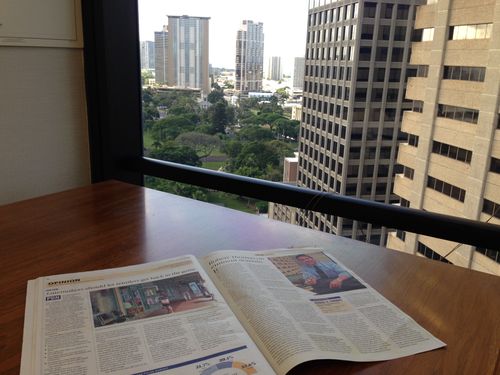
We can’t reproduce the entire interview, and the link to the online version is behind a partial paywall, but here are the highlights of a recent interview, where A. Kam Napier, the Editor-in- Chief of Pacific Business News, came by and chatted with us about eminent domain, property rights, and the Honolulu rail project.
Continue Reading Pacific Business News Report On Eminent Domain And The Honolulu Rail