March 2015

What will they think of next?

Those of us who know inverse condemnation understand that because the cause of action is based in the constitution, that the usual tort concepts such as negligence and comparative fault aren’t part of the equation. Generally speaking, under California law, liability is triggered when government conduct is a “substantial cause” of the damage. 

The California Assembly wants to change all that. It has introduced Assembly Bill No. 1402 (Feb. 27, 2015), which would, in the bill’s words, “apply the doctrine of comparative fault to inverse condemnation actions and would require a court or arbitrator to reduce the compensation paid to a plaintiff in an inverse condemnation proceeding in direct proportion to his or her percentage of fault, if any, in the damaging of property that constitutes a taking.”

Bad idea, and certainly not one that merely codifies “existing law” as the second sentence of

Continue Reading California Wants To Import “Comparative Fault” to Inverse Condemnation
Thankfully, the only “Tiki Island” we have in Hawaii is a miniature golf course. Because the name “tiki” should be reserved for such things, or for kitschy bars, or Trader Vic-knockoffs.

And please, honest-to-goodness real municipalities should never be named Tiki Island. No matter how nice they appear to be. Just no.

(Martin Denny, by the way, gets a pass – rock on, Mr. Denny.)

But there it is, the Village of Tiki Island, Texaspopulation 968, “a waterfront community in Galveston County consisting of about 960 homes, with approximately 40% full-time occupants, and 60% part-time occupants.” 

Something tells us that TI, TX’s smallish population and the resident-to-part-timers ratio had something to do with the fact that in 2014, the Village adopted an ordinance prohibiting the short-term rental of residences, an activity that apparently had been ongoing for some time

Continue Reading Tiki Island’s Prohibition Of Vacation Rentals A Penn-Central Taking (For Now)

In Coleman v. Mississippi Transportation Comm’n, No. 2013-CA-01161-SCT, the Mississippi Supreme Court addressed an issue we’ve been pondering lately, holding that evidence of the condemnor’s initial appraisal, its offer, and its deposit, were admissible when its appraiser presented a lower valuation at trial. The appraiser was also subject to cross-examination about why he lowered his valuation.

We’ve been pondering this issue lately, because the Virginia Supreme Court currently has under submission a case dealing with pretty much the same issue in which we filed an amicus brief, which argues for admissibility of this type of evidence. So naturally we think the Mississippi court came down on the right side of this question.

The court concluded that the property owner was entitled to introduce evidence of the condemnor’s initial offer and deposit of $380,300, and to cross-examine the Commission’s appraiser about why his trial testimony was that the property was

Continue Reading Condemnor’s Higher Initial Appraisal, Offer, And Deposit Admissible

Here’s the amici brief we filed today on behalf of the Owners’ Counsel of America and the National Federation of Independent Business Small Business Legal Center with the California Supreme Court in Property Reserve, Inc. v. Dep’t of Water Resources, No. S217738. In that case, the court is reviewing a decision of the Court of Appeal which held that the DWR’s attempts to enter private property to survey and study the land and the environment in anticipation of condemnation were beyond the minor intrusions allowed by California’s “entry statute.” The Court of Appeal concluded the proposed entries rose to the level of takings, meaning that if the DWR wanted to undertake them, it would have to exercise its eminent domain power to do so.

We posted background on the case here, but the short story is that the State of California is once again planning a massive public

Continue Reading Amici Brief: Precondemnation Entry That Goes Beyond “Innocuous” And “Superficial” Is A Taking

A couple of noteworthy conferences upcoming, one in-person, the other a “webinar” format:

  • The first is “Kelo: A Decade Later” at the U. Connecticut Law School, Friday, March 20, 2015, from 8:30 am – 4:30 pm. The conference promises to “look back at the decision and its repercussions,” and includes the lawyers for Ms. Kelo and the City of New London. “The conference will then explore the role of eminent domain in government planning generally. What role does and should eminent domain play in economic development?  What is the impact of post-Kelo changes to state law?  Does eminent domain have distinctive impacts on low income communities?  Leading scholars and practitioners in law, planning, sociology, and economics will explore these questions.” We note that our Connecticut Owners’ Counsel colleague Dwight Merriam is one of those “leading practitioners,” and will be moderating a panel entitled “Eminent Domain and Economic Development”


Continue Reading Upcoming Conferences – Kelo In Connecticut, APA And The ESA

Frequent readers know that we just love the Australian comedy film “The Castle,” which tells the tale of one man’s legal fight to save his family’s home from the abusive exercise of eminent domain power. (See “Kelo Down Under,” our review.) The case is played for laughs and in the end, the homeowner naturally prevails, the private benefit is quashed by Australia’s High Court, and all’s well that ends well.

Those of us who practice this kind of law understand that real life doesn’t always — or even often — work out the way it does in the movies: the good guys may not always prevail, and even when things are looking up, the road ahead may be filled with many unexpected bumps and turns. 

So it is in “Leviathan,” the latest film from Russia’s Andrey Zvyagintsev.

Not that we would expect

Continue Reading Movie Review: Leviathan – “The Castle” Gone Bad

We can’t hear or read the word “plethora” without thinking of the “¡Three Amigos!” scene with Jefe and El Guapo, so when the California Court of Appeal “apologize[d] for the plethora of statutory citations and footnotes” (in a footnote!) in the latest opinion about the fallout and intragovernmental battle over the money in the wake of the “Great Dissolution” of California’s redevelopment agencies, we naturally had to post the video.

Bottom line: the agreements which the County entered into as the successor to the county redevelopment agency “are ‘enforceable obligations’ of a former redevelopment agency that continue to be payable out of property taxes before distribution of the remainder to the taxing entities.” Slip op. at 2. 

County of Sonoma v. Cohen, No. C075120 (Cal. App. Mar. 12, 2015)


Continue Reading Cal App: “A Plethora of Statutory Citations And Footnotes” In The Latest Redevelopment Chapter

IMG_0049

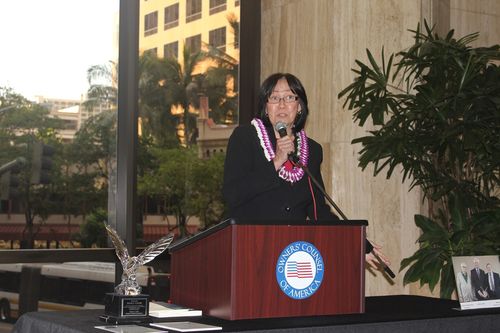
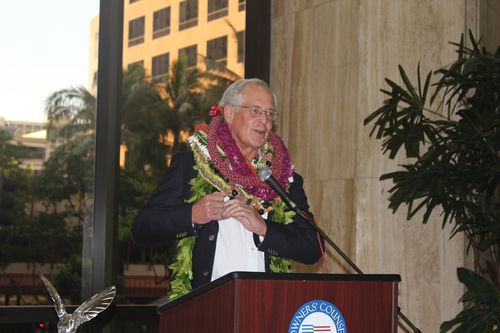
Yesterday, on behalf of my Owners’ Counsel of America colleagues, I was pleased and honored to present to University of Hawaii School of Law Professor David L. Callies the Crystal Eagle, recognizing his lifetime of property law and property rights scholarship. 

Professor Callies’ present and former students (there are many), his faculty colleagues, the Hawaii property law bar, and his family and friends came to my law firm in downtown Honolulu to congratulate him with a short ceremony followed by a reception.  

Associate Justice Sabrina S. McKenna of the Supreme Court of Hawaii (and a former student and law faculty colleague of Prof. Callies) introduced him. We’ll post her remarks — which included haiku! — and more photos and videos of the event, and a transcript of everyone’s words, shortly.

IMG_0044

The Honolulu event was the “local” version of the formal presentation of the Crystal Eagle in San Francisco at

Continue Reading Presenting The Owners’ Counsel Crystal Eagle To U. Hawaii Lawprof David Callies

When we hear the phrase “buy the farm,” we think of the cliche from the old war movies, not eminent domain.

But in Minnesota, “buy the farm” is taken literally. In Great River Energy v. Swedzinski, No. A13-1474 (Mar. 4, 2015), the Minnesota Supreme Court interpreted that state’s “buy the farm” statute, which gives certain landowners the option to require a public utility which is taking an energy corridor easement to buy their entire parcel if certain conditions set out in the statute are met. 

To be accurate, the court was not “interpreting” the statute, but reviewing the lower courts’ refusal to graft a reasonableness requirement into the statute as Great River, a utility with the power of eminent domain under the statute, had requested, after Great River condemned a permanent easement and a temporary access easement across Swedzinski’s land, and Swedzinski exercised the option to require

Continue Reading Minnesota Supreme Court Orders Power Company To Buy The Farm – Literally

With rare exception, we don’t cover unpublished, nonprecedential decisions. But we’re posting Fuller v. United States, No. 2014-5117 (Mar. 10, 2015), an unpublished opinion from the Federal Circuit, because it reminded us of a presentation by Jim Burling at the recent ALI-CLE Eminent Domain conference, “Novel Takings Theories: Testing the Boundaries of Property Rights Claims.” 

Jim’s presentation didn’t focus on cases quite like this one (which was really borderline), where Dr. Fuller, a neurosurgeon and pro se litigant, argued that it was a taking when a dissatisfied patient of his, a marine biologist who was employed by the National Marine Fisheries Service of NOAA (an agency of the Department of Commerce), posted a comment on “runningforums.com” pointing out Dr. Fuller’s use of hyaluronidase, which noted that it posed a “remote risk” of transmitting mad cow disease. Doc Fuller sued in California state courts for defamation, and

Continue Reading Fed Cir (Nonprecedential): A Federal Employee Posting On The Internet From A Gov’t Computer Isn’t A Taking