


2015

Check out the Federal Takings blog, which notes that the Supreme Court has asked the federal government to respond to the cert petition in Ministerio Roca Solida, Inc. v. United States, No. 14-5058 (filed May 27, 2015). The government previously waived its right to respond.

The issue presented in the case is one which the Supreme Court dodged in in United States v. Tohono O’odham Nation, 131 S. Ct. 1723 (2011): whether 28 U.S.C. § 1500’s jurisdictional bar — which deprives the Court of Federal Claims of jurisdiction if a related case is pending in another court at the time the CFC complaint is filed — operates in takings claims, which are required to be split between the CFC and the district courts (aka the “Tucker Act Shuffle”). We filed an amicus brief in Tohono, arguing that the statute cannot be read to deprive takings plaintiffs of

Continue Reading SCOTUS Requests Response To § 1500 Petition
If you need CLE credits, you are in luck. There’s a plethora of upcoming programs that may be of interest to readers. 

First, the ones we’re involved with:

  • The Takings Issue – August 10, 2015, 1 – 2pm ET (webinar) – from the International Municipal Lawyers Association. We’re joining Professors Dan Mandelker and John Echeverria, and land use lawyer Michael Giairno, to talk takings. “Two titans of takings, who just happen to have profoundly opposing views of the world, have graciously agreed to discuss the latest developments and spar. This will be the Great Debate of 2015.” Sounds like fun, no? Registration free for IMLA members, $99 for everyone else. More information, including registration, here
  • Is Sharing Really Caring? The Law of Transportation Sharing: Uber, Lyft, and the Sharing Economy – July 30, 2015, 2:15-3:45pm CT (in-person) –  at the ABA Annual Meeting in Chicago. We’re moderating a session


Continue Reading Mark Your Calendars For Upcoming Events: Takings, Sharing Economy, Fair Housing, etc.

No, it’s not the latest economic development project, but an item we’ve reported on earlier: Jeff Benedict’s Little Pink House” book about the Kelo case is being turned into a movie. Here’s a Reason interview with one of the movie’s producers explaining why the story attracted them, and what we can expect from the film.

Biggest question we have is the casting. Here are our earlier suggestions

Continue Reading Eminent Domain Abuse, Coming To A Theater Near You

We’ve covered this topic before (see here, here, and here), but we haven’t heard much about it lately. But thanks to this new article by colleague Dwight H. Merriam, we can get back up to speed.

In “Eminent Domain for Underwater Mortgages: Already on the Way to the Bottom of the Sea of Bad Ideas,” from the Virginia State Bar’s Real Property Section’s journal, The Fee Simple (Spring 2015), Dwight discusses “the foreclosure crisis and how so many homeowners became victims of bad lending practices and a deep economic recession. Many are stuck in their homes, which are underwater with a value far below what was owed on them.” The article explores the question: can eminent domain bail out underwater mortgages?

Short answer: no.

To learn more, click here to view the article.

And what’s the latest that Richmond, California, which was leading the

Continue Reading New Article: “Eminent Domain for Underwater Mortgages: Already on the Way to the Bottom of the Sea of Bad Ideas”

20150422_112618
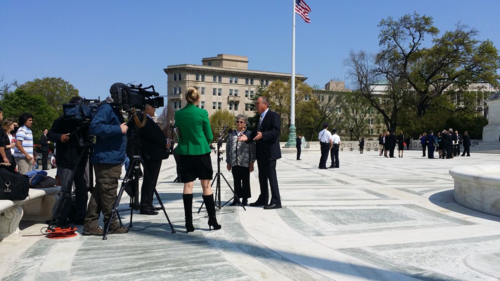
The Hornes outside the Supreme Court

“Separate educational facilities are inherently unequal.”
Chief Justice Earl Warren,
Brown v. Board of Education

“The Fourteenth Amendment does not enact
Mr. Herbert Spencer’s Social Statics.”
Justice Oliver Wendell Holmes,
dissenting in Lochner v. New York

“…prejudice against discrete and insular minorities…”
Justice Harlan Fiske Stone, in footnote 4,
United States v. Carolene Products Co.

“Raisins … are a healthy snack.”
Chief Justice John G. Roberts,
Horne v. Dep’t of Agriculture

A Supreme Court win is a win, particularly by a margin of 8-1, so we’re not going to complain too much about the Court’s opinion in Horne v. Department of Agriculture, No. 14-275 (U.S. June 22, 2015), holding that the USDA’s requirement that raisin producers physically turn over a percentage of their yearly crops to the government without being provided compensation is a taking in violation of the Fifth Amendment.

I

Continue Reading Horne v. USDA: Way More Than Silly Raisin Jokes

Readers know that some jurisdictions have statutes which permit private condemnations — actions in which the owner of a landlocked parcel can exercise eminent domain to take the property of a neighbor for access. They are somewhat like common law easements by necessity, and we’ve seen then in Pennsylvania (private takings still must serve a public purpose) and Colorado (condemning owner must have concrete development plans), for example. 

In Vise v. Pearcy Tennessee River Resort Inc., No. W2014-00649-COA-R3-CV (July 15, 2015), the Tennessee Court of Appeals reviewed that state’s private condemnation statutes and concluded they only allow use of the private condemnation mechanism to create access to a landlocked parcel, and do not allow an owner who already enjoys limited access to condemn a neighbor’s property to create “better” access.  

Pearcy’s parcel wasn’t completely landlocked, and dirt roads over a neighboring TVA-owned parcel allowed limited access. Another

Continue Reading Tennessee Doesn’t Allow Private Condemnation For Better Access, Only To Create Access To Otherwise Landlocked Parcels

This opinion isn’t big news, but come on, it’s about two of our favorite topics (eminent domain and appellate jurisdiction), it’s short, and it’s from the Supreme Court of the Virgin Islands. How often do we get those? Plus, we’re just interested in how courts from fellow island jurisdictions rule.

Bottom line: in a quick-take action, a trial court’s order rejecting a property owner’s claim that the condemnor did not have the power of eminent domain is interlocutory, and is not immediately appealable. Go determine compensation, enter a final judgment, and then you can appeal the whole case. 

This doesn’t make much sense, practically. If the condemnor does not have the power to take the property, why should the parties incur the costs and delay in determining valuation? In our home island jurisdiction, a property owner is entitled by statute to calendar preference, and an immediate interlocutory appeal of

Continue Reading USVI: No Appellate Jurisdiction For Quick-Take Ruling Until Eminent Domain Judgment Finalized

There’s nothing new in the California Court of Appeal’s opinion in Rancho de Calistoga v. City of Calistoga, No. A138301 (July 7, 2015), which is probably why the court didn’t designate it for publication. 

But read it anyway, since there’s some interesting bits. Nothing in the details, mind you, but in the overall vibe of the opinion. 

It’s a mobile home rent control case, so you shouldn’t expect much from a California court, and this decision certainly meets those low expectations: it goes through the usual analysis dealing with the park owner’s argument that the city — at the northern end of the Napa Valley — didn’t agree to increase the rent to $625 per month from the $471 average which tenants were paying. The city permitted an increase of only $60, so the owner sued, asserting among other things that the failure to increase the rent to $625 was

Continue Reading Cal App: No Takings Claim, Because Property Owner Makes “Enough”

Here’s the Complaint, filed late last week in an Oklahoma federal court, challenging the EPA and Corps of Engineers’ new “waters of the United States” rule under the Clean Water Act.

According to the lawsuit, the new WOTUS rules are an attempt to expand the regulatory authority of the agencies well beyond what the Clean Water Act allows. 

This lawsuit joins two others recently filed. The first was a complaint in a South Dakota federal court filed by 13 states, and the other a complaint by the State of Oklahoma, filed in federal court in the Northern District of Oklahoma.

All three make the same general allegations: the EPA and the Corps of Engineers went too far under both the Clean Water Act and the Commerce Clause, and are attempting to regulate property well beyond the reach of “navigable water of the United States” or “waters of

Continue Reading New Clean Water Act WOTUS Rule Challenged: “The Agencies Drastically Expand Their Jurisdiction by Redefining ‘Waters of the United States’”

Even though the defendant in Martinez v. California Dep’t of Transportation, No. G048375 (June 12, 2015, ordered published July 7, 2015) was Caltrans, this was not an eminent domain case, but rather a tort case about whether the agency negligently designed a roadway which caused Mr. Martinez to crash his motorcycle.  

But no matter. Eminent domain lawyers — those who represent either condemnors or property owners — need to read this opinion, because it is about how we conduct ourselves in court.

It starts off with a bang:

This is a case of egregious attorney misconduct. That word – egregious – is difficult to write, but nothing else seems adequate. Blessed with a trial judge who allowed it, trial counsel ran roughshod over opposing counsel and the rules of evidence. We have no choice but to reverse.

Generally, what happened is this: Defendant‟s attorney Karen Bilotti would ask

Continue Reading Cal App Calls Out Trial Judge And DOT Trial Counsel: “This is a case of egregious attorney misconduct. That word – egregious – is difficult to write, but nothing else seems adequate.”