2015

There’s apparently a huge backlog in California of liens which workers’ comp medical providers file to seek payment for services they’ve provided to injured workers.

These are liens possessed by service providers for workers whose employers declined to provide treatment on the ground it is not work related. In those cases, the worker may seek treatment on her own, and if the injury is later determined to be covered by workers’ comp, the employer is liable for payment. The service provider cannot seek payment from the injured employee, and is limited to filing a lien on the workers’ comp case. The lien filing gives the provider standing in the workers’ comp case to protect its interests. The rights of a lien holder are contingent on the worker prevailing on her claim that the injury is work-related.  

In response to the huge backlog in processing such liens, the legislature adopted
Continue Reading 9th Circuit: Fee To “Activate” Workers’ Comp Lien Not A Taking – The Liens Are Not Property

6a017616c47f03970c017617465b53970c-800wi

Nobody’s perfect, as much as we may want them to be. Least of all fictional characters. But Atticus Finch, the Alabama lawyer portrayed in the novel “To Kill a Mockingbird” and the celebrated film, seemed above reproach. 

The first year we sponsored the Law in Film festival, we had to feature “To Kill a Mockingbird,” because, as our colleague Mark Murakami wrote in his review of the film, “[s]tanding alone against a lynch mob armed only with words and his abiding morality, Atticus represents what author Scott Turow calls the ‘paragon’ of lawyer morality: a champion willing to make a stand even if his client, as an African-American accused of raping a white woman, is the most reviled man in their rural Deep South community.”

The book is loved equally, if not more than the film.

Well, get ready. The New York Times reports in its

Continue Reading Et Tu? In The “To Kill A Mockingbird” Sequel, The New York Times Reports That Atticus Finch Has Feet Of Clay

In North Carolina, a property owner has a right to direct access to adjacent highways, and “[i]f the State’s action eliminates all direct access to the abutting road, then the action is ‘a taking as a matter of law.'” Dep’t of Transportation v. Harkey, 301 S.E.2d 64, 71 (N.C. 1983). And it doesn’t matter if the parcel has alternative access to the road. Id. at 65.

Unless the abutting highway moves, according to the North Carolina Court of Appeals in Dep’t of Transportation v. BB&R, LLC, No. 14-1185 (July 7, 2015). 

In that case, there was no dispute that the DOT’s road project took a portion of BB&R’s land on which a convenience store/gas station was located, and that before the taking, the property enjoyed direct access to Dowdle Mountain Road along the property’s northern side.

However, the court concluded the DOT was not liable for a

Continue Reading NC App: No Taking Even Though DOT Cut Off All Of Property’s Northern Access Because Parcel Gained Eastern Acess

Here’s an article by IJ’s Dana Berliner, a retrospective on public use in eminent domain and where the decade since Kelo has left us.  

It is a sign of the constitutional damage Kelo caused that these two related features of the opinion—blind deference and the refusal to engage with facts—have marked post-Kelo jurisprudence.

Berliner, Looking Back Ten Years After Kelo, 125 Yale L.J.F. 82 (2015). 

A quick and worthy read. 

Continue Reading Worth Reading: “Looking Back Ten Years After Kelo”

ALI-CLE-2016-masthead

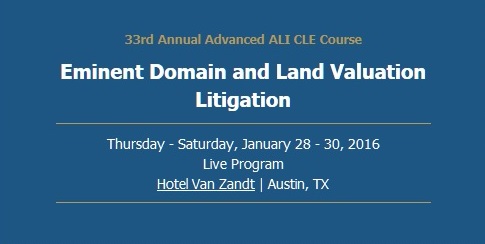
ALI-CLE has posted the registration page for the 2016 ALI-CLE Eminent Domain and Land Valuation Conference, in Austin. Register now for a $200 discount off the tuition. Or you can sign up for notification when the full brochure is published. 

Save the spot on your calendar so you can join us in Austin. 

We’re still working on the agenda and faculty, but here are the details thus far:

Date: January 28-30, 2016 (Thursday – Saturday)

Location: Hotel Van Zandt, Austin Texas

Reserve your hotel room here. [link updated 7/8/2015]

More about the annual conferences — the premiere CLE programming on the subject, in our opinion — here

Stay tuned for more information. We’ll continue to keep you posted. 

Continue Reading 2016 ALI-CLE Eminent Domain Conference (Austin) Early Registration Available

Donald Trump is garnering a lot of press these days for things not related to eminent domain. And there’s a lot of awareness of the high-profile eminent domain battle in New Jersey, in which he was the “B” in an attempted “A to B” taking. But not everyone is as aware of a later, similar controversy. 

So we dusted off our review of the 2011 documentary You’ve Been Trumped, and post it below. The film focuses on the property owners whose land is in the shadow of Trump’s golf course and luxury residential project in Aberdeenshire, on the west coast of Scotland. Compulsory Purchase Orders were threatened (but ultimately not issued), but the scenario presented the film will be familiar to anyone who follows eminent domain and property rights issues.

The film is available on DVD and streaming from a variety of sources. Definitely worth your time. Especially if

Continue Reading If You Are Even Thinking About Voting For Trump …

Remember the Roca Solida case? That’s the follow up to the Supreme Court’s recent decision in United States v. Tohono O’odham Nation, 131 S. Ct. 1723 (2011), highlighting the jurisdictional problem in takings cases which that case left open. We labeled it a “jurisdictional ambush” that awaits any property owner who has a takings claim against the federal government.   

The question presented by the cert petition in Roca Solida is whether 28 U.S.C. § 1500, the statute which deprives the Court of Federal Claims of jurisdiction over a case if a related case is pending in another court at the time the CFC complaint is filed, applies to takings claims. In Tohono O’odham, which was not a takings case, the Court held that the statute prohibited the CFC from taking jurisdiction over the Nation’s monetary claim against the United States, when its related claims against the federal

Continue Reading Amici Brief In § 1500 Case: Congress Cannot Limit Property Owners’ Rights To Just Compensation By Narrowing CFC Jurisdiction, Especially With An Absurd Statute

The Solicitor General of South Carolina has issued this opinion letter, answering the following three questions about a state statute which “purports to confer all rights, powers, and privileges given to telegraph and telephone companies” to pipeline companies:

  • Since S.C. Code § 58-7-10 et seq. appears to mainly concern waterworks, sewage disposal, and natural gas lines, do its provisions also apply to oil and gasoline pipelines and extend to them the public power of eminent domain?
  • If your answer to Question 1 is “yes,” then why isn’t an extension of eminent domain power to a private, for-profit pipeline company unconstitutional under S.C. Article 1, § 13(A)?

  • If an oil and gas pipeline company has eminent domain authority, and this authority is not unconstitutional, must an oil or gasoline pipeline company follow all regulations, rules, legal requirements, or other policies or procedures that are applicable to telephone and telegraph companies


Continue Reading SC AG: Oil And Gas Pipelines Probably Can’t Exercise Eminent Domain Like Telephone Companies

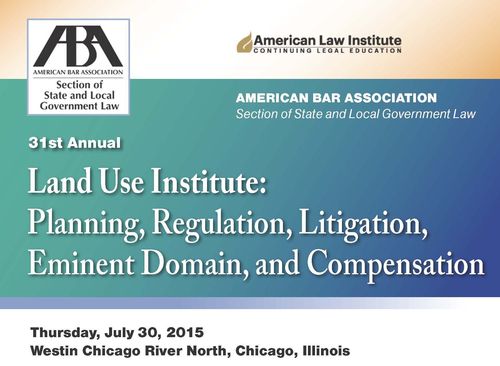
LUI header

The Land Use Institute, a program that for many years has been planned by co-chairs Frank Schnidman and Gideon Kanner, has found a new home with the American Bar Association’s Section of State and Local Government Law as the main sponsor. It also has a new Planning co-chair, Dean Patty Salkin of Touro Law School, who has stepped in for Professor Kanner.

This program is designed for attorneys, professional planners, and government officials involved in land use planning, zoning, permitting, property development, conservation and environmental protection, and related litigation. It not only addresses and analyzes the state-of-the-art efforts by government to manage land use and development, but also presents the key issues faced by property owners and developers in obtaining necessary governmental approvals.

This year, the one-day program is being held in conjunction with the ABA Annual Meeting in Chicago. It will be held on Thursday, July 30, 2015

Continue Reading Land Use Institute: Planning, Regulation, Litigation, Eminent Domain, and Compensation – 31st Annual Conference, Chicago, July 30, 2015