2015

2012-02-06_11-19-51_574

Here’s a case in which the court ruled there wasn’t a taking, but it could be argued that the property owners won. How so? Because this case pitted the property rights of railroads against the property rights of the owners over whose land the rail lines run.

The U.S. Court of Appeals asked the Louisiana Supreme Court to answer this certified question:

Whether the application of LA. REV. STAT. § 48:394 to any of the properties in this case amounts to an unconstitutional taking of private property without a public purpose, in violation of Article I, Section 4 of the Louisiana Constitution.

In Faulk v. Union Pacific Railroad Co., No. 2014-CQ-1598 (June 30, 2015), the Supreme Court answered no.  

The case arose in 2007 after the railroad planned to close 100-year old private crossings over its tracks, which the property owners asserted disrupted their farming operations and their

Continue Reading Takings Claim Rejected, But Property Owners Win In Louisiana: Statute Limiting Closing Of Private Railroad Crossing Isn’t A Taking Under State Constitution

20150205_072910

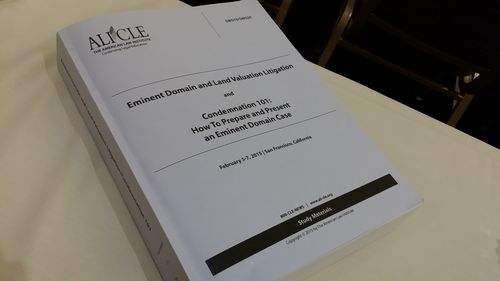
The hotel reservations link for the 2016 ALI-CLE Eminent Domain and Land Valuation and Condemnation 101 Conference is now live.

Reserve your hotel room now, via this link to ensure that you have a spot in the conference hotel. [note: link updated 7/8/2015]

We’re still working on the agenda and faculty, but here are the details thus far:

Date: January 28-30, 2016 (Thursday – Saturday)

Location: Hotel Van Zandt, Austin Texas

The Hotel Van Zandt is a new hotel (not even opened as of the date of this post), but our Austin sources tell us that it’s centrally located, close to everything that Austin is known for. More about the annual conferences — the premiere CLE programming on the subject, in our opinion — here

Stay tuned for more information. We’ll continue to keep you posted, and when the registration page at ALI-CLE is up and ready to

Continue Reading 2016 ALI-CLE Eminent Domain Conference, Austin: Hotel Now Taking Reservations

Picture 011

You probably already knew this, but in case not. As of tomorrow, Wednesday, July 1, 2015, you no longer will be able to get the old-style plastic bags at checkout at most grocery stores on Oahu.

If you don’t already have your own bags to bring with you (so you can avoid paying the $.10 for the paper bag which the stores will provide), we are here to help you out. You can save yourself the embarrassment of carrying out all your stuff in your arms or in an old box like when you go to Costco, by obtaining one of our firm’s reusable eco-friendly bags.

The photos above and below show you what they look like.

These are not your typical cheapo reusable bags, but are heavy duty, cloth-like bags that in our experience can hold up to two paper bags’ worth of groceries. Really fine. We even use

Continue Reading Prepared For Honolulu’s Plastic Bag Ban? Get Your Damon Key Eco-Friendly Bag Here, Free

We were involved with this issue in the days leading up to the initiative election, and we represent an amicus party in this case, so we will post the court’s order without comment.

The title of this post tells you what you want to know. 

Order Determining that the County of Maui GMO Ordinance is Preempted and Exceeds the County’s Authorit…

Continue Reading Federal Court: Maui County GMO Regulation Ordinance Preempted by Federal And State Law

2010-06-08 13.10.15

If there’s one thing that keeps appellate lawyers up at night, it’s jurisdictional questions. Too late and you’re toast: failing to appeal within the short appellate time frames are usually fatal to your case. Although there’s usually no overall harm in an early filing, it can be awkward when you’ve teed up a case only to have the court of appeals find some problems and dismiss. It’s embarrassing and when it happens when you are well underway with briefing, wasteful.  

Hawaii appellate practitioners know the latter problem as the “Jenkins” or “Cades” issue, after the seminal case reminding us that the sine qua non of civil appellate jurisdiction in most cases is the entry of a final judgment by the trial court disposing of all claims against all parties. See Jenkins v. Cades Schutte Fleming & Wright, 76 Haw. 115, 869 P.2d 1334 (1994).

Continue Reading HAWSCT Again Clarifies When A Judgment Is “Final” And Appealable (They’re Serious About This Finality Thing)

There’s a category of cases in which it isn’t difficult, with reasonable accuracy, to predict the ultimate outcome without knowing much about the substantive law. The recent ACA and marriage cases, for example. You kind of just know how they’re going to come out. Bush v. Gore, 531 U.S. 98 (2000), was another one of those. Because the practical and political forces at play in those and similar cases overwhelm the legal objections no matter how technically and logically correct they appear, and the justices in the majority probably end up making their decisions based on pragmatic as well as their (perceived) policy inclinations. The opinions and dissents get dressed up with citations to precedent and the like, but what really seems to drive these cases is their practicalities. 

It seems to us that today’s 5-4 decision in Arizona State Legislature v. Arizona Independent Redistricting Comm’n, No. 13-1314 (June 29

Continue Reading Hawaii’s Reapportionment Commission Breathes A Sigh Of Relief: SCOTUS Upholds Arizona Redistricting Commission

131996

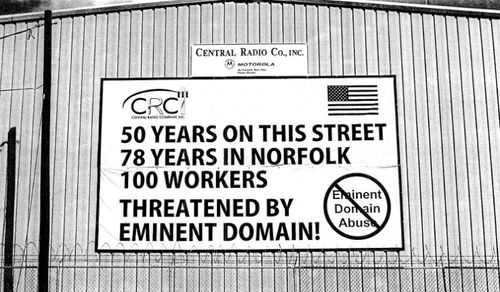
In this Order, the Supreme Court has granted the cert petition in the case we’ve been following about the anti-eminent domain sign in Norfolk, Virginia. The Court vacated the Fourth Circuit judgment and sent the case back down for consideration in light of the recent ruling in Reed v. Town of Gilbert. Here’s the text of the Order:

CENTRAL RADIO COMPANY, ET AL. V. NORFOLK, VA

The motion of Six Law Professors, et al. for leave to file a brief as amici curiae is granted. The motion of Neighborhood Enterprises, Inc., et al. for leave to file a brief as amici Curiae is granted. The petition for a writ of certiorari is granted. The judgment is vacated, and the case is remanded to the United States Court of Appeals for the Fourth Circuit for further consideration in light of Reed v. Town of Gilbert, 576 U. S.

Continue Reading SCOTUS GVR’s Anti-Eminent Domain Sign Case

In State ex rel. Dep’t of Transportation v. Eighth Judicial Circuit, No. 15-19376 (June 25, 2015), the Nevada Supreme Court covered territory addressed by other courts recently (see here by North Carolina, Florida, and here by California) — whether there’s a taking when an agency with the power of eminent domain takes steps to condemn property, but hasn’t actually done so yet.

Here, the Nevada court concluded that there wasn’t a taking, because even though the DOT announced “Project Neon,” a “six-phase, 20- to 25- year highway improvement for the Interstate Highway 15 (I-15) corridor between Sahara Avenue and the U.S. Route 95/I-15 interchange in Las Vegas” which included plaintiff’s property, it did not result in a “de facto moratorium” on development as the property owner characterized it.

Rather, the court viewed the DOT’s actions as preliminary because the plaintiff’s property “is not anticipated to be

Continue Reading Nevada: No Regulatory Taking When DOT Announced Future Plans To Condemn

Attend any talk by a judge which includes legal writing tips, and there’s sure to be this one: keep it as short as is necessary to make your points. Justice Kennedy’s remark that “I never read a brief I couldn’t put down in the middle” and Chief Justice Roberts noting “I can’t recall ever being sorry to see a brief end,” for example. Good advice. But what judges may not realize is that it is very often a two way street, and we consumers of judicial opinions also appreciate brevity. (With the exception of opinions in cases we win; in those circumstances, please do drone on Your Honors.) 

Well, here’s one that is somewhat lengthy at 49 pages, but is the exception to the rule and that we think more than a few readers will enjoy for their weekend reading: the concurring opinion in a case decided

Continue Reading Worth Reading: An “Economic Liberty” Decision From The Texas Supreme Court, With Lessons For Eminent Domain

One for you muni law types (and for future students of Admin Law to assist them with writing their outlines). In Ruggles v. Yagong, No. SCWC-13-0000117 (June 25, 2015), a divided Hawaii Supreme Court refined the test for determining when a municipal ordinance or charter provision is preempted by state law.

The court clarified that the two part Richardson test is a disjunctive and not conjunctive standard, and if the plaintiff can show either that the local law covers the same subject as a comprehensive state statute intended to be uniform statewide, or the local measure conflicts with state law, it is beyond the power of the municipality to adopt. Until Ruggles, there was a little ambiguity about whether a plaintiff needed to show both. No longer. Plaintiff wins if she can show either. 

To the unfamiliar, state law preemption can seem like a result-driven exercise since it

Continue Reading HAWSCT On Preemption: Local Weed No-Enforcement Initiative Conflicts With State Criminal Law (And That’s Enough)