


2015

In Gallenthin [Realty Development, Inc. v. Borough of Paulsboro, 191 N.J. 344 (2007)] requires, namely a degree of ‘deterioration or stagnation that negatively affects surrounding areas’ by promoting conditions that can develop into blight. 

nn Download A19136264MainStreetvHackensack, No.

62-64 Main Street, LLC v. Mayor and City of Hackensack, No. 072699 (N.J. Marc. 23, 2015)

Continue Reading NJ Retreats From Curtailed “Blight” Takings Standard
In Kirby v North Carolina Dep’t of Transportation, No. COA14-184 (Feb. 17, 2015), the North Carolina held that state’s “Map Act,” which gives the DOT the ability to designate property for future highway use and prevent its development in the meantime, was a taking. There was great shouting and gnashing of teeth that making the DOT actually pay just compensation would crash the system and cost the state a lot of money, so we were not terribly surprised when the DOT recently filed this Notice of Appeal and Petition for Review posing three questions:

1. Did the Court of Appeals erroneously hold that the Map Act, N.C.G.S. § 136-44.50 et seq., empowered NCDOT to exercise the power of eminent domain and that NCDOT exercised that power and took Plaintiffs’ property rights when it recorded protected corridor maps?

2. Did the Court of Appeals erroneously remand this matter for

Continue Reading State Appeals NC “Map Act” Takings Case

Brost v. City of Santa Barbara, No. B246153 (Mar. 25, 2015) is an unpublished opinion, but (1) we hope the property owners ask the court to publish it, and (2) even if it remains unpublished, it is worth reading, because the court correctly applies both Williamson County‘s futility exception, and the “background principles” exception to a Lucas “wipeout” regulatory taking. 

It’s a longer opinion, but here’s the short story: the plaintiffs’ properties are in a part of the city that is an active landslide area. The city adopted an ordinance that prohibited new construction in the area. The plaintiffs’ homes were destroyed in a wildfire (not a landslide, mind you), and the city refused to allow them to rebuild and refused to amend the ordinance. The trial court held that the total prohibition was a regulatory taking, and “[t]o avoid having to compensate plaintiffs for a permanent taking,

Continue Reading Cal App (Unpub): Temporary Prohibition On Rebuilding In A Landslide Zone Is A Taking

The Wisconsin Court of Appeals’ decision in Somers USA, LLC v. Wisconsin Dep’t of Transportation, No. 2014AP1092 (Mar. 25, 2015), is the second case we’re posting today that has us asking — just what was the government thinking?

This kerfuffle resulted from the DOT trying to take advantage of Somers’ scrivener’s error, made when Somers recorded a map (known as a “CSM”) that stated it was “dedicating” some of its property for a future state highway, rather than merely “reserving” it for highway use. No one disputed that this was an error, and no one doubted that Somers had not intended to donate its property for the highway. 

But the DOT said “thank you very much,” and it went ahead and built its highway without condemning the land or paying compensation.

Somers’ inverse condemnation claim followed, as you might expect. The DOT conceded that the “dedication” language was “no doubt

Continue Reading What Were They Thinking, Part II: DOT Can’t Take Advantage Of “Scrivener’s Error” To Avoid Eminent Domain

Here’s the first of two cases we’re going to post today, both with the same theme — what was the government thinking?

The facts in Irwin v. City of Minot, No. 20140217 (Mar. 24, 2015), are similar to cases we’ve covered before, the government’s claim that it took property during the course of an emergency as a function of its police power, and therefore it cannot be liable for a taking (see this post — about a fire — and this post — shoreline protection — for examples). In this case is was flooding.

The City did the right thing to combat the flood. It hired contractors who used clay from nearby privately-owned parcels to build dikes. They contracted with the Irwins’ neighbors to remove 20,000 cubic yards of their clay, for which the city paid $.65 per yard. But for some reason, they didn’t bother asking the Irwins: “The City

Continue Reading What Were They Thinking, Part I: City Stealing Dirt Is A Taking

IMG_1534

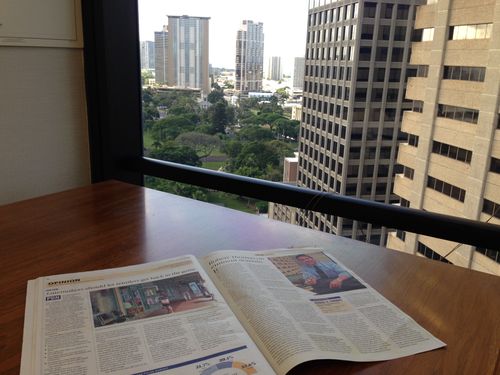
We can’t reproduce the entire interview, and the link to the online version is behind a partial paywall, but here are the highlights of a recent interview, where A. Kam Napier, the Editor-in- Chief of Pacific Business News, came by and chatted with us about eminent domain, property rights, and the Honolulu rail project.  

  • Robert H. Thomas thinks it’s no accident that the Fifth Amendment in the Bill of Rights protects not only the right to due process for people accused of a crime but also the same rights for people who own property the government would like to take. The right of the people to be secure in their private property was that essential to the Founders.
  • “’The Kelo decision was a direct result of the Midkiff decision, where essentially any public purpose that the government advances is going to be enough [to take the


Continue Reading Pacific Business News Report On Eminent Domain And The Honolulu Rail

What will they think of next?

Those of us who know inverse condemnation understand that because the cause of action is based in the constitution, that the usual tort concepts such as negligence and comparative fault aren’t part of the equation. Generally speaking, under California law, liability is triggered when government conduct is a “substantial cause” of the damage. 

The California Assembly wants to change all that. It has introduced Assembly Bill No. 1402 (Feb. 27, 2015), which would, in the bill’s words, “apply the doctrine of comparative fault to inverse condemnation actions and would require a court or arbitrator to reduce the compensation paid to a plaintiff in an inverse condemnation proceeding in direct proportion to his or her percentage of fault, if any, in the damaging of property that constitutes a taking.”

Bad idea, and certainly not one that merely codifies “existing law” as the second sentence of

Continue Reading California Wants To Import “Comparative Fault” to Inverse Condemnation

Thankfully, the only “Tiki Island” we have in Hawaii is a miniature golf course. Because the name “tiki” should be reserved for such things, or for kitschy bars, or Trader Vic-knockoffs.

And please, honest-to-goodness real municipalities should never be named Tiki Island. No matter how nice they appear to be. Just no.

(Martin Denny, by the way, gets a pass – rock on, Mr. Denny.)

But there it is, the Village of Tiki Island, Texaspopulation 968, “a waterfront community in Galveston County consisting of about 960 homes, with approximately 40% full-time occupants, and 60% part-time occupants.” 

Something tells us that TI, TX’s smallish population and the resident-to-part-timers ratio had something to do with the fact that in 2014, the Village adopted an ordinance prohibiting the short-term rental of residences, an activity that apparently had been ongoing for some time

Continue Reading Tiki Island’s Prohibition Of Vacation Rentals A Penn-Central Taking (For Now)

In Coleman v. Mississippi Transportation Comm’n, No. 2013-CA-01161-SCT, the Mississippi Supreme Court addressed an issue we’ve been pondering lately, holding that evidence of the condemnor’s initial appraisal, its offer, and its deposit, were admissible when its appraiser presented a lower valuation at trial. The appraiser was also subject to cross-examination about why he lowered his valuation.

We’ve been pondering this issue lately, because the Virginia Supreme Court currently has under submission a case dealing with pretty much the same issue in which we filed an amicus brief, which argues for admissibility of this type of evidence. So naturally we think the Mississippi court came down on the right side of this question.

The court concluded that the property owner was entitled to introduce evidence of the condemnor’s initial offer and deposit of $380,300, and to cross-examine the Commission’s appraiser about why his trial testimony was that the property was

Continue Reading Condemnor’s Higher Initial Appraisal, Offer, And Deposit Admissible

Here’s the amici brief we filed today on behalf of the Owners’ Counsel of America and the National Federation of Independent Business Small Business Legal Center with the California Supreme Court in Property Reserve, Inc. v. Dep’t of Water Resources, No. S217738. In that case, the court is reviewing a decision of the Court of Appeal which held that the DWR’s attempts to enter private property to survey and study the land and the environment in anticipation of condemnation were beyond the minor intrusions allowed by California’s “entry statute.” The Court of Appeal concluded the proposed entries rose to the level of takings, meaning that if the DWR wanted to undertake them, it would have to exercise its eminent domain power to do so.

We posted background on the case here, but the short story is that the State of California is once again planning a massive public

Continue Reading Amici Brief: Precondemnation Entry That Goes Beyond “Innocuous” And “Superficial” Is A Taking