2015

A couple of noteworthy conferences upcoming, one in-person, the other a “webinar” format:

  • The first is “Kelo: A Decade Later” at the U. Connecticut Law School, Friday, March 20, 2015, from 8:30 am – 4:30 pm. The conference promises to “look back at the decision and its repercussions,” and includes the lawyers for Ms. Kelo and the City of New London. “The conference will then explore the role of eminent domain in government planning generally. What role does and should eminent domain play in economic development?  What is the impact of post-Kelo changes to state law?  Does eminent domain have distinctive impacts on low income communities?  Leading scholars and practitioners in law, planning, sociology, and economics will explore these questions.” We note that our Connecticut Owners’ Counsel colleague Dwight Merriam is one of those “leading practitioners,” and will be moderating a panel entitled “Eminent Domain and Economic Development”


Continue Reading Upcoming Conferences – Kelo In Connecticut, APA And The ESA
Frequent readers know that we just love the Australian comedy film “The Castle,” which tells the tale of one man’s legal fight to save his family’s home from the abusive exercise of eminent domain power. (See “Kelo Down Under,” our review.) The case is played for laughs and in the end, the homeowner naturally prevails, the private benefit is quashed by Australia’s High Court, and all’s well that ends well.

Those of us who practice this kind of law understand that real life doesn’t always — or even often — work out the way it does in the movies: the good guys may not always prevail, and even when things are looking up, the road ahead may be filled with many unexpected bumps and turns. 

So it is in “Leviathan,” the latest film from Russia’s Andrey Zvyagintsev.

Not that we would expect

Continue Reading Movie Review: Leviathan – “The Castle” Gone Bad

We can’t hear or read the word “plethora” without thinking of the “¡Three Amigos!” scene with Jefe and El Guapo, so when the California Court of Appeal “apologize[d] for the plethora of statutory citations and footnotes” (in a footnote!) in the latest opinion about the fallout and intragovernmental battle over the money in the wake of the “Great Dissolution” of California’s redevelopment agencies, we naturally had to post the video.

Bottom line: the agreements which the County entered into as the successor to the county redevelopment agency “are ‘enforceable obligations’ of a former redevelopment agency that continue to be payable out of property taxes before distribution of the remainder to the taxing entities.” Slip op. at 2. 

County of Sonoma v. Cohen, No. C075120 (Cal. App. Mar. 12, 2015)


Continue Reading Cal App: “A Plethora of Statutory Citations And Footnotes” In The Latest Redevelopment Chapter

IMG_0049

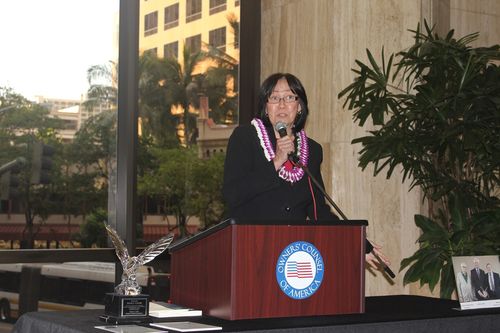
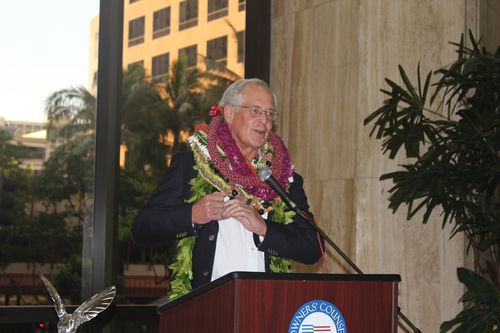
Yesterday, on behalf of my Owners’ Counsel of America colleagues, I was pleased and honored to present to University of Hawaii School of Law Professor David L. Callies the Crystal Eagle, recognizing his lifetime of property law and property rights scholarship. 

Professor Callies’ present and former students (there are many), his faculty colleagues, the Hawaii property law bar, and his family and friends came to my law firm in downtown Honolulu to congratulate him with a short ceremony followed by a reception.  

Associate Justice Sabrina S. McKenna of the Supreme Court of Hawaii (and a former student and law faculty colleague of Prof. Callies) introduced him. We’ll post her remarks — which included haiku! — and more photos and videos of the event, and a transcript of everyone’s words, shortly.

IMG_0044

The Honolulu event was the “local” version of the formal presentation of the Crystal Eagle in San Francisco at

Continue Reading Presenting The Owners’ Counsel Crystal Eagle To U. Hawaii Lawprof David Callies

When we hear the phrase “buy the farm,” we think of the cliche from the old war movies, not eminent domain.

But in Minnesota, “buy the farm” is taken literally. In Great River Energy v. Swedzinski, No. A13-1474 (Mar. 4, 2015), the Minnesota Supreme Court interpreted that state’s “buy the farm” statute, which gives certain landowners the option to require a public utility which is taking an energy corridor easement to buy their entire parcel if certain conditions set out in the statute are met. 

To be accurate, the court was not “interpreting” the statute, but reviewing the lower courts’ refusal to graft a reasonableness requirement into the statute as Great River, a utility with the power of eminent domain under the statute, had requested, after Great River condemned a permanent easement and a temporary access easement across Swedzinski’s land, and Swedzinski exercised the option to require

Continue Reading Minnesota Supreme Court Orders Power Company To Buy The Farm – Literally

With rare exception, we don’t cover unpublished, nonprecedential decisions. But we’re posting Fuller v. United States, No. 2014-5117 (Mar. 10, 2015), an unpublished opinion from the Federal Circuit, because it reminded us of a presentation by Jim Burling at the recent ALI-CLE Eminent Domain conference, “Novel Takings Theories: Testing the Boundaries of Property Rights Claims.” 

Jim’s presentation didn’t focus on cases quite like this one (which was really borderline), where Dr. Fuller, a neurosurgeon and pro se litigant, argued that it was a taking when a dissatisfied patient of his, a marine biologist who was employed by the National Marine Fisheries Service of NOAA (an agency of the Department of Commerce), posted a comment on “runningforums.com” pointing out Dr. Fuller’s use of hyaluronidase, which noted that it posed a “remote risk” of transmitting mad cow disease. Doc Fuller sued in California state courts for defamation, and

Continue Reading Fed Cir (Nonprecedential): A Federal Employee Posting On The Internet From A Gov’t Computer Isn’t A Taking

Check out State ex rel. Sunset Estate Properties, LLC v. Village of Lodi, No. 2013-1856 (Mar. 10, 2015),  a case in which the Ohio Supreme Court held that a local zoning ordinance was unconstitutional on its face.

The Village’s zoning code, adopted in 1987, banned manufactured home (trailer) parks. Of course, the ordinance could not ban those parks already in existence, which were allowed as nonconforming uses. Sunset Estates was one such park.

The ordinance also provided that if a nonconforming use was discontinued for six months, that was evidence of the owner’s intent to abandon the nonconforming use:

Whenever a nonconforming use has been discontinued for a period of six months or more, such discontinuance shall be considered conclusive evidence of an intention to legally abandon the nonconforming use. At the end of the six-month period of abandonment, the nonconforming use shall not be re-established, and any further

Continue Reading A Zoning Due Process Violation From The Land Of Euclid: Owner Can’t Lose Nonconforming Use By Actions Of Tenant

Here’s the amici brief of the National Association of Home Builders, the National Association of Realtors, the National Association of Independent Business Small Business Legal Center, and others in the case we’ve been following out of the federal courts in Florida about a county’s “right of way preservation” ordinance (which is somewhat similar, but perhaps worse in some ways than North Carolina’s Map Act).

As you might recall, the federal district court held that the ordinance — which allows the county to land bank for future road corridors by means of an exaction is “both coercive and confiscatory in nature and constitutionally offensive in both content and operation” — violated Hillcrest’s due process rights. Yes, the Takings Clause was part of the mix in that it was Hillcrest’s right to just compensation that the county wrongfully interfered with (see Nollan, Dolan, and Koontz), but this was

Continue Reading Amici Brief: Didn’t Lingle Tell Us That Due Process And Takings Are Distinct Claims?

Railcoming

If you didn’t have a chance to attend last week’s community meeting on the Honolulu rail project and property rights at Farrington High School, we’ve posted the audio clips, which include the big picture, the current status, and a series of frequently asked questions.

  • FAQ’s and background (including “The Numbers: How Much Land, How Much Money, How Much Time?,” “Key Terms in Eminent Domain,” “The ‘Dear Owner’ Letter,” “Appraisals From an Eminent Domain Perspective,” “Business Losses, Lost Profits, and Business Interruptions,” “Relocation Benefits,” and more)
  • KITV video report

Continue Reading Honolulu Rail FAQ’s (And Answers) From Last Week’s Community Meeting

On Thursday, March 5, 2015, we held a community forum on the Honolulu rail project, with an overview of the acquisition, eminent domain, and relocation process. For those who were not able to join us, we recorded the sessions, and post them below.

For HART’s video flyover simulation of the entire Phase 1 system, go here.

Introduction: An Overview of the Honolulu Rail Project:

The Numbers: How Much Land, How Much Money, How Much Time?

Key Terms in Eminent Domain Law:

The Acquisition Process: Negotiation and the “Dear Owner” Letter:

Appraisals From the Eminent Domain Perspective:

Frequently Asked Questions

Can I stop the Honolulu Rail Project?

Can I force HART to move the alignment of the guideway?

Do I have claims for noise, dust, and vibrations from the project construction and operation?

Business losses, business interruption, and lost profits

Property Taxes in Eminent Domain

Mortgages and Eminent Domain

Continue Reading The Honolulu Rail – An Overview Of Property Rights Issues & Answers To Frequently Asked Questions