2015

The State of New York wants to build the Bronx River Greenway, a “23-mile-long ribbon of green with a multi-use path that will extend along the full length of the river in Westchester County and the Bronx.” Who could argue with that?

Amtrak, that’s who. After failing to acquire 6 parcels along the river owned by the “private corporation created by the Rail Passenger Service Act of 1970, 49 U.S.C. § 24101,” in 2008, the state filed notices of appropriation and maps with the county clerk, and title to the land vested in the state. They kept trying to work things out, apparently, but to no avail and in 2012, Amtrak sued in federal court, arguing that the takings were invalid under the Supremacy Clause because they were expressly or impliedly preempted by federal law.

In National Railroad Passenger Corp. v. McDonald, No. 13-4161-cv (Feb. 24, 2015), the Second Circuit

Continue Reading 2d Cir: Amtrak SOL On Claim Its Property Immune From NY’s Eminent Domain Power

A short one from the Texas Court of Appeals. As we noted in this post recently, Texas has bifurcated its eminent domain process. After a petition in condemnation is filed in court, in the “administrative” phase, the court appoints commissioners whose job it is to hold a hearing and render an opinion on value. If any party doesn’t like commissioners’ decision, the “judicial” phase commences and the more familiar process begins. 

In In re Tarrant Regional Water District, No. 12-14-00329 (Feb. 11, 2015), the question was whether the court, in the administrative phase, has the obligation to appoint commissioners even where the court might agree with the property owner’s contention that its property was immune from condemnation. The trial court refused to appoint commissioners, holding it would only do so after a hearing on whether the condemnor could legally take the property. 

The court of appeals granted the

Continue Reading Tex App: Trial Court Cannot Determine Power To Take Until After Commissioners Determine Value

Railiscoming

[To reserve your space, please email your RSVP to me or Mark, or call either of us at (808) 531-8031.]

On Thursday, March 5, 2015, from 6:00 – 7:15 p.m. at the Farrington High School Cafeteria (1564 North King Street, Honolulu, Hawaii), we’re inviting property owners, businesses, and residents whose rights may be impacted by the Honolulu rail project to join us for an informational meeting about the rights of property owners when their property is targeted for acquisition for public transit projects, and how to protect those rights. 

Here’s the invite which we sent out:

Hawaii’s Constitution requires “just compensation” and monetary damages be paid if private property is taken for a public use such as the Honolulu rail project. The Honolulu Authority for Rapid Transit has already begun acquiring privately-owned property it needs for the rail corridor from the airport to Ala Moana, as

Continue Reading Property Owners Invited: Honolulu Rail Project Public Informational Meeting, Thursday, March 5, 2015, Farrington High School

20150205_072910

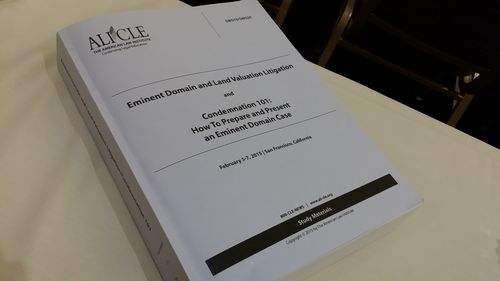
Here are the posts about the 2015 ALI-CLE Eminent Domain and Land Valuation Conference (San Francisco), and where we will post information on the 2016 conference as those details are finalized:

UPDATE October 13, 2015: The complete agenda, faculty list, and conference registration pages are live at ALI-CLE’s website. Register now.

Reports from the 2015 San Francisco conference:

Continue Reading 2015 ALI-CLE Eminent Domain And Land Valuation Conference (and 2016)

Worth reading: “Legislative Exactions after Koontz v. St. Johns River Management District,” an article by colleagues Luke Wake and Jarod Bona, recently posted to SSRN. Here’s the abstract:

Decided in June, 2013, Koontz v. St. Johns River Management District settled a long-running debate among scholars as to whether the nexus test — first pronounced in Nollan v. California Coastal Commission — applies in review of monetary exactions. In the preceding years, the lower courts had largely resolved this question in the government’s favor — limiting Nollan to its facts, and holding the nexus test inapplicable if a challenged permit requires the applicant to pay or expend money as a condition of permit approval. Further, the trend among the lower courts held the nexus test inapplicable in review of legislatively imposed exactions, regardless of whether the contested condition requires a dedication of real property or money.

Without question

Continue Reading New Article: “Legislative Exactions after Koontz v. St. Johns River Management District”

Here’s one that we’ve had in our “to read” stack for a while, but put off since it didn’t look all that interesting. But after finally reading it recently, there’s a line in the opinion that jumped out at us. Read on. 

Araya v. JPMorgan Chase Bank, N.A., No. 13-7036 (Dec. 30, 2014) is a pro se case in which, after foreclosure and sale of rental property to a third person, a property owner sued in D.C. Superior Court claiming the defendants (Fannie Mae, the bank, a law firm, and the person who purchased the property at the auction) had not provided him proper notice or an opportunity to cure the default. The plaintiff also asserted that the defendants took his property without just compensation under the Fifth Amendment. The defendants removed the case to federal court and sought dismissal and summary judgment. In response, the plaintiff asked to

Continue Reading DC Circuit: No Supplemental Federal Jurisdiction Because “Elvis Had Left The Building” Upon Failure Of Takings Claim

Although we just wrapped this year’s ALI-CLE Eminent Domain and Land Valuation Litigation and Condemnation 101 conferences, we’ve already started to think about the 2016 programs. 

Those of you who attended this year or have attended in the past, please watch your email inboxes in the next few days for an informal survey from ALI-CLE, asking for your thoughts about the 2016 location, and asking for input on topics you’d like to see covered on the agenda. Be sure to respond without delay, as the earlier we can lock down the date and location, the sooner we can start making concrete plans.

Of course, you can always just email me with your suggestions for venue city and agenda topics. Charleston, SC? Austin, TX? Miami, FL? You don’t need to have attended in the past — we also want to hear from those who have never attended an ALI-CLE conference

Continue Reading Your Thoughts On The Venue And Topics For 2016’s ALI-CLE Eminent Domain Conference?

Have you ever read one of those opinions where each piece seems okay, but as a whole the result just doesn’t sit well? The Idaho Supreme Court’s opinion in State of Idaho, Dep’t of Transportation v. Grathol, No. 40168 (Feb. 11, 2015) is just one of those.

You’ve no doubt heard a lot about “eminent domain abuse” in the past few years, and that’s what seemed to fuel the opinion. Except here, it wasn’t abuse of the property owner by the condemnor, but rather the other way around: the overall vibe of the opinion was that the court wasn’t too pleased with the property owner’s approach. It determined the appeal was “extreme and unlikely” and assessed the property owner the attorneys’ fees and costs the government incurred on appeal.

It also concluded that the property owner may have interposed “extreme and unlikely” defenses in the trial court, even though

Continue Reading “Eminent Domain Abuse” Turnaround In Idaho: Property Owner Liable For Condemnor’s Attorneys Fees For “Extreme And Unlikely” Appeal And Defenses

Here’s the latest in an issue we’ve been following out of North Carolina.

In Kirby v North Carolina Dep’t of Transportation, No. COA14-184 (Feb. 17, 2015), the N.C. Court of Appeals not only held that the property owners’ claims were ripe, but that the Map Act — which gives the DOT the ability to designate property for future highway use and prevent its development in the meantime — effected a taking. The court reversed the trial court’s dismissal and sent the case back down for a calculation of the compensation owed to each property owner. A big win for the property owners.  

We’ve set out the background here and here, but the short story is that the N.C. legislature adopted a statute which allows the DOT to designate future highway corridors, but doesn’t require it to actually acquire the property. Once the DOT files a map showing

Continue Reading NC App: “Map Act,” Which Land Banks Property For Future Highways, Is A Taking