



2015

Sodarock

Beach cases from Hawaii. The South gets gator law opinions. Vermont, snow law.

To this list of “local flavor” cases, add Belle Terre Ranch, Inc. v. Wilson, No. A137217 (Jan. 13, 2015), an opinion by a California Court of Appeal resolving a boundary dispute between a Northern California winery and the owner a neighboring vineyard.

There’s a lot of discussion about old boundary descriptions, hundred year old surveys, and other stuff, but in the end the court of appeal concluded the trial court got it right when it determined that the winery did indeed encroach on the vineyard and enjoined it from future trespass. The court of appeal had no quarrel with the trial court’s assignment of $1 as nominal damages.

The interesting part of the opinion, however, is the court’s reversal of the attorneys’ fee award of $117,000. The court held that the statute which the plaintiff
Continue Reading Cal App: Award Of $1 Not Enough To Support Attorney Fee In Vineyard Boundary Dispute

The Nevada Supreme Court’s opinion in Buzz Stew, LLC v. City of North Las Vegas, No. 15-03100 (Jan. 29, 2015) was the second time the court had issued a published ruling in the case, the first being Buzz Stew, LLC v. City of North Las Vegas, 181 P.3d 670 (Nev. 2008), in which it held that “the just compensation provision requires compensating a landowner for a lesser invasion of his property rights when a would-be condemnor acts improperly following its announcement of intent to condemn, such as by unreasonably delaying condemnation of the property.” The court remanded the case for a jury determination of whether the city unreasonably delayed condemnation.  

The jury didn’t think so, which resulted in this second appeal and the second opinion. Unfortunately, this round didn’t turn out as well for the property owner as the first, and the Supreme Court affirmed the jury’s

Continue Reading Nevada: That Contract For Future Condemnation Proceeds Isn’t Property

Here’s one with a somewhat unusual twist: the condemnee objecting to the taking by a public utility district was the state.

In Public Utility Dist. No. 1 of Okanogan Cnty. v. State of Washington, No. 88949-0 (Jan. 29, 2015), the Washington Supreme Court affirmed the power of the county utility district to take an easement over “school trust lands” for the construction of an high-voltage, high-capacity transmission line and corridor. The land was owned by the public and held in trust for schools, was “a portion of the largest publicly owned tract of shrub-steppe habitat in the Methow Valley,” and was being used for cattle grazing. The grazing leases generated $3,000 per year for the state’s public schools, and also acknowledged that the land may be subject to easements and condemnation. 

The court first concluded that an environmental organization could intervene to address the power of the utility district to take

Continue Reading Washington: State Trust Land Can Be Condemned By County Utility

No, it’s not about the weird dude down at the Planning Department, but a new (draft) article by two familiar property lawprofs, Lee Fennell and Eduardo Penalver. Here’s the abstract:

How can the Constitution protect landowners from government exploitation without disabling the machinery that protects landowners from each other? The Supreme Court left this central question unanswered — and indeed unasked — in Koontz v St. Johns River Water Management District. The Court’s exactions jurisprudence, set forth in Nollan v. California Coastal Commission, Dolan v. City of Tigard, and now Koontz, requires the government to satisfy demanding criteria for certain bargains — or proposed bargains — implicating the use of land. Yet because virtually every restriction, fee, or tax associated with the ownership or use of land can be cast as a bargain, the Court must find some way to hive off the domain of exactions

Continue Reading New Article: “Exactions Creep”

Land users, please read the California Court of Appeal’s opinion in Woody’s Group, Inc. v. City of Newport Beach, No.G050155 (Jan. 29, 2015), which starts off with this straightforward summary:

The language of the law is replete with synonyms for fairness: due process, equal protection, good faith, harmless error are all ways of expressing our commitment to fairness. The City Council of Newport Beach violated at least two basic principles of fairness in overturning a permit application approved by the city’s planning commission. It should come as no surprise, then, that their action also violated California law.

First basic principle: You cannot be a judge in your own case. In this case Councilmember Mike Henn, having already voiced his “strong[]” opposition to Woody’s application, was allowed to appeal the approval of Woody’s application to the very body on which he sits, where he did his best to convince his

Continue Reading Cal App: Zoning Authorities Need To “Play Fair”

The wheels of justice may grind slowly, but they do grind. Yesterday, the Ninth Circuit granted a motion we filed back in June 2013, and permitted us to file this amicus brief on behalf of the Western Manufactured Housing Communities Association in a case that is scheduled to be argued in mid-February 2015, Rancho de Calistoga v. City of Calistoga, No. 12-17749.  

The case is a federal court challenge to a California wine-country municipality‘s decision to deny a rent increase for a mobilehome park subject to the city’s rent control ordinance. The complaint alleged that the city’s failure to allow the ground lease rent to increase to $624 violated the park owner’s rights under the takings, due process, and equal protection clauses. The District Court eventually dismissed the complaint for failure to state a claim for relief under Rule 12(b)(6), because, among other things, the park

Continue Reading 9th Circuit Amicus Brief: How To State A Valid Claim After Lingle – Regulatory Taking, Private Taking, Or Due Process?

Sorrentino v. Godinez, No. 13-3421 (Jan. 23, 2015) was a lawsuit by prisoners complaining that several items which they purchased from the prison commisary — a fan and a typewriter — were later declared by the warden to be prohibited contraband.

Under the new rules, their property was “removed,” and the prisoners given options for what they wanted done with the items: destroy them, store them, or send them to someone on the outside at the prison’s expense. They didn’t like these options and instead sued, claiming a taking, among other things. The District Court dismissed with prejudice.

The Seventh Circuit affirmed the result, concluding that the plaintiffs’ failure to avail themselves of the available remedy under Illinois law for obtaining compensation in the Illinois Court of Claims for a physical taking was fatal: “[t]he latter rule is what dooms Sorrentino’s claims. Illinois provides such a procedure, but he

Continue Reading 7th Circuit Tosses Prisoner’s Takings Claim Under Williamson County’s State Procedures Rule

This is a longer post, but since we think this case may be going further and is worth watching, we’re going to hit it up in some detail.

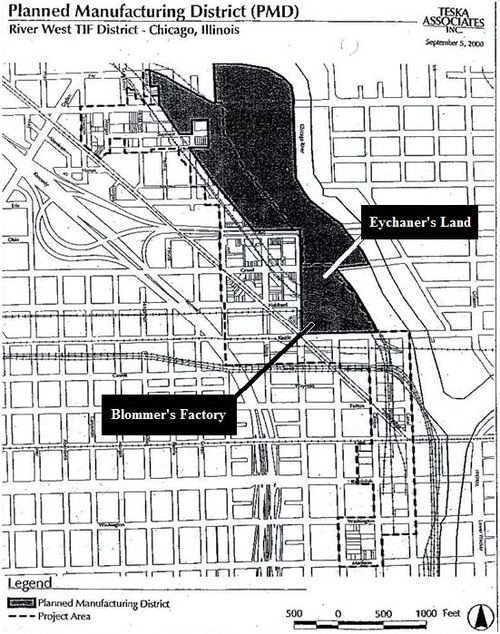
In City of Chicago v. Eychaner, No. 05L050792 (Jan. 21, 2015), the Illinois Appellate Court upheld the taking of private vacant land near the Chicago Loop (Eychaner’s Land on the map below) so that it could be transferred to the owners of a nearby chocolate factory (Blommer’s Factory).

The court viewed this “A-to-B” taking as merely a part of an area redevelopment and tax increment finance plan, which would keep the chocolate factory from moving out as the area gentrified.


1131833

The opinion contains a long recitation of the reasons for the taking, how the Planned Manufacturing District (PMD) was designed to “protect[] the 2,800 industrial jobs located in the area, [to] prevent[] residential encroachment on the existing manufacturing facilities, and

Continue Reading The Chicago Way: City Taking Non-Blighted Property For Economic Development Was Not Pretextual Because … Studies