2015

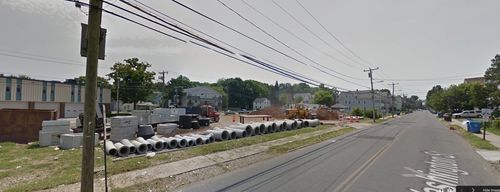
The Township of Ocean, New Jersey downzoned the plaintiffs’ residentially-and-commercially-zoned land to “Environmental Conservation.” The EC district allows “only very low density residential development or other low intensity uses,” with a minimum lot size of 20 acres. 

The plaintiffs, who own 34 acres subject the EC zoning, challenged the zoning ordinance, asserting it was “arbitrary, unreasonable, capricious and illegal,” and that it resulted in an inverse condemnation because it prohibited all uses.

In Griepenburg v. Township of Ocean, No. A-55-13 (Jan. 22, 2015), the New Jersey Supreme Court seemed to agree that there is little chance the property owners can make any use of their land: “[a]lthough plaintiffs’ single-family residence conforms to the ED district’s density requirement of one unit per twenty acres, no further development of their property within the EC district is permitted under the new zoning.” Slip op. at 13. 

The Supreme Court, however, held that the
Continue Reading NJ: Environmental Preservation Zoning Might Prohibit Development, But Owner Must First Try To Develop

Last we checked in with the Bridge Aina Lea case, the Ninth Circuit said it would hold off on a decision until the Hawaii Supreme Court ruled in the associated state court litigation (see 9th Cir Says “Let’s Wait” On Hawaii Supreme Court To Rule In Bridge Aina Lea).

This is the federal court side of a case in which a developer is suing the State Land Use Commission (and certain Commissioners in their individual capacities) after the LUC reclassified its land on the Big Island from urban to agricultural use. Aina Lea filed two actions in state court: an administrative appeal under the administrative procedures act, and an original jurisdiction civil rights complaint. The defendants removed the latter action to federal court. The District Court, however, abstained. After oral arguments in the Ninth Circuit, the panel withdrew the case from submission to allow the Hawaii Supreme Court

Continue Reading 9th Cir: No Need For Pullman Abstention In Aina Lea After Hawaii Supreme Court Ruling

AFTER

Here at invesecondemnation.com, we do our best to bring you timely decisons on cases of interest from around the nation and the world. But today we’ve outdone ourselves, because we have an opinion from the Connecticut Court of Appeals, issued … next week: Dep’t of Transportation v. Cheriha, LLC, No. 155AP144 (Jan. 27, 2015).

The case involved the condemnation of a parcel in New Britain at the intersection of Beaver and Washington Streets shown above in the “after” condition. The trial court did not allow the property owner to introduce the testimony of one Dr. Sheik Ahmed, who was prepared to testify that 17 months before the taking he had submitted a letter of intent to buy the parcel for a price even in excess of the property owner’s appraiser’s trial valuation. The court of appeals held that it was proper to exclude Dr. Ahmed’s testimony

Continue Reading Back To The Future With The Connecticut Court Of Appeals: Prospective Purchaser Cannot Testify As Expert About Valuation

Here’s the latest in a case we’ve been following, the property owner’s cert petition, filed last week, in which a U.S. District Court invalidated a Florida county’s “Right of Way Preservation Ordinance” which allows it to land bank for a future road corridors by means of an exaction. The court concluded the ordinance is “both coercive and confiscatory in nature and constitutionally offensive in both content and operation,” and struck it down under Nollan/Dolan

The transportation corridor protrudes into Hillcrest’s undeveloped commercially-zoned property. Hillcrest wanted to build a shopping center and it submitted a plan to the Review Committee, which rejected the application because it did not account for the corridor. Hillcrest submitted a second plan which was rejected, and a third plan which was eventually approved, which required Hillcrest to dedicate the right of way to the county. Hillcrest reserved its right to object

Continue Reading New Cert Petition: Must A Plaintiff Challenging An Ordinance For Facial Invalidity File Suit Before Her As-Applied Claim Has Ripened?

20150117_084032

This could be your view, winging your way to San Francisco in a couple of weeks, to join us for the 2015 ALI-CLE Eminent Domain and Land Valuation Litigation Conference (and the concurrent Condemnation 101 program), at the Hotel Nikko, February 5-7, 2015. 

There’s still a few spaces left, and time to register. We’re the co-Planning Chair of the Eminent Domain and Land Valuation Litigation program along with Joe Waldo, and we’ve assembled an exciting agenda, presented by a faculty comprised of the nation’s best-of-the-best in our field of law.

Winter in San Francisco is the one time of the year when you are likely to not be fogged in, and in addition to the 2 and a half days of programming, there are networking and social events so you can get to know your colleagues and the faculty better.

Please come and join us, if you

Continue Reading Still Time To Join Us For The 2015 ALI-CLE Eminent Domain Programs In San Francisco

It’s always a safe bet to predict that the Supreme Court will deny review in a case, and if that’s what you had guessed for Kurtz v. Verizon New York, Inc., No. 14-439 (cert. petition filed Oct. 14, 2014), today’s order list would prove you right. 

That’s the case in which the Second Circuit threw out a complaint on Williamson County ripeness grounds, which, were the claim a takings claim, isn’t all that certworthy. The odd thing was, the court concluded that a procedural due process claim was not ripe under Williamson County‘s exhaustion of state remedies prong. Say what?

We submitted an amicus brief in the case, because the Second Circuit’s ripeness mission creep wasn’t warranted: Williamson County‘s rationale, is built on a takings-specific rationale and has no application to a due process claim, and our brief called for the Court to both reverse the Second Circuit

Continue Reading Cert Denied In Kurtz: Williamson County Lives! (For Now)

Perhaps lost in all of today’s excitement surrounding the Supreme Court agreeing to review the same-sex marriage cases, is today’s cert grant in Horne v. USDA, No. 14-275, the California raisin case. That’s the case in which on remand from SCOTUS, the Ninth Circuit held that “the world’s most outdated law” was not a taking

So fire up your raisin puns, and get ready for another takings decision from the Supreme Court. 

Continue Reading California Raisins Redux: SCOTUS Grants Cert In Horne II

The people of Margate City, New Jersey, voted to say “no thank you” to building dunes on the beach to limit damage in the event of another hurricane like Sandy were to hit.

But the State of New Jersey decided to do it anyway, and issued an administrative order “taking” an easement. Problem is, the State didn’t bother to actually go through the trouble of condemning the easement. Instead, “Bob Martin, Commissioner of the New Jersey Department of Environmental Protection,” declared:

1. The New Jersey Department of Environmental Protection Office of Floor [we assume that was meant to be “Flood”] Hazard Risk Reduction Measures hereby immediately enters upon and takes real property interest(s).

Just like that.

The City didn’t appreciate having its beach summarily taken, and filed a complaint in federal court against the Corps of Engineers and the state, and even got a TRO temporarily halting

Continue Reading Summary Takings, Eminent Domain, And Due Process At The Jersey Shore

It’s been accepted for such a long time that it’s become one of those things that “everyone knows we’ve always done it that way,” but most probably don’t quite know why that is so: if you have to sue the United States for a regulatory taking or inverse condemnation, you go to the Court of Federal Claims.

In the CFC, just compensation determined isn’t determined by a jury, nor is your case presided over by an Article III judge. In other words, your case is wholly decided by a judge with a 10-year appointment who technically is an employee of the Executive branch, instead of your peers and a guy or gal with life tenure, who is independent and in the Judicial branch. 

Comes now a complaint, filed in the United States District Court for the Western District of Michigan earlier this week, that one would normally expect

Continue Reading Right To Compensation Self-Executing: Property Owners Entitled To Jury & Article III Judge In Federal Inverse Cases

20150115_091355-1
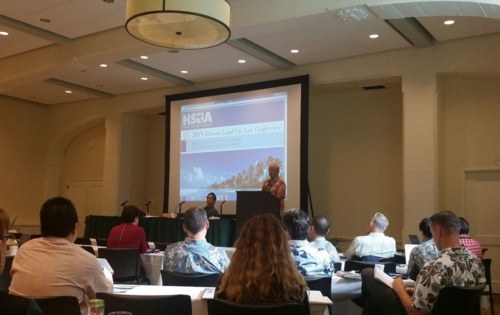
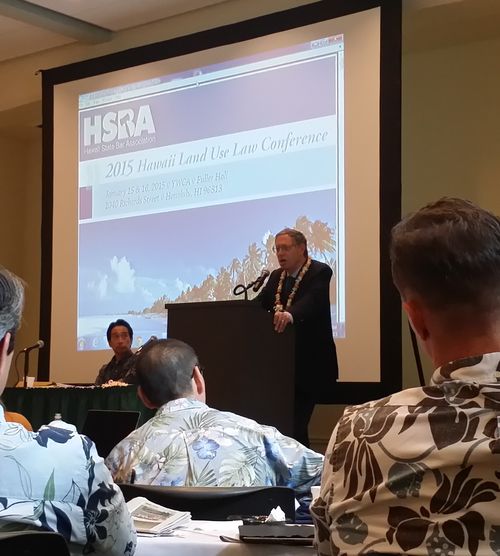
Ben Kudo and David Callies, leading off

Professor Richard Epstein began the Hawaii Land Use Law Conference with the keynote presentation on “Stealth Takings: Exactions, Impact Fees, and More,” which was his usual comprehensive and non-stop takedown of takings law. 

20150115_100935

Our panel on Impact Fees and Exactions After Koontz followed, and here are the promised links and other materials which I mentioned:

Later today, I will also post up a recording of my short backgrounder on the exaction issue, to give you a flavor of the panel discussion (the Hawaii State Bar Assocation

Continue Reading 2015 Hawaii Land Use Law Conference