


May 2016

Cinematic Rude Awakenings from Roman Holiday on Vimeo.

If there’s one thing that makes lawyers sit bolt upright in a sweat at 3 am, it’s the prospect of missing a jurisdictional deadline. A statute of limitations, a notice of appeal. Come on, you know you’ve been there. Keep your carrier’s number on speed dial. 

Well here’s one that might help you sleep better by making the rules for when and how to file more clear, at least in voter registration challenges.

On May 11, 2016, the Hawaii Supreme Court accepted certiorari and agreed to review the Intermediate Court of Appeals’ unpublished memorandum opinion which upheld the dismissal by the Big Island’s Board of Registration of a voter registration challenge. The ICA held that the appeal to the BoR was not timely filed even though the challenger mailed the appeal to the state’s Office of Elections (located on Oahu) within

Continue Reading HAWSCT To Decide On Timing Of Voter Registration Appeals: When Is An Appeal “Filed?”

PICT0632

2013. August 28. 2:00 p.m. I was working the day watch patrol on the Belt Highway. I observed a green flatbed pickup truck driving towards Hilo with a load of open containers loaded with a green leafy substance. I suspected this could either be cabbage or lettuce. I pursued to investigate. Approximately a half a mile to a mile up the road, I began observing cabbage or lettuce on and to the side of the road. I had passed this location approximately 45 minutes earlier, and there was no such cabbage. I observed no other vehicle with cabbage. I then engaged my siren and lights and commenced a pursuit of the suspect green flatbed pickup truck which I had earlier observed. I apprehended the suspect and issued a citation for violation of Hawaii Revised Statutes § 291-C-131, which prohibits the transportation of a load without preventing any of it —

Continue Reading HAWSCT: Removal Of Cabbage Trimmings From Highway Would Have Been Unreasonable

Someone up in Asheville must’ve really ticked off someone else down at the North Carolina legislature. Because for some reason, the state adopted a statute which, just like that, transferred the city-owned water system to a newly-created county sewer and water district. The statute didn’t change the water system’s operation — and this was key in the resultant lawsuit in which the city sued the state — only the ownership.

The law on its face is one of general application, and doesn’t name Asheville’s system specifically. But the statute covered only systems that met certain standards (population, for example), and which were located in a county that already has a public sewer system. And guess which was the only city in all of North Carolina which qualified? You guessed it, Asheville.  

The city wasn’t too happy about that and called bunk (perhaps appropriate, given that the new entity to which

Continue Reading NC Supreme Court Arguments: Can A State Take A City’s Water System?

The Honolulu Star-Advertiser today ran a story by Timothy Hurley about a new bill adopted by the Hawaii legislature which puts certain cases on the appellate fast-track, “New law could speed process for Thirty Meter Telescope.”

The bill mandates that in certain cases, any administrative appeals skip the usual first two steps (circuit court, Intermediate Court of Appeals), and go straight from the agency to the Hawaii Supreme Court. 

We were interviewed for the story, and although the impact on the rebooted contested case about the Thirty Meter Telescope is pretty obvious, we’re of the opinion that this measure wasn’t designed to address only that case: 

Robert H. Thomas, a veteran Honolulu land use and appellate lawyer, said he sees the new law shaving off a year or more of legal sparring on the way to the state’s highest court.

“Our state gets rapped frequently for our levels of

Continue Reading New Appellate Law May Shortcut “Death By A Thousand Days”

A good story for your weekend reading from the Los Angeles Times, “U2’s The Edge and his decade-long fight to build on a pristine Malibu hillside,” about the rock guitarist’s decade-long effort to build his dream home compound in the exclusive coastal town. Running smack dab in to the California Coastal Commission, this was a clash between a guy who is touted as being “an activist, an artist, that made his money from spreading peace and love in the world,” and people whom you might expect would support a guy like The Edge. 

Yeah, but it’s still filthy lucre, and even Mr. Edge’s donation of a public-access hiking easement and $1 million to maintain it were not enough. 8-4, project denied. 

Not until the Coastal Commission’s Director-For-Life died, and The Edge replaced his project manager with “an artist and sometime model, who had interrupted his architecture career

Continue Reading California Coastal Development In A Nutshell: Hire Jesus – Moses, Actually – To Sell Your Luxe Home Plans, And Become One With The Mountain.

We thought there was a chance in a case out of San Jose, California, that the U.S. Supreme Court might take up the long-standing issue of whether legislatively-imposed exactions meet the nexus and proportionality unconstitutional conditions tests from Nollan, Dolan, and Koontz. Do those tests require an individualized determination, or is it enough that the conditions are imposed on everyone? 

But the Court declined to review that case. There was a question in whether San Jose’s affordable housing requirements were “exactions,” because the California Supreme Court disposed of the case by concluding that the regulations were mere run-of-the-mill zoning ordinances, and thus not subject at all to N-D-K. Thus, the heightened scrutiny required by N-D-K didn’t apply.  

This cert petition, recently filed, however, presents the legislatively-imposed question very clearly. In Common Sense Alliance v. Growth Management Hearings Bd., No. 72235-2-1 (Wash.

Continue Reading New Cert Petition: Are Legislative Exactions Immune From Nexus And Proportionality Requirements?

Untitled Extract Pages

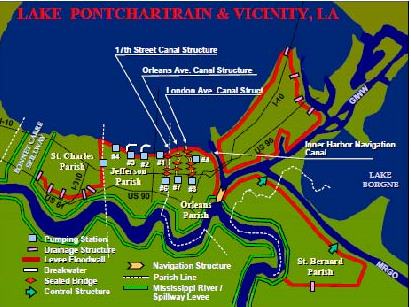
About this time last year, the Court of Federal Claims held that the federal government was liable for a temporary taking to certain property owners for the flooding caused by Hurricane Katrina and the Corps of Engineers’ failure to maintain the “MR-GO” (Mississippi River-Gulf Outlet) canal system. See also a guest post by our colleague Ed Thomas, “Katrina Flood Decision Emphasizes Science.” 

The CFC has now followed up on that ruling with an order (St. Bernard Parish Gov’t v. United States, No. 05-1119L (May 4, 2016)) determining just compensation, thus teeing the case up for the federal government’s appeal to the Federal Circuit.

The opinion is a long one (44 single-spaced pages, including footnotes) and has a lot of detail and technical stuff for you smart readers, but it also has pictures and charts for the rest of us.  

The opinion also contains

Continue Reading CFC Awards Just Comp In Katrina Flooding Case And Tees Up The Appeal

In this order, the Hawaii Supreme Court agreed to review (“accepted certiorari” in the local appellate lingo) the Intermediate Court of Appeals’ opinion in Green Party of Hawaii v. Nago, No. CAAP-14-0001313 (Dec. 18, 2015). That decision answered in part the often elusive question of “what is an agency ‘rule’ that triggers the rulemaking requirements?” 

There, the ICA held that certain practices by the State Office of Elections were not “rules,” and thus need not have been adopted via the rulemaking procedures in the Hawaii Administrative Procedures Act.

For more, see our post on that decision, “‘Mistakes Were Made’ – Elections Office Practices Were Not ‘Rules.’” 

The Supreme Court will be hearing oral arguments later this month (Wednesday, May 18, 2016, at 8:45 a.m.). Here is a summary of the issues from the Judiciary’s web site:

This case involves an action by the Green Party

Continue Reading Hawaii Supreme Court Election/Admin Law Case To Watch

Update: Here’s the syllabus and reading list.

Most of us who practice condemnation law probably didn’t start off in law school thinking “gee, I’d sure like to be an eminent domain lawyer.”

Even if we did, the law school curriculum wasn’t set up to accommodate any such wishes, and the topic of eminent domain was maybe a single day in the first year Real Property course, if it was covered at all. 

And the place of property rights in the larger scheme of things? Again, not much in the law school agenda there, unless it was to downplay the role. At least in our experience.

So check this out. Two law schools are, or will be, teaching classes on eminent domain and property rights, according to this media release (“Law Schools at UT-Austin and University of Houston Offer First Courses on Eminent Domain Law“):

HOUSTON and AUSTIN

Continue Reading Law School Courses On Eminent Domain And Property Rights

In Ransom v. Village of Cross Plains, No. 2015AP1556 (Apr. 28, 2016), the Village took a part of Ransom’s property, 703 square feet to be precise. The parties actually agreed on the amount of just compensation for the 703 square feet. But Ransom asserted that the Village also took a temporary easement after the case was initiated, and that he should be compensated for that as part of the eminent domain case.

The Village acknowledged that it might owe him compensation for taking the temporary easement, but argued that it shouldn’t be part of the eminent domain case. Ransom’s remedy, it argued, was to sue the Village for inverse condemnation.

The Wisconsin Court of Appeals agreed with the Village. The court rejected Ransom’s arguments that it was unfair and made little sense to force him to bring a separate inverse claim, when the Village knew at the outset that

Continue Reading So Sue Me: Remedy For Condemnor Taking More Than It Is Condemning Is Inverse Condemnation