


August 2016

Forgive me for the length of this post, but I’m writing while the thoughts are fresh, and before I get back to the real world. Those of you who may have emailed me in the past week, or who saw this post know that I’ve been occupied with the American Bar Association Annual Meeting in San Francisco. Meetings, CLE’s, and more meetings. Some of it very useful, some merely necessary.  

As usual, I spent most of my time with my main group, the Section of State and Local Government Law, where, unless my colleagues change their minds soon (there’s still time, guys), I will become the Chair of the Section at about this time next year.

This is the ABA we’re talking about — an organization with a mixed reputation among members of our profession — and some of you have asked me why it is I am
Continue Reading ABA State And Local Government Law Section: The Hows, Whens, And Most Importantly, Whys

A short one from the Georgia Court of Appeals.

In Summerour v. City of Marietta, No. A16A0640 (July 8, 2016), the city condemned a grocery store for a recreation center. After multiple attempts to contact the property owner and multiple offers of compensation, the city and the owner finally began the negotiation process, during which Summerour asked the city to produce a summary of its appraiser’s report as required by Georgia statute. The city eventually provided the summary, and its full report. They still could not agree, and the city instituted condemnation.   

The court of appeals’ opinion starts on a good note, reiterating that “private property rights are among ‘the most basic of human rights.'” Slip op. at 7 (quoting William K. Lane III, “Your Raisins or Your Life”: The Harrowing of the Takings Clause in Horne v. U.S. Department of Agriculture, 750 F.3d 1128 (9th Cir.

Continue Reading Ga App: Requirement To Provide Appraisal Summary “Before” Negotiations Means Just That

One for you land users. We’re not going to analyze the Hawaii Intermediate Court of Appeals’ published opinion in Robert D. Ferris Trust v. Planning Comm’n of the County of Kauai, No. CAAP-15-0000581 (Aug. 9, 2016) in too much detail, because our Damon Key colleagues Greg Kugle and Chris Leong represent the prevailing appellant. But here’s a short summary, after which you can read the opinion itself.

The narrow issue in the case involves the definition of the term “applicant” in two different sections in the County’s zoning ordinance. The underlying issue is one that’s hot right now across Hawaii and elsewhere: short-term or transient vacation rentals, defined in the Kauai zoning ordinance as rental for less than 6 months.  

Here, the homeowner had a parcel in an agricultural district, with a single-family residence on the lot. It began renting the home to vacationers in 2003, prior to

Continue Reading HAWICA Rejects Planning Department’s Formalistic Definition Of “Applicant” In Vacation Rental Case

To state a claim for inverse condemnation in Nevada, the property owner must allege that the government was “substantially involved” in activities that caused the taking of the property.

In Fritz v. Washoe County, No. 67660 (Aug. 4, 2016), the Nevada Supreme Court addressed what constitutes substantial involvement. Does it require actual physical “involvement” in the actions which resulted in flooding, or is the government doing governmental things like approving applications enough? In the end, the court set out a test somewhere in between those two poles. 

This is a flood case where the property owners alleged that the County approved plat maps and managed the drainage system which ultimately resulted in their property being inundated. As part of that process, the County accepted dedications, and worked with the Nevada DOT to direct where water coming down a mountain would flow. The County asserted the owners didn’t have standing

Continue Reading Nevada Clarifies Inverse Condemnation And What Is “Substantial Government Involvement”

IMG_20160804_161355 (1)

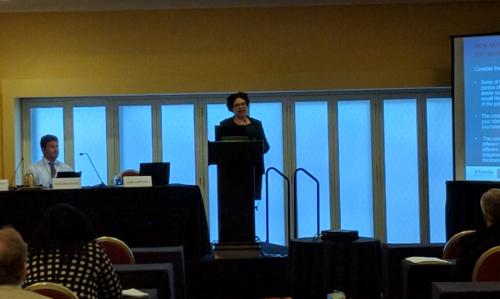
We’re experiencing the madness that is the ABA Annual Meeting — this time in San Francisco — hanging with colleagues from the State and Local Government Law Section (where we’re slated to be the Chair-Elect this year), and at the Council of Appellate Lawyers. These meetings are a lot of … meetings .. but there’s also a healthy dose of CLE programming, some of it focused on things like eminent domain and land use, and other topics near and dear. 

Pictured above is our friend and colleague from the Northwest, Jamila Johnson, who gave a spirited defense of the Fifth Amendment and property rights in her session on energy corridors. We were discussing the pros and cons of “quick take” statutes, and to counter the assertion that these things allow for efficient, convenient, and cost-effective government projects, Jamila responded (and we’re recalling this from memory here), “the government has

Continue Reading Eminent Domain Programming At The ABA Annual Meeting

The issue resolved by the Minnesota Supreme Court in Zweber v. Credit River Township, No. A14-0893 (July 27, 2016) was one that land use lawyers deal with constantly: when an administrative agency is alleged to have violated someone’s constitutional rights, what procedural route must the legal challenge take — is the plaintiff required to go to court via administrative channels, or can she initiate an original jurisdiction (“de novo”) case?

In Zweber, the court came down on the side of original jurisdiction. There, Zweber owned undeveloped land which he wanted to develop, and he submitted a preliminary subdivision plat to divide it up. After a neighbor objected for the usual reasons (traffic), the County approved the plat application. But Zweber didn’t begin development and instead, a couple of years later applied for a new subdivision. “This time, based on the recommendation of the Planning Commission, the County Board denied

Continue Reading Constitutional Property Claims Are For Courts, Not Agencies

In City of Missoula v Mountain Water Co., No. DA-15-0365 (Aug. 2, 2016), a sharply divided Montana Supreme Court upheld the City of Missoula’s exercise of eminent domain to take a private water system. We’ve been following the case (see our oral argument notes here). The court’s majority concluded that the takings clause of the Montana Constitution isn’t really any impediment to a government takeover of property, even when it will use the property in exactly the same way as the former owner. 

The court addressed eight issues, with issues 6-8 being the most interesting to us, because they consider the meaning of the phrase “more necessary public use” in Montana Code Annotated § 70-30-111, and and what kind of proof is necessary to support such a claim. The city of Missoula is condemning Mountain Water Company, a private company which supplies municipal water to the city. The company (and its

Continue Reading City Can Take Over Water Company: Montana Supreme Court Writes Out “More” From The “More Necessary” Statute