October 2016

Are you like us and cannot type, write, or say “statue” without it coming out “statute?” That’s an affliction we’ve had since law school days, and one we’re probably never going to shake.  

As lawyers, we’ve all no doubt seen plenty of crappy statutes in our careers.

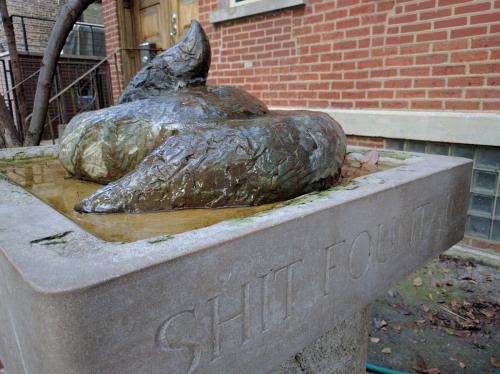
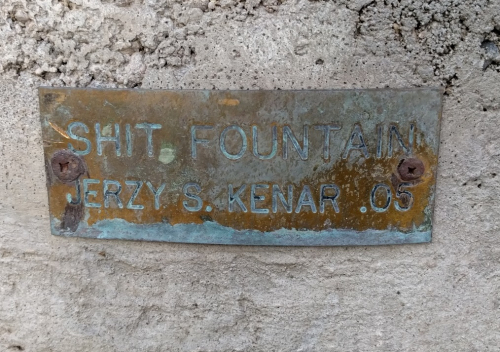
But, at the risk of being offensive, here’s an actual s**t statue, located in the City of Chicago. Created by an artist tired of dog owners allowing their Fidos to do their business on the artist’s front steps, he protested in the only way he knew how: by reproducing the offending items in bronze, larger than life, with water flowing out of the top.

Crass but apparently effective: evidence of actual dog doo was nowhere to be found during our recent visit.  
IMG_20160924_173444
The artist.

IMG_20160924_173527
Another angle on his work. 

Continue Reading NSFW (Maybe): A Chicago Statue

Photo

Tomorrow, Thursday, October 6, 2016, at 10:00 a.m. at Aliiolani Hale, the Hawaii Supreme Court will hear oral arguments in a case we’ve been following (we filed an amicus brief in the case, supporting the property owner on the first Question Presented), County of Kauai v. Hanalei River Holdings, Ltd., No. SCWC-14-0000828. 

The case is a taking by the County of several parcels on the north short of Kauai, but the main issue in the case — do parcels need to physically touch in order for the jury to consider them part of a larger economic parcel — goes well beyond this one case. The Honolulu rail project, probably the biggest eminent domain project in Hawaii’s history, is underway, and the larger parcel issue could arise is more than a few cases there. What we thought was settled doctrine in Hawaii law was thrown into question by the

Continue Reading Oct 6, 2016: HAWSCT Oral Argument In Eminent Domain Case: Do Parcels Need To Touch To Be Part Of A “Larger Parcel”

Here’s the latest in a case we’ve been following, and which earlier resulted in a very good decision from the North Carolina Supreme Court. 

In Kirby v. North Carolina Dep’t of Transportation, No 56PA14-2 (June 10, 2016), the N.C. Supreme Court held that the “Map Act,” a statute by which the DOT designated vast swaths of property for future highway acquisition, was a taking because the act prohibited development of designated properties in the interim. The court concluded that “[t]hese restraints, coupled with their indefinite nature, constitute a taking of plaintiffs’ elemental property rights by eminent domain.” The court remanded the case for a parcel-by-parcel determination of just compensation.

Here’s the trial court’s Order on remand, granting in part the plaintiffs’ motion for partial judgment on the pleadings on inverse condemnation liability, and ordering the NCDOT to “file plats, make deposits with the required statutory interest, and, if any plaintiff

Continue Reading NC Map Act: DOT Ordered To Pay For Designating Property For Future Highway Use (But Then Not Taking It)

ALI2017 - Copy
ALI2017

We’ve teased some of the details on the 2017 ALI-CLE Eminent Domain and Land Valuation Litigation and Condemnation 101 Conference, to be held at the Westin San Diego, January 26-28, 2017, but here are the details you’ve been waiting for.

This is the “big one,” our annual 3-day festival of all things eminent domain, property, takings, inverse condemnation, and just compensation. Truly national in scope, this is the 34th annual edition, and the one conference you must attend. Our 2016 conference in Austin was one of the best in years, and we’re on the way to replicating it in 2017, with a great venue in an exciting city. 

Look for the web and printed brochures to show up in your mailboxes, but in the meantime, here are some of the highlights (we’ll post more in the next few days):

  • Relocation, relocation, relocation: we are featuring two sessions on this


Continue Reading Details: ALI-CLE Eminent Domain And Land Valuation Conference – San Diego, January 26-28, 2017

There’s a lot of pages in the Pennsylvania Supreme Court’s opinion (and two concurring opinions) in Robinson Township v. Commonwealth of Pennsylvania, No. J-34A-2016 (Sep. 28, 2016), and the good stuff from the headline starts on page 78. But to understand the case, you need a bit of background.

Pennsylvania has been one of the hotbeds of property owner objections to natural gas (including the related fracking extraction method) and other pipeline projects, and this case was a lawsuit by several townships and municipal officials challenging a state statute which made fracking and eminent domain easier for the gas companies. The townships asserted this went beyond what the state legislature had the power to allow, because it was “special legislation” designed to help a particular industry, and not applicable to all, and allowed an unconstitutional taking of private property for private use. The court held the statute was special

Continue Reading Pennsylvania Supreme Court: Delegation Of Eminent Domain Power To Pipeline Companies Violates Fifth Amendment’s Public Use Clause