2016

The only issue in Caffe Ribs, Inc. v. Texas, No. 14-0193 (Apr. 1, 2016) was whether the jury could hear evidence proffered by the property owner that the delay in cleaning up the land to make it marketable could have been attributable to the government. The trial court said no, and the court of appeals affirmed.

The Texas Supreme Court disagreed: “We hold that the trial court’s exclusion was an abuse of discretion, and further hold that the exclusion was harmful because it allowed the government to use an eight-year holding period to reduce the property’s value without allowing the jury to consider the role the government played in creating that holding period.” slip op. at 2.

The court’s opinion is a quick read and we recommend you digest the entire thing. But here’s the short version. Caffe purchased the property, which was already contaminated, and began its voluntary remediation efforts
Continue Reading Government’s Role In Delay In Cleanup Of Contaminated Property Admissible In Eminent Domain Case

Earlier this week, we posted our visit to the site of the U.S. Supreme Court’s decision in Hadacheck v. Sebastian, 239 U.S. 394 (1915). It’s been over 100 years since that case was decided by the Court, but to Hinga Mbogo, the Dallas auto mechanic profiled in the above video from the Institute for Justice, 2016 sure must seem like 1915.

The more things change…

Continue Reading Hadacheck Revisited: The More Things Stay The Same Dep’t…

In most cases — as you can probably tell — we’re rooting for the property owner. But there are some cases where we’re okay with suspending our usual predilections. The case which resulted in the Oklahoma Supreme Court’s opinion in Dani v. Miller, No. 114482 (Mar. 29, 2016) is one of those. 

It’s a long opinion (39 pages), way longer than the issues deserved. But for some reason, the court addressed each of the plaintiff’s challenges to Oklahoma’s unclaimed property statute. All over a grand total of $169.56. Actually, it wasn’t even over this amount, because the plaintiff was able to claim it from the state:

Plaintiff/Appellant Robert N. Dani (Appellant) is an Oklahoma resident and taxpayer. Certain property belonging to Appellant was handed over to the State Treasurer pursuant to the Uniform Unclaimed Property Act (UUPA), 60 O.S. §§ 651-688, because it was presumed abandoned. The property consisted of $19.56, received

Continue Reading State’s Failure To Pay Interest On $169.56 Of Abandoned Property Isn’t A Taking

Here’s a new cert petition, seeking SCOTUS review of an unpublished opinion from the Eleventh Circuit. That court concluded that Dibbs’ equal protection challenge to the Hillsborough County’s Community Plan failed because he could not identify others who were similarly situated but treated differently.

Dibbs asserted. among other claims, that the County treated him differently from others when it rejected his development proposals as inconsistent with the Community Plan for three parcels he owned. Motivated by malice, he asserted, the County singled him out for ill treatment because of “vindictiveness, maliciousness, animosity, spite or other reasons unrelated to a legitimate government interest.”

Dibbs isn’t part of a protected class, so this is an Olech class-of-one claim in which he must show that he was treated differently from others similarly situated, and that the County “applied a facially neutral ordinance for the purpose of discriminating.” The district court and the

Continue Reading New Cert Petition: Circuit Split On “Class Of One” Equal Protection Claims – “Similar” Or “Identical?”

As part of a railroad realignment project, Salt Lake City needed B’s land. But B wouldn’t sell, and since B’s land was already committed to public use as a power substation, the city had doubts whether it could condemn it. So the city and B agreed that B would voluntarily give the city the land, as long as it could move the power substation elsewhere.

The city identified nine potential sites for the relocated power plant. At least one of these sites was privately owned by “A.” Let’s call “A” Evans. That’s the parcel the city settled on, and it instituted condemnation proceedings to take it by eminent domain. Evans objected, but the trial court agreed with the city, and allowed the taking. In Salt Lake City Corp. v. Evans Dev. Group, LLC, No. 20130741 (Mar. 24, 2016), the Utah Supreme Court reversed.

Even though both railroads and power plants

Continue Reading Utah: City Can’t Condemn Property From A To Exchange With B, Even Where B’s Use Would Be Public

Rhode Island has a provision in its constitution which allows condemning agencies to take more property than they might actually need “for actual construction” when building “public highways, streets, places, [and] parks or parkways.”  See R.I. Const. art. VI, § 19. This provision also requires that in the event the condemnor doesn’t use all of the property it acquired for the project, the remainder may be sold as long as “the person or persons from whom such remainder was taken shall have the first right to purchase or lease” the property. 

That’s what happened in Estate of Deeble v. R.I. Dep’t of Transporation, No. 14-235 (Mar. 24, 2016), where the DOT took property belonging to Mr. and Mrs. Deeble for a highway relocation project. Mrs. Deeble later died, and so did Mr. Deeble.  Mr. Deeble’s estate succeeded to his rights.

The DOT didn’t use all of the

Continue Reading Rhode Island: Right To Buy Back Excess Condemned Property Dies With (Former) Owner

20160325_125208

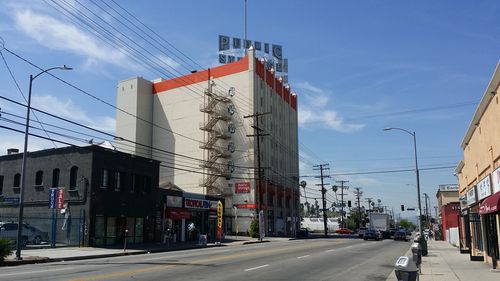
A nondescript corner of what could be just about any urban city street in America. Nothing of overwhelming interest, just the usual commercial buildings, traffic signals, and small businesses. A self-storage facility. Pretty typical in a Commercial district. Here, the “C-4 District.”

Nothing at all, in fact, to indicate that just over a century ago, this was the site of what was to become one of the most important land use cases in U.S. history — the place that gave us the first Supreme Court decision that dealt with how the expanding power to regulate the uses of property meshes with private property rights.

DSCF2746

For this area — the block southeast of the corner of Pico and Crenshaw Boulevards — was once a Los Angeles brickyard owned by Joseph C. Hadacheck.  

What is now the Arlington Heights neighborhood was once outside of the city limits. Indeed, Hadacheck’s title went back

Continue Reading Takings Pilgrimage, LA Edition: Police Power, The Zoning Game, And Nuisances

Today is Good Friday, an official state holiday in Hawaii, so we’re reposting our annual recounting of how it came to be that the State commemorates the date of the crucifixion, and how that squares with the Establishment Clause of the First Amendment

Turns out that we don’t really commemorate today as the crucifixion date, and it is just coincidence that the official State “spring holiday” occurs on the same day.

It’s plausible, isn’t it, that the State had a secular purpose when it officially sanctified “a religious holiday observed primarily by Christians commemorating the crucifixion of Jesus Christ and his death at Calvary?” 

Or so says the Ninth Circuit.

Continue Reading Go Shopping, Hawaii, It’s The Secular Good Friday State Holiday!

Mississippi, like many states, by statute allows private parties to condemn a neighbor’s land for use as a private access road, if doing so is “necessary” for a landlocked parcel to gain ingress and egress. This power is subject to limitations: for example, the parcel must be truly landlocked with no other access. Mississippi apparently has an additional requirement, that the power cannot be exercised within the limits of an incorporated city or town. 

The property at issue in High v. Kuhn, No. 2015-IA-00072-SCT (Miss. Mar. 17, 2016) is within the incorporated City of Gulfport, so the owner objected when his neighbor tried to exercise the power to take his land for access to an otherwise landlocked parcel. The trial court, however, held that the owner had waived the right to assert this objection by not objecting within five days as required by another statute. Besides, the court held, the incorporated

Continue Reading Mississippi: Statute That Says No Private Takings For Access Within City Limits Means Just That