


2016

20160126_164326

Austin, Texas, is where we’re at for the next few days, for the 2016 edition of the American Law Institute-CLE Eminent Domain and Land Valuation conference, now in its 33d year. First time we’re in Austin, however, and our registration numbers are looking very good, and we haven’t had this big a turnout in years.

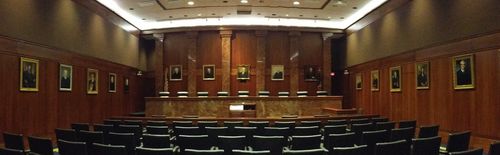
We haven’t been back to Austin in a few years ourselves, so we did what law nerds sometimes do when we go to new towns: visit the local courtroom to check out the scene. So we dropped by the Supreme Court of Texas to take a look. Turns out it was an off-day for the court and it was not in session and the courtroom was locked. But Security suggested that if we asked the Clerk nicely, she might retrieve the key and let us take a look around. And you know what? She did.

Continue Reading ALI-CLE 2016 Eminent Domain Conference: Austin Scouting Report

We know inverse condemnation liability can be triggered by intentional government action. But what about when government doesn’t act?

That was the issue before the Court of Appeals of Maryland in Litz v. Maryland Dep’t of the Environment, No. 23 (Jan. 22, 2016). And when the opinion starts this way, you just know where this is going to end up:

“The nine most terrifying words in the English language are, ‘I’m from the government and I’m here to help.’”

-Ronald Reagan, 40th President of the United States, News Conference (12 August 1986).

Petitioner, Gail B. Litz, might have welcomed hearing those nine words spoken to her, but, according to her Third Amended Complaint, they were not forthcoming.

Slip op. at 1.

The case involved “human sewage” flooding onto Ms. Litz’s once-popular campground from nearby septic fields, which, quite naturally resulted in a dearth of people who wanted to camp

Continue Reading “We’re Here From The Government, And We’re Here To … Do Nothing” – Gov’t Inaction Gives Rise To Inverse Condemnation

The California Supreme Court has agreed to review a recent Court of Appeal decision (see “Court Of Appeal Files Pro-Condemnor Amicus Brief In Cal Supreme Court “Entry Statute” Case“), but only after the court rules on Property Reserve v. Superior Court (S217738)  

On January 13, 2016, the court granted and held the petition in Young’s Market:

The petition for review is granted. Further action in this matter is deferred pending consideration and disposition of related issues in Property Reserve v. Superior Court (S217738) (see Cal. Rules of Court, rule 8.524 (c)), or pending further order of the court. Submission of additional briefing, pursuant to California Rules of Court, rule 8.528, is deferred pending further order of the court. The stay previously issued by the Court of Appeal remains in effect until further order of this court. Votes: Cantil-Sakauye, C.J., Werdegar, Chin, Corrigan, Liu, Cuéllar and Kruger

Continue Reading Cal Supreme Court “Grants And Holds” Second Entry Statute Case

Here’s the amici brief filed last week by the Cato Institute and the National Association of Reversionary Property Owners in Resource Investments, Inc. v. United States, No. 16-802. That’s the case in which the property owner is claiming that the delay in issuing Clean Water Act permits was so extraordinary, it was a temporary taking. Ultimately, the Federal Circuit upheld the dismissal of a takings claim by the Court of Federal Claims for lack of jurisdiction under of 28 U.S.C. § 1500.  

We also filed an amicus brief in the case (posted here). 

Here’s a summary of the Cato/NARPO brief:

In United States v. Tohono O’odham Nation, 131 S. Ct. 1723 (2011), this Court considered 28 U.S.C. 1500, a Civil War-era statute intended to relieve the United States from responding to duplicative litigation in multiple courts. The Tohono majority found that Section 1500

Continue Reading Amicus Brief: Congress Cannot Bar Property Owners From Vindicating Right To Just Compensation

This morning, the U.S. Supreme Court declined to hear what might have been a major property rights case, California Building Industry Ass’n v. City of San Jose, No. 15-330 (cert. petition filed Oct. 16, 2015). 

In that case, the California Supreme Court upheld the city’s “affordable housing” requirement against a challenge which asserted that it was an exaction and thus should have been subject to the heightened scrutiny of the unconstitutional conditions doctrine of Nollan, Dolan, and Koontz. The California court disagreed, holding that because the ordinance did not require a developer to give up land, or money in lieu of land, it was a mere zoning restriction and subject to the “rational basis” test. 

We filed an amici brief in the case in support of the petitioners.

While we believed there was a good change that SCOTUS was going to hear this case (it

Continue Reading SCOTUS Won’t Review Affordable Housing Exactions And “Inclusionary Zoning” Case

This morning, the Supreme Court agreed to hear another important property rights case, California Building Industry Ass’n v. City of San Jose, No. 15-330 (cert. petition filed Oct. 16, 2015). 

In that case, the California Supreme Court upheld the city’s “affordable housing” requirement against a challenge which asserted that it was an exaction and thus should have been subject to the heightened scrutiny of the unconstitutional conditions doctrine of Nollan, Dolan, and Koontz. The California court disagreed, holding that because the ordinance did not require a developer to give up land, or money in lieu of land, it was a mere zoning restriction and subject to the “rational basis” test. 

We filed an amici brief in the case in support of the petitioners.

SCOTUS on a tear lately, as it recently also agreed to review a case on the “relevant parcel” in regulatory takings.

Continue Reading SCOTUS Takes Another “Takings” Case – Inclusionary Housing And Affordable Housing Exactions On The Menu

A longer one from the California Court of Appeal, but unfortunately, we don’t have the time to digest it in detail. But you really should read Pacific Shores Property Onwers Ass’n v. Dep’t of Fish and Wildlife, No. C070301 (Jan. 20, 2016), in which the court upheld a ruling that the Department of Fish and Wildlife inversely condemned the plaintiffs’ property by a physical taking, when it allowed their land to be flooded.

The interesting part of this decision is the Department’s purpose in allowing the flooding, environmental protection. Local government had historically provided some flood protection to these properties by “breaching” a sandbar when the water reached a certain level. When the Department took over that function, it decreased the level of protection, and although it required the water to reach a higher level before breaching, it didn’t eliminate it completely. The Department argued that it could not

Continue Reading Cal App: Intentionally Flooding Land To Protect The Environment Is A Physical Taking

Here’s the amicus brief we filed today in support of the Petitioner/property owner in Resource Investments, Inc. v. United States, No. 16-802. That’s the case in which the property owner is claiming that the delay in issuing Clean Water Act permits was so extraordinary, it was a temporary taking. Ultimately, the Federal Circuit upheld the dismissal of a takings claim by the Court of Federal Claims for lack of jurisdiction under of 28 U.S.C. § 1500.  

That statute, as federal takings mavens know (and as the Supreme Court recently held in United States v. Tohono O’odham Nation, 131 S. Ct. 1723 (2011)), deprives the CFC of subject matter jurisdiction if there’s a claim based on the same operative facts “pending in any other court any suit or process.” In this takings case, the property owner filed its CFC complaint — which alleged that the


Continue Reading Amicus Brief: Applying Civil War-Era Statute To Toss Federal CFC Takings Claims “Gives Credence To The Belief That ‘The Law Is An Ass.’”

Good news, takings fans. The U.S. Supreme Court today granted cert, and will review Murr v. Wisconsin, the case in which the Wisconsin Court of Appeals held that two separate parcels owned by the same family must be treated as a single unit for purposes of determining whether there has been a taking. 

The Court agreed to review this Question Presented:

In a regulatory taking case, does the “parcel as a whole” concept as described in Penn Central Transportation Company v. City of New York, 438 U.S. 104, 130-31 (1978), establish a rule that two legally distinct, but commonly owned contiguous parcels, must be combined for takings analysis purposes?

Cert petition posted here. Other cert briefs here.

More to come, naturally. 


Continue Reading SCOTUS To Take On Regulatory Takings Parcel As A Whole Doctrine

When we first read the caption in Metropolitan St. Louis Sewer Dist. v. City of Bellefontaine Neighbors, No. SC94831 (Jan. 12, 2016), we admit to a bit of confusion because this is an inverse condemnation case, and it appeared that a public entity was suing one of those activist groups, “The Bellefontaine Neighbors.”

A public entity bringing an inverse claim against some citizens? We’re intrigued.

But then we read the caption more carefully and noticed the “City of” part, which caused us to do what we usually do these days when curiosity strikes: we googled it. And we learned something new: there is a City of Bellefontaine Neighbors in Missouri. In addition to having a very friendly name and an imposing motto (“Strong Traditions … Strong Moral Values”), it also has the distinction of having, “[a]t 22 letters, … the longest name of any incorporated place in the United States.”

Continue Reading City With Really Long Name Didn’t Take Private Property When It Damaged Publicly-Owned Pipes