May 2017

Here’s the Reply Brief we’re filing today in Bay Point Properties, Inc. v. Mississippi Transportation Commission, No. 16-1077 (cert. petition filed Mar. 3, 2017), a case which seeks review of a decision by the Mississippi Supreme Court. We represent the petitioner.

The brief responds to the MTC’s Brief in Opposition, and rather than paraphrase our arguments, we’re just going to copy-and-paste them below, after we link to the other briefs in the case:


Continue Reading SCOTUS Cert Reply Brief: Mississippi Can Rewrite Its Easement Laws, But It Can’t Avoid Compensation When It Takes Property

Some of you may have been wondering what happened in the past few days to Gideon’s Trumpet, the blog by Professor Gideon Kanner. We check it daily, so were surprised when we surfed over and instead of the usual commentary on eminent domain and property law, we were redirected to a web hosting service. 

The good news is that the technical difficulties have been resolved, and Professor Kanner is back on line. Back to your usual programming! Continue Reading Gideon’s Trumpet Back On-Line After Technical Difficulties

No, it’s not for that job position, recently vacated.

This is an opening at a slightly lower level, but perhaps of more interest to our readers. The U.S. Department of Justice is seeking a “Trial Attorney (Inverse Condemnation) GS-14/15.” Here’s the job description:

The attorney selected will be expected to represent the United States in Fifth Amendment takings litigation before the Court of Federal Claims and federal district courts throughout the nation. Cases will involve border security, military readiness, transportation infrastructure, and flood control. The attorney must be comfortable in a “first-chair” role in multiple complex cases, and have demonstrated and substantial experience in all aspects of civil litigation, including pre-trial discovery, presentation of oral argument, and examination of fact and expert witnesses.

The cases handled by the Section require attorneys to achieve intellectual command of complicated facts, scientific principles, and legal issues, often rapidly. Successful candidates

Continue Reading Job Opening At The DOJ (No, Not That One)

25103267

Here’s what we’re reading today: 

Continue Reading Area 51 Taking, Dodger Stadium Taking, Attorneys’ Fees

Here’s the latest in the “audacious” takings case brought by AIG against the federal government for the 2008 fed takeover. The heart of the complaint is that the acquisition of AIG was an unconstitutional exaction. The Court of Federal Claims rendered a verdict that was hailed as a groundbreaking victory, but which ultimately denied the only relief which the CFC can enter, a money judgment. An appeal to the Federal Circuit followed, naturally.

In Starr International Co., Inc. v. United States, No. 15-5103 (May 9, 2017) that court threw out the takings claim for lack of standing. The corporation had standing to assert the claim, not individual shareholders.

There’s a lot to digest in the 38 page opinion, and the 32 page concurring opinion, and we will allow you to read them for yourself. The key portion of the majority opinion, in our view, starts on

Continue Reading Fed Cir: Even Uberlawyers’ Plaintiffs Need Standing To Bring A Takings Claim

This case — a related case, actually — has been up to the West Virginia Supreme Court before. SeeWest Virginia: DOT Should Not Have Mined Privately Owned Limestone Without Owner’s Permission.” But even though the underlying facts were the same (the DOT mined limestone from private property without first buying it from the landowner), the issues presented in West Virginia Dep’t of Transportation v. Veach, No. 16-0326 (Apr. 17, 2017) were somewhat different.   

In Veach, after the Supreme Court affirmed the earlier case, DOT’s new counsel sought to repudiate a stipulation which prior counsel entered into with the property owners, by which the parties agreed that the landowner owned the limestone. DOT now argued that West Virginia law was that the state owned these mineral deposits, not private landowners.

The trial court rejected this tactic, and the Supreme Court affirmed. The DOT didn’t show that the stipulation

Continue Reading West Virginia: Condemnor Must Abide By Stipulation, Even If Contrary To Law

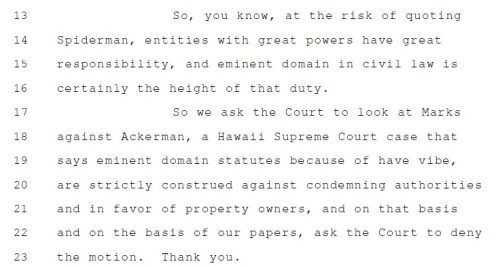
Spiderman

Thank you, Justice Kagan, for giving us a citeable Spider-Man reference (Kimbel v. Marvel Ent. LLC., 135 S. Ct. 2401, 2415 (2015) (“[I]n this world, with great power, there must also come—responsibility”)), and to The Castle, just for being a good, quotable eminent domain movie.Continue Reading When You Quote Both “Spider-Man” And “The Castle” In Your Eminent Domain Hearing

61RcOQLR1DL._SX355_

Here’s one that — although unpublished — is still worth a quick read. Because it’s a case where the Sixth Circuit held that a federal court takings claim against the City of Franklin, Tennessee, which is the seat of Williamson County, Tennessee, should be dismissed under Williamson County because it wasn’t ripe.

In Beech v. City of Franklin, No. 16-6326 (Apr. 19, 2017), Beech sued the City claiming it was a taking for the City to allow Beech’s neighbor to operate a barbershop next door. That’s a tough claim to begin with, but Beech pressed a mandamus claim in Tennessee state court, seeking to enjoin the neighboring barber shop. Included within the petition were claims for damages for violations of Beech’s federal constitutional due process and equal protection rights because (allegedly) the City was not enforcing its zoning code. Beech did not assert a takings claim. The state court

Continue Reading A Williamson County Ripeness Case From Williamson County, Tennessee

Apparently, property owners setting their buildings on fire to collect the insurance is a thing in Pennsylvania, the location of our story. We say this because the Pennsylvania legislature adopted a statute which requires that before an insurance company pays out proceeds from a fire policy to a “named insured,” it check with the local municipality to see if any property taxes are owed on the property. If so, the municipality grabs the payout to satisfy the delinquent taxes.  

You can kind of see where this is going, can’t you? Yes, one entity owned the burned building, while another entity was the named insured.

We usually leave insurance matters to our law partner Tred Eyerly, who blogs about insurance coverage and related matters. Stuff like that is above our pay grade, and we defer to professionals.

But the U.S. Court of Appeals’ opinion in Trustees of Conneaut

Continue Reading 3d Cir: PA Statute Requiring You To Pay Someone Else’s Property Taxes Isn’t A Taking