October 2017

Update: 10/28/2019: Lights Out in the Land of No: The Practical Effects of California’s Wildfire Inverse Condemnation Doctrine,” a post about the (ongoing) wildfires and latest developments in inverse condemnation doctrine.

Update 3/12/2018:California Wildfires, Inverse Condemnation, and Climate Change,” a post about the various responses to the wildfire inverse condemnation lawsuits.

——————————————–

Here’s a story from the San Francisco Chronicle about the legal angles in the recent northern California wildfires, “PG&E could pay dearly for North Bay fires, even if it followed rules. (“The lethal wildfires in the North Bay could exact a heavy cost on Pacific Gas and Electric Co., even if the utility did nothing wrong.”).

The focus of the piece is on inverse condemnation and the potential liability of the power company (PG&E):

If investigators do find that PG&E’s electrical lines started the fires, the company will probably be liable

Continue Reading California Fires And Inverse Condemnation: The “You Broke It, You Bought It” Theory

Here are the final two amici briefs in in Jarreau v. South LaFourche Levee District, No. 17-163 (cert. petition filed July 31, 2017), the case asking the Court to consider whether a property owner whose business is destroyed due to an exercise of eminent domain is entitled to just compensation for business losses under the Fifth Amendment’s Just Compensation Clause.  Our amici brief in the case is available here. (sidebar: it’s pronounced “lafoosh”).


Continue Reading Amici Briefs In SCOTUS Just Comp Case: Does Fifth Amendment Allow Categorical No-Comp Rule For “Business Losses?”

Okay, we get it: the text of a statute is the text, and it says what it says. And Virginia’s “buyback” statute — which says that if a condemning agency hasn’t started the project for which property was condemned within 20 years, the agency must reconvey it to the owner upon demand — dictates that the owner must buy it back at the “original purchase price.” 

And the Virginia Supreme Court in Kalergis v. Commissioner of Highways, No. 161347 (Oct. 26, 2017) concluded that “original purchase price” means exactly that — the price for the property which the condemning agency paid back in the day, regardless of whether or how the agency altered the property in the intervening 20 years. And there’s something about that conclusion that doesn’t quite sit right. 

There, VDOT acquired the property from Mr. and Mrs. Kalergis in 1994, taking about 1/2 of their 26-acre

Continue Reading “Buyback” Statute Requires Owner Pay Premium After Condemnor Devalues Property

Here’s the Reply Brief and Brief in Opposition in Jarreau v. South LaFourche Levee District, No. 17-163 (cert. petition filed July 31, 2017), the case asking the Court to consider whether a property owner whose business is destroyed due to an exercise of eminent domain is entitled to just compensation for business losses.

The issue goes back at least to Kimball Laundry Co. v. United States, 338 U.S. 1 (1949), where the Court held that “an exercise of the power of eminent domain which has the inevitable effect of depriving the owner of the going-concern value of his business is a compensable ‘taking’ of property.” But the Louisiana Supreme Court held no, the condemnor only had to pay for the land. The dissenting Justice there noted:

Defendant is in the dirt business and owns land from which he digs and sells dirt. The government is entitled to “appropriate&rdquo

Continue Reading Reply Brief And BIO In SCOTUS Just Comp Case: “Real And Serious” Split On Whether Condemnor Can Just Pay For Land, But Not Businesses, Destroyed By Eminent Domain

-fronts-N-6450-00-000012-WZ-PYR

We usually don’t post trial court decisions, preferring instead to wait until the issue works its way up the food chain. But we make exceptions to that general rule when a case catches our eye and is either unusual or otherwise interesting. The U.S. District Court’s opinion in Williams v. The National Gallery of Art, London, No. 16-CV-6978 (Sep. 21, 2017) is one of those cases.

It’s the facts of the case which compel us to post it, since it involves a somewhat famous painting (Portrait of Greta Moll, above), by the famous painter Henri Matisse. Commissioned and purchased by two of Matisse’s art students, the painting was privately owned until just after World War II, when Greta entrusted it to another former student to take the painting to Switzerland to protect it from looting. Well the former student didn’t take it to Switzerland, but sold it

Continue Reading A Different “Takings Clause” – Art Museum Immune Under FSIA’s Expropriation Exception To A Claim That Matisse Painting Wrongly “Taken”

Here’s one we’ve been meaning to post for a while because it is on one our favorite (sub)topics: attorneys’ fees in eminent domain. Indeed, it is about what we consider a very interesting subtopic of the subtopic, the question of whether an owner can recover attorneys’ fees for the efforts expended in recovering attorneys’ fees, the aptly-named “fees on fees” question. We did a case like this a few years ago in the Hawaii Supreme Court, and have been hooked ever since. 

The opinion, Tri-County Metro. Trans. Dist. of Oregon v. Aizawa, No. S064112 (Oct. 5, 2017), is from the Oregon Supreme Court, and overall, may not be that relevant to your specific jurisdiction because it focuses on the court’s interpretation of the Oregon fee-shifting statute and a rule of civil procedure. Thus, your mileage may vary back home. But we encourage you to review it anyway (even in

Continue Reading Oregon: Legislature Didn’t Preclude Condemnee From Recovering “Fees On Fees”

We were all set to dive into the California Court of Appeal’s opinion (rendered in September, but only published yesterday) in Dryden Oaks, LLC v. San Diego County Regional Airport Authority, No. D069161 (Oct. 19, 2017), when our colleague Bryan Wenter beat us to the punch. 

So we won’t go into detail, and recommend instead you read his post at the Miller Starr Regalia Land Use Developments blog, “Court Rejects Regulatory Takings and Pre-Condemnation Misconduct Claims Based on Airport Land Use Commission’s Reclassification of Property Within Different Safety Zone.”

As Bryan writes:

In short, in 2002 the City approved permits for both lots despite determinations the San Diego County Regional Airport Authority’s determination the projects were incompatible with the airport. The developer completed construction of a commercial building on one of the lots in 2005, but the second permit expired in 2012 without commencement of any

Continue Reading Cal App: Airport Didn’t Take Property By Adopting A Safety Plan That Prohibited Nearby Building (But Maybe The City Did)

The complete agenda and faculty list has now been posted on the ALI-CLE website, and early registration is open! Go now and reserve your spot. 

We paid a visit to Charleston recently, the venue for our January 2018 conference, to scout it out. We can report that we’re going to have a great time, for sure. When we polled you last year, you selected Charleston as your first choice (a new city for the Conference), and it is shaping up to be a very good selection. In addition to the usual lineup of CLE programming, there are a ton of things to see and do in the area. We recorded a short video down at the “four corners of law” (the intersection of Meeting Street and Broad Street), to give you a preview (the weather was much better than in our 2016 preview video, too).

As an added

Continue Reading 2018 ALI-CLE Eminent Domain Conference – Agenda And Faculty Now Posted

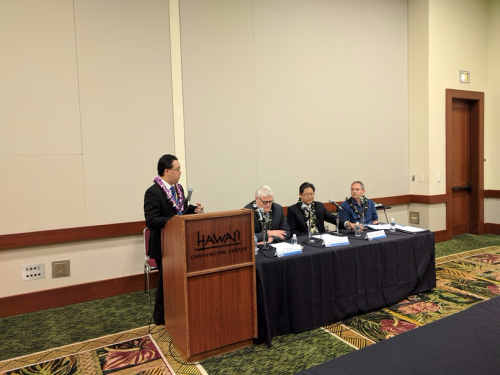
IMG_20171018_112108
Chris Leong and the CJ’s

Earlier today, I spoke to the Hawaii State Bar Association in a session sponsored and produced by the HSBA’s Appellate Section (the best section in the HSBA, by the way), titled “The Top Ten Appellate Traps (And How To Avoid Them).”

My Damon Key colleague Chris Leong (also an appellate guy) moderated a following panel discussion with Chief Justice Recktenwald (HAWSCT), Chief Judge Nakamura (Intermediate Court of Appeals), and Clyde Wadsworth (Hawaii Solicitor General) on insider’s appellate tips and do’s and don’ts from the bench and lectern. 

Here are the materials and the cases which I mentioned during my session:


Continue Reading Hawaii Appellate Traps (And How To Avoid Them) – Materials And Links From Today’s Session