October 2017

This just in: the Hawaii Supreme Court has rendered a unanimous opinion in Leone v. County of Maui, No. SCAP-15-599 (Oct. 16, 2017), a case we’ve naturally been following because it involves regulatory takings (and we were involved in a similar case on a neighboring property). 

We haven’t had a chance to review the 48-page opinion in detail (once we do so, we will post a more detailed review), but the issue the court was presented with was, as we noted here, whether leaving land in its vacant state court be considered an economically beneficial use. Short story is that the court held yes, it could, thus seeming to create a lower court split (hello, cert petition) with at least one other court, the Federal Circuit in Lost Tree, concluding that economically beneficial use means more than someone might buy it down the road. 

There’s
Continue Reading Conflict Check: Hawaii Adds To Lower Court Regulatory Takings Split: Is Leaving Land Vacant On The Hope It Is Worth More In The Future “Economically Beneficial Use”?

IMG_2931

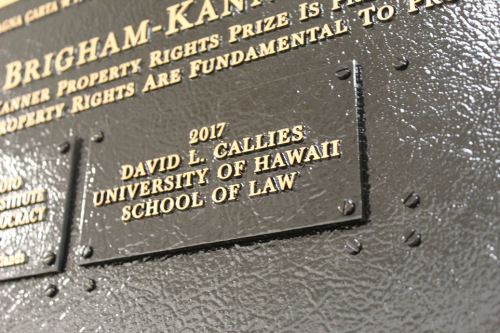
University of Hawaii Law School Professor David Callies last night was presented with William and Mary Law School’s Brigham-Kanner Property Rights Prize which is “presented annually to a scholar, practitioner or jurist whose work affirms the fundamental importance of property rights.” 

As W&M notes about Professor Callies, a “prolific scholar whose work explores land use, property, and state and local government law, Callies has lectured around the world and authored or collaborated on about 90 articles and 20 books. He has been a member of the prestigious American Law Institute since 1990 and is the Benjamin A. Kudo Professor of Law at the University of Hawaiʻi at Mānoa. Prior to entering academia, he was an attorney in private practice and an assistant state’s attorney.”

IMG_3028

We’re spending today in a series of panels which explore and build upon Professor Callies’ lifetime of work. Michael Berger, a past Prize winner, kicked off

Continue Reading Professor David Callies Awarded William & Mary Law’s Brigham-Kanner Property Rights Prize

Survey

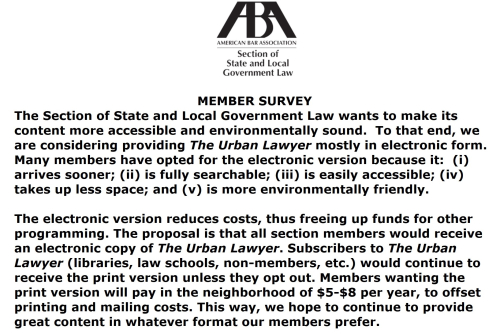
A lot of you read or get published in The Urban Lawyer, the scholarly journal published the ABA’s Section of State and Local Government Law (my Section). It’s our flagship publication: it is published quarterly, and has the largest circulation of any journal devoted to the Section’s subjects. A subscription is included as part of your Section membership. 

Publishing has changed a lot since the journal was first published half a century ago, and we’ve commissioned a short survey to ask readers and authors in which direction they want the journal, and our other Section publications (State and Local Law News (the newsletter), and the e-News (a monthly quick update) to go. 

So please take a couple of minutes, and complete the survey. It won’t take long. Tell us what you want — a hard copy delivered to your mailbox like now, a searchable pdf version

Continue Reading Urban Lawyer Survey

A quick one since we’re in transit, and don’t really have time to post much. But that doesn’t mean that the Fifth Circuit’s opinion in Boerschig v. Trans-Pecos Pipeline, L.L.C. , No.  16-50931 (Oct. 3, 2017), isn’t worth your time to read in-depth. 

Here’s the setup:

Texas law allows a natural gas utility to condemn land for “public use.” Tex. Util Code § 181.004; Tex. Const. art. I, § 17(a). Trans-Pecos Pipeline, LLC exercised that authority and initiated a condemnation proceeding to obtain a 50-foot wide permanent right-of-way and easement on John Boerschig’s ranch. The ranch is along the route of a 148-mile pipeline Trans-Pecos is constructing in west Texas that terminates at the Mexican border in the middle of the Rio Grande.

Boerschig contends that by ceding condemnation power to a private company, Texas eminent domain law offends due process. His argument principally relies on the private nondelegation

Continue Reading 5th Circuit: Texas Delegating Eminent Domain Power To A Private Pipeline Isn’t A Due Process Problem

The HSBA Bar Convention is being held on Wednesday, October 18, 2017 at the Hawaii Convention Center.

The Appellate Section has a wonderful line-up for the morning (9:00 am – Noon), and our wonderful line-up of speakers:

  • Robert Thomas, of Damon Key Leong Kupchak Hastert, will provide tips and solutions on the top 10 appellate traps; 
  • Hawaii Attorney General Doug Chin and Deputy Attorney General Deirdre Marie-Iha will provide an update on the travel ban litigation (only a few days after their upcoming United States Supreme Court oral argument), and tips and advice based on unique appellate procedure that has arisen during the litigation; and
  • Our popular Appellate Panel with guests HAWSCT Chief Justice Mark Recktenwald, ICA Chief Judge Craig Nakamura, and Hawaii Solicitor General Clyde Wadsworth.

Here is a link to register on-line, and by Wed. 9/27, there is an early bird discount: 

 http://hsba.org/HSBA/HSBA_CLE/2017_HSBA_Bar_Convention/HSBA/HSBA_CLE/HSBA_Bar_Convention/HSBA_Bar_Convention.aspx?hkey=aa3b38fd-1670-478f-8ab2-384cec22804cContinue Reading HSBA Annual Meeting: Ten Appellate Traps, And How To Avoid Them

Chucknorris
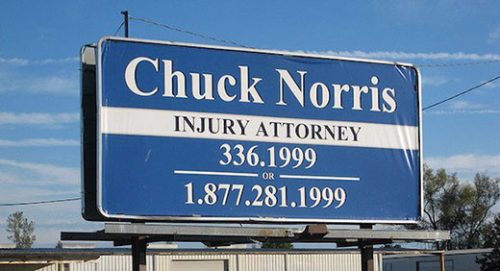
No, this isn’t the billboard.

As the title of Dep’t of Transportation v. Adams Outdoor Advertising of Charlotte LP, No. 206PA16 (Sep. 29, 2017) might indicate, this is a condemnation case involving billboard valuation in North Carolina. But the issues in the case go much deeper, we think.

On the surface, the North Carolina Supreme Court resolved a question of which state statute applies when the DOT acquires land on which an income-generating billboard is located: a statute which requires DOT to pay “fair market value of the property at the time of the taking” when it takes property for highway purposes (Article 9), or a statute which requires inclusion of the “value of the outdoor advertising” in compensation when certain prohibited billboards on leased land are condemned (Article 11) in order to remove them. The billboard was one of those now-prohibited billboards (it was a nonconforming use, since

Continue Reading NC: Evidence Of Rental Income From A Billboard Is Admissible In Just Comp Trial