


June 2018

Here’s the latest in a case we’ve been tracking, the City of Missoula, Montana’s takeover of a privately-owned water system. In 2016, the Montana Supreme Court held that the city could exercise its power of eminent domain to take the property for a “more necessary” public use. The court allowed the city to take the company, and on remand, the lower court determined compensation. There was also a follow up case on who pays property taxes on land while it is being condemned (the owner, although it may eventually have a claim for a refund from the city once the condemnation is completed and title transfers). 

In City of Missoula v. Mountain Water Co., No. DA-17-0272 (June 5, 2018), the Montana Supreme Court considered the payment of attorneys’ fees and costs. After the owners–the water company itself and its “upstream” owner–rejected the city’s offer of $50 million, the condemnation
Continue Reading Montana: When An Eminent Domain Case Is Complex And Requires Out-Of-Town Talent, A Statutory Cap On Attorneys’ Fees May Not Apply

Here’s the latest in a case we’ve been following. In Alimanestianu v. United States, No. 17-1667 (May 7, 2018), the U.S. Court of Appeals for the Federal Circuit affirmed the Court of Federal Claims’ ruling rejecting takings liability for the government wiping out a money judgment in favor of terrorism victims against the Libyan government.

Libyan terrorists blew up a plane, and plaintiffs, the survivors of one of the victims, sued Libya and obtained a $1.3 billion judgment in U.S. District Court. Libya appealed and before the appeal was resolved, the U.S. government settled all claims with Libya and vacated the judgment. The settlement with Libya referred claims to a settlement commission, which awarded plaintiffs $10 million. Plaintiffs sued the U.S. for the difference.

The CFC held there was no Penn Central taking because the plaintiffs had no reasonable expectation for any recovery greater than what they got from

Continue Reading Federal Circuit: Restoration Of Foreign Govt’s Sovereign Immunity For Terrorist Acts Isn’t A Physical Taking Of Victim’s Money Judgment

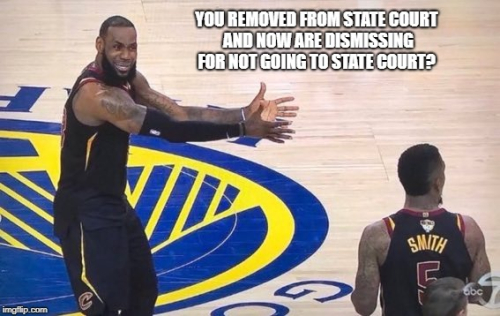
Lebronremoval

The main point we’re trying to make in the amici brief we are filing today on behalf of Citizens’ Alliance for Property Rights Legal Fund in Knick v. Township of Scott, No. 17-647 (cert. granted Mar. 5, 2018), is that the average property owner simply cannot fathom why—if a state or local government has taken property in violation of the Fifth Amendment—he cannot bring a takings claim in federal court until he has first pursued and lost an inverse condemnation claim in state court.

Other cases arising under the Constitution get the keys to the federal courthouse door, no questions asked. But not takings. 

Yes, this is the case in which the “exhaustion of state remedies” requirement from Williamson County Regional Planning Comm’n v. Hamilton Bank, 473 U.S. 172 (1985) is finally being directly reviewed. The last time the Supreme Court considered Williamson County in an argued case was

Continue Reading Our Knick Amicus Brief: Monkey Selfies Can Get To Federal Court, But Not Fifth Amendment Takings?