2018

Eminentdomainromanc

Tired of that dry, stuffy legal text on eminent domain law?

If so, you are in luck because author Tessa Berkley has the solution, her latest novel, “Eminent Domain” ($1.99 on Amazonfair market value). Here’s the synopsis:

When two brothers are sent to the opposite coasts, each man must decide between the dream of a lifetime, a chance to run the company, stepping out from their father’s shadow or living their own lives.

Asa Kingston journey to the Eastern Shore of Virginia is what he considers a fool’s errand. In an attempt to take over the company from his estranged brother, he is required to purchase the property known as Pinnacle Point. The owner, an elderly woman, should be easy to manipulate but he didn’t count on running in to her beautifully brilliant granddaughter, Mallory.

Pinnacle Point is the only home Mallory Bennett has ever known. When

Continue Reading Eminent Domain: He Came To Claim Her Land. Instead, She Stole His Heart

18730910_303

Here’s the not unexpected decision from the U.S. Court of Appeals for the Ninth Circuit in a case we’ve been following (sort of). It should never have gotten this far, even as the “plaintiffs” raise the specter of a cert petition.

We say again: the federal courts seem to have time for this brand of nonsense, but when it comes to land use and takings cases, they won’t be “super zoning boards of appeals,” and almost always refuse to give them the time of day. At least PETA didn’t make a takings claim and further hose up the law. 

Once again, Dr. Zaius could not be reached for comment.

Rock on, Naruto.

Naruto v. Slater, No. 16-15469 (9th Cir. Apr. 23, 2018)

Continue Reading 9th Cir: “Ape Shall Not Sue Ape!” Court Has Time For Silly Monkey Selfie Case, But Not For Takings

IMG_2947
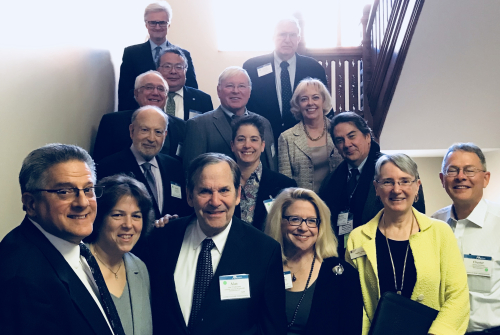
Some of the Land Use Institute faculty, including (front row left), Planning Chair Frank Schnidman and Planning Co-Chair Patty Salkin

Last Friday at the 32nd Annual Land Use Institute in Detroit, I was honored to moderate a freewheeling discussion by a panel of takings experts, Professor Steven Eagle, Minnesota lawyer Howard Roston, and Michigan’s own Alan Ackerman on “Takings, Eminent Domain, and Vested Rights.”

Here are the cases and other materials we discussed, as well as a few others which we did not have time to cover (but wish we could have):


Continue Reading Cases And Materials From The Takings And Eminent Domain Session At The Land Use Institute

Do we really need to tell you how a rent control regulatory takings claim fared in the Ninth Circuit? We didn’t think so.

In Colony Cove Properties, LLC v. City of Carson, No. 16-562655 (Apr. 23, 2018), a three-judge panel reversed a district court jury verdict which concluded that the City was liable for a Penn Central regulatory taking for the mobilehome Rent Board’s setting of a rent increase artificially low. The total award to the park owner, including damages for lost rental income, attorneys’ fees, and interest, was over $9 million. 

As we wrote in this post, the city and its amici predictably went ballistic and argued that the upholding the verdict threatened the very existence of mobilehome rent control. The court concluded that as a matter of law, the owner failed each of the three Penn Central factors.

First, the owner did not prove that the

Continue Reading 9th Cir: City Rent Board Determining Owner “Made Enough” Profit Isn’t A Penn Central Taking

MRGO

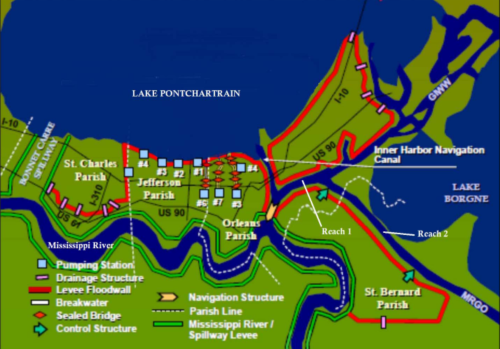
When you a federal takings plaintiff in the Federal Circuit and you pull Judge Timothy Dyk on your panel, your heart sinks. More so when he aggressively questions you in oral argument. And when you see he has written the opinion, you know it’s game over at this level.

Because we can’t remember a single case in which he’s ever held for a property owner in a regulatory takings or inverse case. He just doesn’t like property owners and their takings claims, apparently. His last big decision on flood takings, Arkansas Game and Fish, adopted a per se rule that any flooding which the owner could not prove was “permanent” is categorically immune from takings liability. His opinion for the Federal Circuit was reversed unanimously by the Supreme Court, in an opinion by Justice Ginsburg, which alone should tell you something. 

Well, Judge Dyk is at it again

Continue Reading MR-GO, Katrina Flooding: Inverse Condemnation And Schlimmbesserung At The Federal Circuit

Here are the cases and materials I either discussed, or planned to discuss (but ran out of time), in this morning’s session at the 32nd Annual Land Use Institute:


Continue Reading Land Use Institute – Cases And Links From Today’s Session On Federal Laws And Local Land Use Decision Making: Water

20180419_150416_HDR

We’re in Detroit the rest of the week at the Mercy Law School for the venerable Land Use Institute, now in its 32nd iteration.

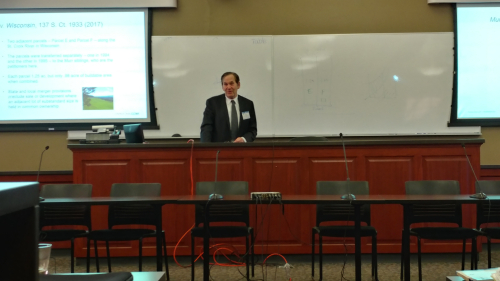
Planning Chair Frank Schnidman has assembled a great faculty including out Detroit colleague Alan Ackerman (above, talking about takings liability for flooding), and we’ll be spending the time talking inverse condemnation, public trust, planning law, homelessness, autonomous vehicles, affordable housing, RULIPA, and similar topics. We’ll be presenting on “Eminent Domain, Vested Rights, and Regulatory Takings,” “Client Representation: Developer, Government, and Citizens Groups,” and “Federal Laws Affecting Local Land Use Decision Making.” 

If you are here with us in Detroit, stop by and say hello. If you aren’t here, shame on you! This is one of the best and most affordable tuition deals in CLE.

But all kidding aside, if you are not in Detroit now, be sure to calendar these

Continue Reading Land Use Institute – Detroit

Today’s case is one of what we call “regionally classic” cases that we come across from time to time. You know, cases that just fit into all your preconceived notions about a place. Beach cases from Hawaii. Gator law opinions from Southern states. Vermont = snow law, California, land and wineries. Here’s another one of those from our Southern courts — Florida’s District Court of Appeals, to be precise — that we think fits the bill.

In Florida Fish and Wildlife Conservation Comm’n v. Daws, No. 1D16-4839 (Apr. 10, 2018), the First District Court of Appeals held that owners whose properties were physically invaded by “deer dog hunters and their dogs during the forty-four days of the year when deer dog hunting is authorized” by the Commission, have not suffered a taking because these invasions were only temporary, and “do not rise to the level of permanent

Continue Reading Fla App: That Takings Dawg* Don’t Hunt: Sporadic Trespass By Deer Dog Hunters (And Their Dogs) Isn’t A Permanent Physical Occupation