2018

Here’s a bit passed on to us from a colleague who reads USA Today. Leading off “Justice Gorsuch confirms conservatives’ hopes, liberals’ fears in first year on Supreme Court,” is this snippet, which points out a Just Compensation case in which we represented the (denied) petitioner:

WASHINGTON – Neil Gorsuch had been a member of the Supreme Court for exactly 11 weeks when he made clear in a single day what type of justice he would be.

The court struck down an Arkansas law that treated same-sex couples differently than opposite-sex couples on their children’s birth certificates. Gorsuch dissented. 

The court refused to consider a challenge to the Department of Veterans Affairs’ system for evaluating disability claims. Gorsuch dissented.

The court declined to hear a challenge to a California law limiting who can carry a concealed gun in public. Gorsuch dissented.

And the court turned aside a challenge to the meager sum Mississippi paid when it converted a former landowner’s property into a park. Gorsuch said the justices should hear a similar case “at its next opportunity.”

Thus it was that on the last day of its 2016-17 term — as the court addressed gay rights, government power, gun ownership and government takings — Neil McGill Gorsuch announced to the legal world that he would not go along to get along.

“He came to the court more ready to jump into the deep end than a lot of recent nominees,” says Jonathan Adler, a law professor at Case Western Reserve University School of Law.

Here’s why

we thought the denial of cert in that case (and others) wasn’t necessarily a bad sign.
Continue Reading USA Today Notes Just Comp An Area Where Justice Gorsuch “Jumping Into The Deep End”

Sterk_475

The William and Mary Law School has announced the recipient of the 2018 Brigham-Kanner Property Rights Prize, Cardozo School of Law Professor Stewart E. Sterk.

He will receive the prize at the 15th Annual B-K Conference in Williamsburg, October 4-5, 2018

Sterk’s publications span a wide variety of areas, ranging from property and land use regulation to trusts and estates, copyright, and the conflict of laws. A member of the American Law Institute, he served as an advisor in the preparation of the Restatement (Third) of Property (Servitudes). He has co–authored casebooks on Trusts and Estates and on Land Use, and he also edits the New York Real Estate Law Reporter, a monthly newsletter published with the assistance of Cardozo students.

He joins an impressive list of legal scholars and practitioners as prizewinners, including Frank Michelman, Richard Epstein, James Ely, Carol Rose, Michael Berger, and David

Continue Reading 2018 Brigham-Kanner Prize Announced: Professor Stewart E. Sterk, Cardozo Law

When the city condemned a portion of CED’s property back in 2012 for a highway project (replacing an intersection with a roundabout), the city’s appraiser testified that the taking did not confer any “special benefits” to CED’s remainder parcel. Eventually, CED and the city settled the case and the city paid agreed-upon compensation and severance damages. 

Flash forward a few years, and to help fund the roundabout project, the city adopted a special assessment and tagged CED and other nearby landowners. Based on its street frontage, the city charged CED a total of $40k, asserting that CED’s parcel had specially benefited from the improvement project by, among other things, “a substantial increase in accessibility, which includes safer, lower cost, and short travel time for customer, deliveries and employees. These special benefits are different in kind that those enjoyed by the public for through traffic.” The city acknowledged there were also

Continue Reading Wisconsin: “Special Benefits” In Eminent Domain Means “Uncommon Advantage,” But Only Regarding Market Value

Space is filling up, but there’s still time to join us later this month in Detroit for the 32nd Annual Land Use Institute (April-19-20). 

We’ll let program Planning Chair Frank Schnidman explain all the reasons why, and we’ll add only these points: (1) it’s a very good program that won’t take much of your time (fly in for the Thursday afternoon program, stay a night, fly home on Friday evening); (2) Detroit is the place to be these days; and (3) it’s one of the best deals in CLE credits, with tuition as low as $400.

2018 Land Use Institute Brochure Detroit 5 2018

Continue Reading There’s Still Time To Join Us In Detroit: 32d Annual Land Use Institute

We don’t usually post up trial court rulings, preferring to wait until the issue percolates up through the food chain. But this one is an exception, because, well, it’s darned interesting, and we wanted to get you all on board on the ground floor.

Here’s the trial court’s order granting the plaintiffs/property owners summary judgment in the case challenging the City of Seattle’s “first in time” ordinance, under which the city established the criteria for screening tenants, and required property owners to accept the first qualified applicant as a tenant.  The city acknowledged that the ordinance “affects a landlord’s ability to exercise discretion when deciding between potential tenants that may be based on factors unrelated to whether a potential tenant is a member of a protected class.” Slip op. at 2-3. The goal was to “eliminat[e] the role of implicit bias.”

In short, because a property owner might have an

Continue Reading Seattle’s “First in Time” Tenant Rule Is A Taking

Here’s the cert petition in a case we’ve been following out of the Tenth Circuit involving an attempt by a private utility company to take property which is now partly tribal land.

In Public Service Co. of New Mexico v. Barboan, 857 F.3d 1101 (10th Cir. 2017), there wasn’t a question that a federal statute prohibited a utility company from taking “tribal land.” The big issue was what land fell within that definition. 

The Navajo Nation owns undivided fractional interests in two parcels which a utility claimed it needed for a electric transmission line. The land earlier had been “allotted” to individual owners, who are treated like fee owners except for certain restrictions on alienation. This land is no long tribal land or part of any reservation, and under a federal statute, allotted land is subject to an exercise of eminent domain:

Lands allotted in severalty to Indians

Continue Reading Cert Petition: Is Land Only Partly Owned By A Tribe Immune From Eminent Domain?

Here’s what we’re reading this Thursday:

Cert(s) Denied

California Wildfires and Inverse Condemnation


Continue Reading Thursday Round Up: Cert(s) Denied, Cal Wildfires, City-to-City Takings, Other Stuff

Verdictform

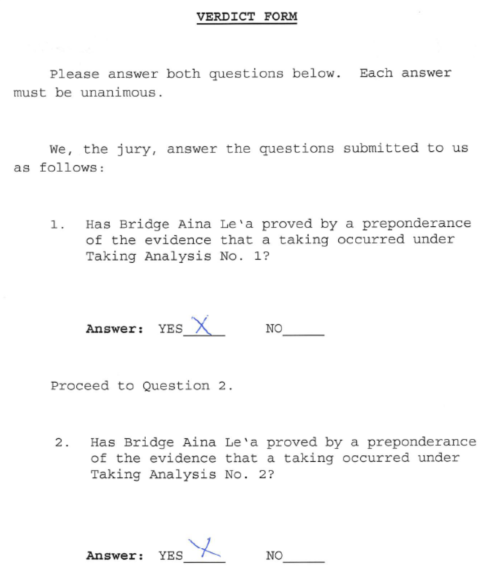
As we reported here, the U.S. District Court for the District of Hawaii just finished a jury trial in a regulatory takings case (removed by the defendant State of Hawaii from Hawaii courts) involving a stalled development on the Big Island.

The jury has returned a verdict after 8 days of trial, concluding the State is liable under both Lucas and Penn Central theories, after only 15 minutes of deliberation after their lunch break. 

But there’s more to this story, because here’s the buried lede. The court yesterday made this entry in the docket: 

EO: The court proposes to enter an order awarding nominal damages of $1 to the plaintiff and then to enter judgment in this case. This will start the running of the clock not only for appeal but also for requests for fees and costs under Local Rule 54.3. If the parties have concerns about this

Continue Reading Lunch And 15 Minutes: Federal Jury Finds State Land Use Commission Liable For Lucas And Penn Central Taking

We always were glad biology prevented us from hearing what others were thinking. Because if we were able to know what people really thought, we might not like each other very much. 

Well, the internet — Twitter in particular — has broken through the biology and given us that opportunity, all in 160+ characters. The crazy is strong with this one.

But you can learn stuff on Twitter. Stuff like the author of the Con Law treatise you used in law school is kinda … out there, for example. 

But despite Twitter’s notoriously low signal-to-noise ratio, Sheldon Gilbert, an attorney with the Institute for Justice, is someone you really should follow on Twitter. Sheldon’s tweets with the hashtag #courtinghistory are gems which make wading into the Twitter swamp worthwhile. In a series of tweets, he walks through some of the most important and interesting Supreme Court cases, focusing on

Continue Reading On This Day: Midkiff SCOTUS Arguments, Tweeted