


March 2019

A bit off of our usual topics, but we thought we would post this anyhow to show we’re not one-trick ponies: here’s the amicus brief we filed yesterday in the Hawaii Supreme Court in an employment law case the court is considering. Yes, we do appeals on employment law, too. 

The issue is whether under Hawaii law, an employer is required to hold open the position of an injured worker indefinitely, or can permanently fill that position with another worker when it has legitimate business reasons for doing so. As our brief argues:

The question presented is whether in Haw. Rev. Stat. § 378-32(a)(2), the legislature intended to require employers to hold open a long-absent injured worker’s position indefinitely, or whether by prohibiting adverse actions by the employer “solely because the employee has suffered a work injury,” it meant to preserve employers’ flexibility to hire a replacement as may
Continue Reading Amicus Brief: Employer Can Fill Injured Worker’s Position If There Are Legitimate Business Reasons For Doing So

Our colleague Dwight Merriam was recently interviewed on the radio about issues surrounding the existing and proposed wall and fence along portions of the southern border.

If you want to get educated on this issue, here’s the quick way to do it.

Dwight discusses funding, emergency powers, the Declaration of Taking Act, and other topics. You may not be practicing where border wall issues are among your cases. But trust us: even so, if you tell people you are an eminent domain lawyer at a cocktail party, the first thing someone is going to ask is what your thoughts are on the border wall. Doesn’t matter if you are in a state far from the border. And if you aren’t familiar with the border wall issues and able to chat about them, they will conclude you are a bad eminent domain lawyer. So get educated! Here’s your chance. 

Dwight has

Continue Reading Dwight Merriam Interviewed On Border Wall Legal Issues

Here’s one we’ve been meaning to post for a while, the latest in a case we’ve been following. Yes, its the Love Terminal Partners cert petition.

Rather than go into the details about the case, we instead refer you to our post about the Federal Circuit’s opinion, the Court of Federal Claims verdict finding a taking and awarding compensation, and the petition itself. Counsel of Record for the property owners is none other than überlawyer Paul Clement. So we really can’t improve on the Questions Presented:

In 1999, petitioners paid millions of dollars to acquire the lease to property designated for aviation use at Dallas Love Field Airport. The next year, they spent another $17 million constructing a state-of-the-art terminal, and a few years later they expanded their investment by another $6.5 million. At the time, federal law limited flights for aircraft with over 56 seats from Love

Continue Reading New Cert Petition: You Don’t Need Positive Cash Flow To Have Investment-Backed Expectations

6a00d83451707369e201bb08b7aef7970d-800wi

Here’s the latest in a case we’ve been following that has resulted in what we’re counting as no less that three lawsuits in state court (all removed to federal court by the State of Hawaii, as far as we are aware), which have gone back-and-forth between the U.S. District Court, the Ninth Circuit, and the Hawaii Supreme Court.

The latest is no different, and asks which statute of limitations applies to takings claims: the two-year personal injury statute, or the six-year “catch all.” The answer has not been definitively resolved by Hawaii’s courts, so Ninth Circuit in this order (Mar.7, 2019) booted this dispositive legal issue to the Hawaii Supreme Court by certifying this question: 

What is the applicable statute of limitations for a claim against the State of Hawai‘i alleging an unlawful taking of “[p]rivate property . . . for public use without just compensation,” Haw. Const. art. I

Continue Reading Ninth Circuit Wants To Know The Statute Of Limitations For Takings Claims In Hawaii

The bulk of the Indiana Court of Appeals’ opinion in Grdinich v. Plan Comm’n for the Town of Hebron, No. 18A-PL-1050 (Feb. 28, 2019) is devoted to details of land use law, specifically exhaustion of administrative remedies. If that floats your boat, we’ll let you read it. 

What caught our eye was at the very last part of the opinion (page 16), where the court concluded that the property owner did not adequately plead an inverse condemnation claim, when his complaint alleged “that real estate owned by him is encumbered by a 150-foot underground storm water drainage pipeline that is owned and controlled by Hebron for public use without payment for just compensation.” In other words, an uncompensated physical invasion taking. 

The court held this did not state a claim as a matter of law because the allegedly offending pipeline was already in place at the time the plaintiff purchased

Continue Reading Indiana App: No Inverse Claim Where Government’s Permanent Physical Invasion Of Property Happened Before Purchase

Who among us doesn’t possess a lot of goodwill for doughnuts? We know we sure do. 

So when we think of “Los Angeles,” what comes to mind: sunshine, beaches, Hollywood, and sprawl? No. What comes to mind are chili, hot dogs, and doughnuts. Those items — more precisely, the roadside architecture which establishments that hawk these foods employ — just sing “LA” to us. Especially doughnuts.

So the California Court of Appeal’s recent opinion in Los Angeles County Metro. Transit Authority v. Yum Yum Donut Shops, Inc., No. B276280 (Feb. 26, 2019) grabbed our attention. And not just for its spelling of “donut,” because the case involved a donut shop, and the recovery in eminent domain for the loss of business goodwill, two things we love.   

There, the MTA condemned a doughnut — donut — shop in central LA. Store 58 to

Continue Reading Cal App Finds Goodwill For Donuts: Shop Owner Entitled To Loss Of Goodwill Damages, Even Where It Has Not Mitigated The Entire Loss

Mansfield flyer 3-13-2019

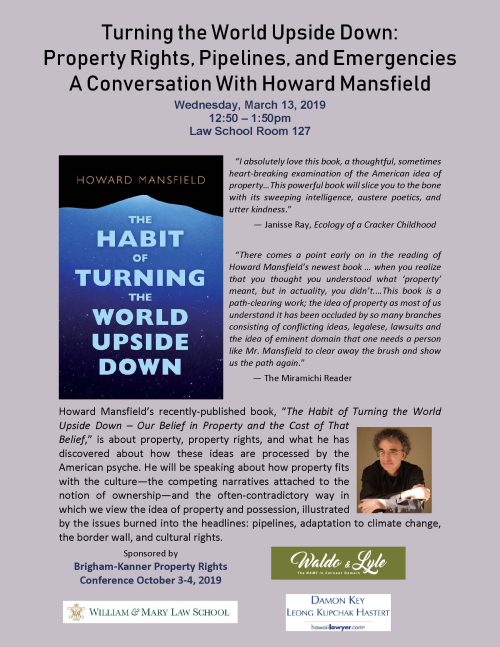
If you are in the Williamsburg, Virginia area next week Wednesday, March 13, 2019, please hold the lunch hour (12:50-1:50pm, Room L127) on your calendar to come join us for a session with Howard Mansfield, author of the recently-published book “The Habit of Turning the World Upside Down – Our Belief in Property and the Cost of That Belief.”

In November, we chatted with Mr. Mansfield, and this semester are basing a seminar on property rights at the William and Mary Law School on the book. Well worth reading. Here’s the printable flyer

His book is about property, property rights, and what he has discovered about how these ideas are processed by the American psyche. He will be speaking about how property fits with the culture—the competing narratives attached to the notion of ownership—and the often-contradictory way in which we view the idea of property and

Continue Reading Upcoming 3/13/2019 Book Talk: Turning the World Upside Down: Property Rights, Pipelines, and Emergencies – A Conversation With Howard Mansfield

Thank you to our colleague, economist William Wade, for sending along this piece, reacting to a recent decision by the Massachusetts Appeals Court.

————————

Financial inconsistency bedevils takings decisions

by William W. Wade, Ph.D.

This blog recently reported on a Massachusetts Appellate Court takings case ruling (Smyth v. Conservation Comm’n of Falmouth, No. 17-P-1189 (Feb. 19, 2019)), that reversed a judgment for the plaintiff, in part, based on an erroneous economic impact evaluation under the famous Penn Central test.

Plaintiff inherited a parcel from her parents seemingly purchased in 1975 for $49,000. Plaintiff’s appraiser valued the land parcel at $700,000 with the intended development and $60,000 in its current status as an unbuildable lot. The trial court awarded damages of $640,000.

While other issues were at issue on appeal, the court ruled on the economic impact prong of Penn Central that the diminution in value, $700,000 to $60,000

Continue Reading Guest Post: Financial Inconsistency Bedevils Takings Decisions

Here’s the motion and proposed amicus brief we filed earlier this week, in a case we’ve been following about natural gas pipelines, eminent domain, and immediate possession.

As we noted here, a panel of the U.S. Court of Appeals for the Fourth Circuit recently concluded that a private condemnor under the Natural Gas Act could obtain immediate possession of property it is in the process of condemning, even though the NGA does not delegate the quick take power. All three judges concluded that this case is “on all fours” with the Fourth Circuit’s earlier decision in East Tennessee Nat. Gas Co. v. Sage, 361 F.3d 808 (4th Cir. 2004), which held that even though Congress did not delegate the quick take power in the NGA, a preliminary injunction under Rule 65 of the Federal Rules of Civil Procedure could achieve the same result, and thus there was

Continue Reading New Amicus Brief: Private Natural Gas Act Condemnors Can’t Use Rule 65 Injunctions To Short-Circuit The Straight Takings Process

Kansas colleague Chris Burger has published an article in the Kansas Bar Journal with the intriguing title, “Sanguine Doves in the Hands of the State or How the Power of Eminent Domain has Few Practical Restraints.” We dare you to resist downloading it and reading.

Thanks to Chris for allowing us to repost it (since most of us are not members of the Kansas Bar). It’s a short article and won’t take too much of your time, but there’s some valuable information there, even if you are not barred in Kansas. We especially appreciated the section on “drafting gamesmanship” and the quotes from the Kansas Supreme Court Justices on pages 31-32, this one in particular:

Left unchecked by flood walls erected either by the people’s representatives or by the people’s constitution, the power of the state will flow like an encroaching ocean into and through every available chink

Continue Reading New Article: Sanguine Doves in the Hands of the State; or How the Power of Eminent Domain has Few Practical Restraints