October 2019

MonthlyArgumentCalNovember2019

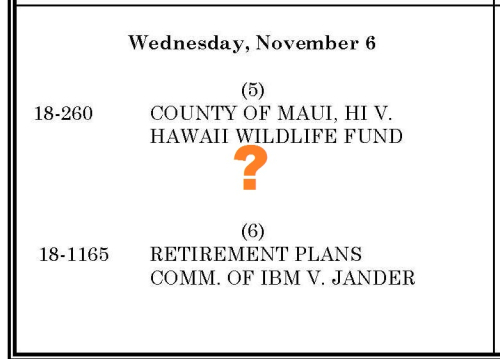
We’ve been following the ongoing efforts to settle the Clean Water Act case involving the County of Maui with some amusement. 

Why, you ask? Part of it is that we like municipal law. (Perhaps sad, but true.) But we’re amused mostly because the case’s current posture illustrates the dual principles of “be careful what you ask for,” and the legal corollary of one of Murphy’s Rule of Combat (“No plan ever survives first contact”): that you may be able to start a lawsuit on your own terms, but you may not always be able to end it the same way. 

The plan here seemed pretty good. Sue the County for violating the CWA for its injection wells, asserting it should have obtained a CWA permit. Yes, the line between a “point source” and a “nonpoint source” was not settled law, but the case seemed like a very good bet. The
Continue Reading Who Is In Charge At The County Of Maui? SCOTUS OA Hinges On Internal Dispute Over Who Can Settle

We’re in California, where we’re playing Lincoln Lawyer for a few days because in its infinite wisdom, the utility company has preemptively shut off power for one week due to the threat of wildfire inverse condemnation lawsuits. We’re actually playing Chevy Tahoe Lawyer, because we’re literally working out of a truck since that’s the only place with power, and we can at least drive to where there’s a (weak) connection to the developed world. 

But court deadlines don’t wait for California’s absurdities, so we do what we need to do.

And that includes filing this amicus brief in a case we’ve been following, Campbell v. United States. That’s the case in which a Federal Circuit panel held that the Tucker Act’s six-year statute of limitations in takings claims against the United States starts to run upon the taking, and “the taking may occur before the effect

Continue Reading Amicus Brief: Federal Circuit Assumes Plaintiffs Understand SCOTUS’ Regulatory Takings Doctrine Better Than SCOTUS Understands Regulatory Takings Doctrine

Untitled Extract Pages

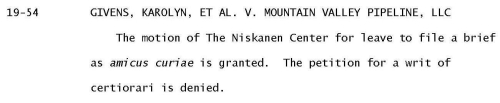
One should never be surprised, we suppose, when the Supreme Court denies a cert petition due to the daunting statistics, but we really thought that maybe the third time was a charm for the quick-take-by-preliminary-injunction issue, and that the Givens petition had a real chance. The petition was strong, the issue (in our opinion) was compelling: can private pipeline companies obtain immediate precondemnation possession of land and start construction of a pipeline even though the Natural Gas Act delegates to them only the straight-takings power?  

Alas no, the Court today issued an Order declining to review the case (and gazillions of others). The circuit split is the Seventh vs everyone else, but apparently the Supreme Court is more interested in ensuring the circuits are consistent than it is about separation of powers issues, and making sure that the “despotic power” is wielded carefully, especially when it is private for-profit

Continue Reading Cert Denied (Again) In Quick-Take-By-Injunction Pipeline Case

IMG_20191004_124327

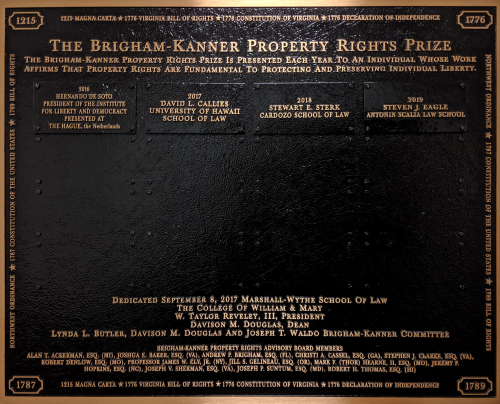
Here is a transcript of the remarks I delivered today at the 2019 Brigham-Kanner Property Rights Conference. I was honored to join lawprof Henry Smith and Florida Supreme Court Justice (ret.) Ken Bell (who authored the Florida court’s opinion in Stop the Beach Renourishment which was challenged in SCOTUS as a “judicial taking”) to speak about “Public Resources and Private Rights” (moderated by Professor Katherine Mims Crocker). After paying our respects to 2019 B-K Prize winner Professor Steven Eagle, we each addressed some part of the question.

—————————-

The New New Property

As always, I bring to you tidings of “aloha” from the state where the legislature thought it was a going to reduce the price of residential housing by taking fee simple interests from “A” and giving them to “B,” the leaseholders

Where now, the median price for a single-family, two bedroom, one bath

Continue Reading 2019 Brigham-Kanner Conference: The New New Property – Public Resources And Private Rights

IMG_20191003_114853

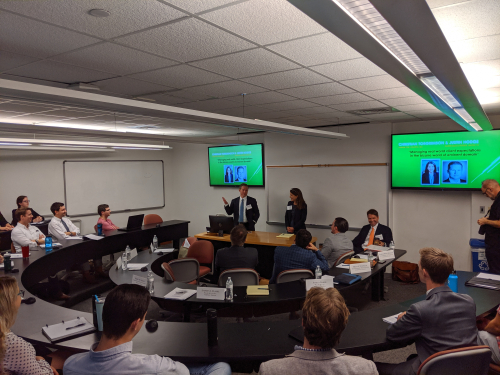
Today’s the kickoff events for William and Mary Law School’s Brigham-Kanner Property Rights Conference. We started the day with eminent domain and property law attorneys speaking about the practice of law (pictured above, Justin Hodge (TX) and Christian Torgrimson (GA)).

Toronto’s Shane Rayman and I spoke about international and comparative property and eminent domain (expropriation) and how even though our way of approaching cases may be different, the goals are the same: justice and fair treatment for our clients. And what we can learn about our own cases by looking at how other jurisdictions do it. 

In that vein, here are the links to the cases we (and others) mentioned:


Continue Reading 2019 Brigham-Kanner Property Rights Conference Kickoff

With the 2019 edition of the Brigham-Kanner Property Rights Conference (and award of the B-K Prize to Professor Steven Eagle) to get underway later this week, it is also publication time for the latest issue of the Brigham-Kanner Property Rights Journal

This edition focuses on the “Federalism Dimension of Constitutional Property,” and we contributed a short essay, “Emerging Issues in Property Law.”  (And yes, this essay was part of my talk at an academic conference, so used the word “normative.”)

Thomas, Emerging Issues in Property Law, 8 Brigham-Kanner Prop. Rts. J. 113 (2019) 

Continue Reading New Article: Emerging Issues in Property Law (Brigham-Kanner Property Rights Journal)

This one is a break from our usual programming because it involves … insurance law. Specifically the law of “bad faith.”

We highlight the case because we represent the prevailing petitioner. (See, we don’t just do property appeals.) And come on, everyone should be interested in insurance law. Especially the law of how health insurers behave, because when you are ill, it is the worst time to be dealing with questions of coverage, claims, and the like; but that’s often when you do have to deal with these questions.

We won’t trouble you with all of the details of the Hawaii Supreme Court’s unanimous opinion in Adams v. Haw. Med. Service Ass’n, No. SCWC-15-396 (Sep. 30, 2019), but if you have health insurance or have ever dealt with an insurer (and who hasn’t?), you might find this interesting and useful. Our research shows this case to be the first

Continue Reading HAWSCT: Insurer’s Duty Of Good Faith Claims Processing Covers Its Conduct Before Submission Of A Claim