October 2019

Here’s a two-fer that covers very difficult and unsettled subjects in takings law: judicial takings and rent control. 

In this cert petition, New York property owners assert that the New York Court of Appeals (the state’s highest court for those of you who do not watch Law & Order (dun-dun)), took private property when the court held that the petitioner’s apartments are governed by the Rent Stabilization Law.

That holding subjected luxury apartments that were never formerly governed by rent control to the tenant’s power to renew less-than-market rent in perpetuity. The petition asserts that before the Court of Appeals’ ruling, “It was settled as a matter of New York law and practice … that Section 421-g property was eligible for luxury decontrol[.]” Pet. at 35.

Here are the Questions Presented:

In Stop the Beach Renourishment, Inc. v. Florida Department of Environmental Protection, 560 U.S. 702
Continue Reading New (Judicial Takings!) Cert Petition: NY Court Took Property When It Disallowed Deregulation Of Luxury Rent Controlled Apartments

EXHIBIT A

We’re back again at that supposed distinction between the police power and the eminent domain power, which reminds us of that old tale about President Lyndon Johnson:

After reviewing a contingent of Viet Nam-bound Marines in California, Lyndon Johnson strode purposefully toward what he thought was his helicopter. “That’s your helicopter over there, sir,” said an officer, steering the President toward a different craft.

“Son,” replied Johnson evenly, “they are all my helicopters.”

Well, it’s all government power. 

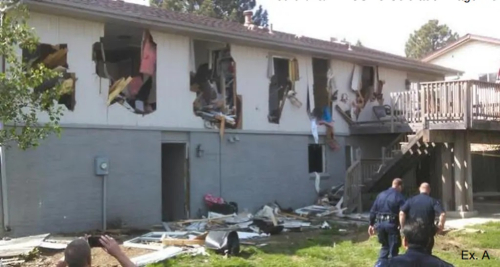
But not to the Tenth Circuit, which in this unpublished order concluded that when local SWAT teams destroyed an innocent family’s house to dislodge a fleeing suspect who had for hours holed up there and taken shots at the police, it wasn’t a taking because, guess what, the police were not exercising eminent domain power, it was the police doing what police do.

The Tenth Circuit relied on the fact that

Continue Reading CA10: SWAT Attack On Home Where Shoplifting Suspect Holed Up Isn’t A Taking

Here’s the other shoe that we’ve been waiting to drop.

Recall that in our last post on the pending Clean Water Act case (SCOTUS oral arguments scheduled for November 6, 2019 – yeah, as in one week from tomorrow), we suspected that a declaratory judgment action would be filed in a Hawaii state court to resolve the internal dispute between the various branches of the Maui County government about which branch(es)’s approval is needed to settle the case. On one side, the Mayor claims that the settlement of the CWA case needs his approval (which he isn’t giving). The Corporation Counsel’s analysis backs his argument up. On the other side, the County Council — which, by a one-member margin voted to settle the case because the CWA plaintiff’s lawyers are terrified of what the Supreme Court might do with the case — who assert that they alone have

Continue Reading Citizens Sue Maui Mayor (Finally) To Force Him To Settle SCOTUS Clean Water Act Case – But Is It Too Late To Scuttle The Arguments?

With the ongoing wildfire dramas ongoing across California, several of you have asked us to collect the posts we have done about inverse condemnation liability in one place. So here you go:

As you can see from the above video, this one isn’t over. Stay tuned.Continue Reading All Of Our Past California Wildfires And Inverse Condemnation Posts

Here’s the State of Hawaii’s response to an amicus brief we filed in a case that asks the Hawaii Supreme Court to resolve the question of what statute of limitations governs takings claims under the state constitution. We argued that constitutional claims such as these might not be subject to legislatively-imposed statutes of limitations, and that if they can then the majority rule in most state courts is that the adverse possession statute of limitations applies. 

The State argues that a takings claim is a breach of contract claim (as some states conclude), and thus a two-year statute of limitations applies. The property owner in this case argues that it is a six-year limitations period under Hawaii’s “catch-all” civil claims statute. 

So, how does your jurisdiction do it?

Defendants-Appellees’ [State of Hawaii] Response to Brief Amicus Curiae of Owners’ Counsel of America 

Continue Reading State’s Amicus Response: Two-Year Statute Of Limitations In State Law Takings Claims Because Inverse Condemnation Isn’t The Same As Eminent Domain

00100lPORTRAIT_00100_BURST20191023131755040_COVER

These days, parts of California often looks more like a developing country than the world’s fifth most powerful economy. Urban encampments — complete with medieval diseases — have become legendary. The streets of its glittering cities of tech are paved not with gold, but with human waste (but there’s an app for that!).

No longer the Golden State, it is more The Land Of No (no market rent, no plastic straws, no natural gas heating or cooking, no foie gras, no plastic bags, no fur, no teeny bottles of hotel shampoo, (no cheap gasoline, either), no early morning school, no state-funded travel to retrograde locales, no “lunch shaming,” no smoking outside. No this, no that. You name it, California will probably eventually ban it. (Except weed; weed anywhere is just fine.)

Most recently, no

Continue Reading Lights Out In The Land Of No: The Practical Effects Of California’s Wildfire Inverse Condemnation Doctrine

We read the Nebraska Court of Appeals’ opinion in Russell v. Franklin County, No. A-18-827 (Oct. 15, 2019), twice, just to be sure we were understanding the holding and rationale correctly. Apparently we were: the court held that when the State (inadvertently) takes property — here, the County highway maintenance department entered the plaintiffs’ rural undeveloped land with permission to cut and remove certain trees, but then went to the wrong place and cut the wrong trees — the only way to measure damages for the taking of the trees is to value the land with the trees, and the land without the trees. In this case, a grand total of $200. 

This case wasn’t a fight about whether the County had taken property. It had, and it admitted its inverse condemnation liability for just compensation. The County’s appraiser used this method:

In his analysis, Gerdes used comparable market

Continue Reading Apparently, Trees Are Not Property In Nebraska

A short post today, since we’re butting up against a deadline, and are attending a conference most of the day (don’t you hate that when that happens?). But we have to share with you a recent Ipse Dixit podcast, which features property lawprof Lee Anne Fennell, talking about her recently-published book, which should be of great interest to dirt lawyers and scholars: 

In this episode, Lee Anne Fennell, Max Pam Professor of Law at the University of Chicago Law School, discusses her new book, “Slices and Lumps: Division and Aggregation in Law and Life,” which is published by the University of Chicago Press. She begins by explaining what she means by “lumps” and “slices,” and why they are concepts that structure the way we think about the world. She observes that aggregating “lumps” together into valuable goods and disaggregating “slices” of goods into valuable segments often increases

Continue Reading Lumps, Slices, And Sticks: Podcast With Property Lawprof Lee Anne Fennell

Update 10/25/2019: an astute and seasoned correspondent writes that the issue of whether a property owner must raise constitutional issues in the administrative proceedings was settled in a published opinion that involved the same agency, the California Coastal Commission. See Healing v. Cal. Coastal Comm’n (1994) 22 Cal. App. 4th 1158 (we put in in California citation style just because) (“These [the takings questions] are questions for a court of law to decide at an evidentiary trial, not by mandamus review of an administrative record of proceedings where the parties’ right to present evidence was limited by the very nature of the administrative process.”).

Why the Coastal Commission doesn’t know its own law, escapes us.  

++++++

Hat tip to Benjamin Rubin at the California Eminent Domain Report for writing up a recent opinion issued by the California Court of Appeal, Greene v. California Coastal Comm’n, No. B293301 (Oct. 9

Continue Reading Cal App: Agency Has Power To Adjudicate Whether The Agency Itself Is Taking Property (Really)

Emoji_u1f4a9.svg

There’s nothing terribly novel in the Texas Court of Appeals’ opinion in City of Houston v. The Commons at Lake Houston, Ltd., No. 14-18-00664-CV (Oct. 15, 2019), but we highlight it here for a couple of reasons. 

First, the court’s holding that a regulatory takings claim was not ripe because the property owner had not sought a permit — and as a consequence, the city had not yet reached a “final decision” whether the regulations in question (which require that buildings in an area be built at least two feet above certain floodplains) — reminds us that the first prong of Williamson County ripeness is alive and well (even though this was a case purely under Texas law, so Williamson County did not govern). The court noted that the owner “had not any permit of plat applications, or requests for variances, denied as a result of the amended

Continue Reading City Engineer’s Email Was Not “Official Action” Triggering Vested Rights Even If You Responded With A Smiley Emoji