2019

Yesterday, our friends and colleagues at the Institute for Justice (Diana Simpson and Bob McNamara) welcomed us to their studios to record an episode of the Short Circuit” podcast.

We talked property, takings, Virginia oysters, the cert petition about Colorado eminent domain abuse, and how the Supreme Court of the Republic of the Philippines would handle cases like Berman v. Parker and Hawaii Housing Authority v. Midkiff

Listen in, and subscribe to the podcast (we don’t miss an ep). 

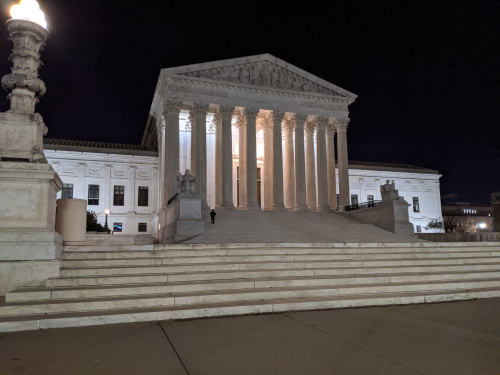
And yes, we really did write up yesterday’s blog post from the Supreme Court steps. Proof:
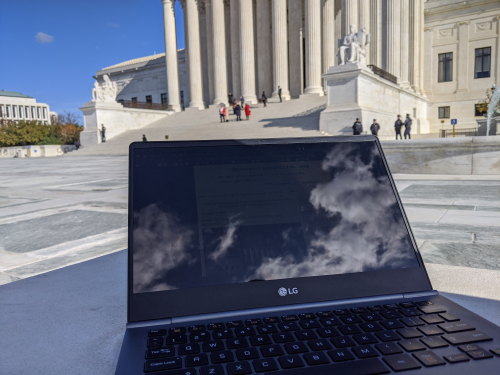
IMG_20191203_125502 (1)Continue Reading We Join IJ’s “Short Circuit” Podcast To Talk Virginia Oyster Takings, Colorado Wild Eminent Domain Abuse Cert Petition, And Berman International

IMG_20191203_055735

We are noted for our ability to find takings and property issues nearly anywhere, and two cases argued today at the Supreme Court — where we had the pole position in the Bar line as the above photo proves — are no exception, even though the first was a case about a tax refund, and the second was about the Superfund statute. 

The tax case was a bit of a stretch, we admit. But there was a brief colloquy about how a taxpayer has property rights to any refund. When we heard that, we sure perked up. There was more to glom onto in the second case on CERCLA (Superfund) where the issue is whether the federal statute allows property owners whose land is contaminated to sue the contaminator under state tort and property law to clean it up. 

As we understand the issues, Atlantic Richfield is such a contaminator

Continue Reading Shades Of Preseault In Big SCOTUS Superfund Arguments

Here’s decision we’ve been anticipating in a case and issue we’ve been following for a while, the question of whether private utilities can be held liable under an inverse condemnation theory for much of the damages caused by the recent California wildfires. 

Short story from the Northern District of California Bankruptcy Court: yes, private utilities can be liable in inverse condemnation:

What Debtors advocate here is to set aside a well-seasoned principle of strict liability. Failing that, they are seeking a solution, fire cost reimbursement, in search of a problem, CPUC’s refusal or unwillingness to allow recovery by a blameless (prudent) investor-owned utility. As noted, they cite no instance when the CPUC denied inverse condemnation cost reimbursement to a prudent operator. And it is the role of the legislative branch, not the judicial branch, to fix problems in advance. As recently as this past July, the California legislature refused

Continue Reading California’s “Well-Seasoned” Inverse Condemnation Strict Liability Principle Not Set Aside By PG&E’s Bankruptcy Court

Following up on the petition, filed last Friday, asking the Virginia Supreme Court to review a trial court’s demurrer which failed to recognize that the owners of a state lease to harvest oysters in the Nansemond River have a property interest . The court concluded that the city and santitation district possess a superior right to pollute the river with sewage.

The case arose when the city and sanitation district declared the oysterbeds “condemned” during certain times of the year because they put sewage into the river. They denied compensation, and the trial court held that Darling v. City of Newport News, 249 U.S. 540 (1919) subjected the lease owners to the city’s superior right to pollute.

We paid a visit to the site a couple of weeks ago to see the pollution source, and how the oysters are harvested in the river. The above video is from that

Continue Reading Videos: Oyster Takings On The Nansemond River

MVIMG_20191108_125325

Just filed: this Petition for Appeal in a case which our William and Mary Law class has a special interest in.

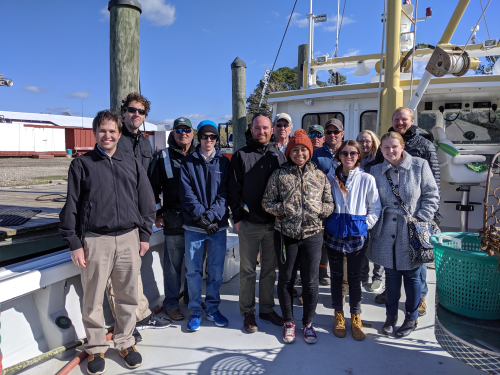
The above photo was taken a couple of weeks ago, when we paid a visit to the property owner/plaintiffs, the owners of a long-standing oyster business operating out of the City of Suffolk, Virginia. The oystermen own a lease from the state for the riverbed, which among other things, allows them to harvest some of the oysters that Virginia is so well known for. But they were forced to bring an inverse condemnation claim in state court, asserting that the City’s dumping of wastewater in the river — and prohibiting the harvesting of oysters during those times — was a taking under both the U.S. Constitution, and Virginia’s taking or damaging clause.

The trial court sustained the City’s demurrer, accepting the City’s argument that it has the right

Continue Reading City: We Have The Right To Pollute – Virginia Oystermen’s Petition Asserting A Taking

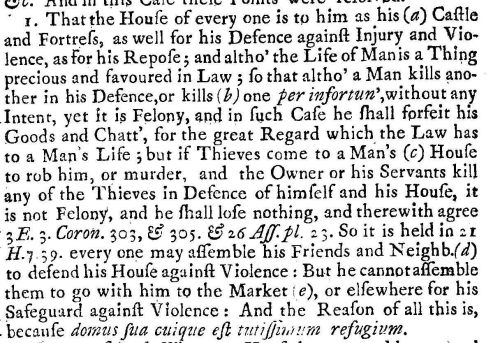
Coke-home is castle quote

Anyone who has followed this blog for any length of time knows that our favorite movie is Australia’s The Castle (yes, eminent domain abuse can be funny!) 

But did you know where the idea that your home is your castle comes from? Like a lot of things, the source is our old friend, Lord Edward Coke (pronounced “cook” or “kook” depending on who you ask). In Semaynes Case, 5 Coke R. 91 (K.B. 1604) he wrote for the court the famous passage above, “[t]hat the House of every one is to him his (a) Castle and Fortress, as well for his Defence against Injury and Violence, as for his Repose …”

You often hear of the “Castle doctrine” being used to describe the right of self-defense without the need to retreat in one’s home. But it is also supports the idea that government agents cannot simply bust down

Continue Reading Lord Coke, And The Whole “Your Home Is Your Castle” Thing

We’re not 100% certain of what the issues are in Landowners United Advocacy v. Cordova, No. 19-1126, a case argued in the U.S. Court of Appeals for the Tenth Circuit yesterday. 

But from what we can gather from listening between the lines to the OA recording (and reviewing some of the District Court documents here), the case is a federal court takings challenge to something the State of Colorado did, and whether the U.S. Supreme Court’s decision in Knick v. Township of Scott, 139 S. Ct. 2162 (2019) limited the impact of the federal Tax Anti-Injunction Act, and whether that statute means the plaintiffs here cannot challenge Colorado in federal court, but must proceed in state court. A similar issue was addressed by the Fifth Circuit recently, in the context of the Eleventh Amendment.

Was the majority in Knick telling us that the self-executing nature

Continue Reading CA10 Oral Argument: “I am a takings law nerd, and I’m going to do my best today to not geek out as I did when the Knick decision came down.”

We were not as creative as our colleague Paul Henry (see below), but our Planning Co-Chair Joe Waldo and I wanted to personally invite you to join the “big guns” in our area of law at the 37th Annual ALI-CLE Eminent Domain and Land Valuation Litigation Conference, January 23-25, 2020, in Nashville, Tennessee.

We’ve assembled an excellent faculty, and an agenda that covers the hot topics of the day. Go here to view the complete faculty list and agenda. Water rights, Knick, appraisal, ethics, civil rights, and a whole lot more in three days of the longest (and we think best) conference in our area of law. Also, for those new to the field, Andy Brigham and Jack Sperber are again leading their “Eminent Domain 101” program. A great way to learn the topic, or for experienced lawyers to get a quick refresher on the basics. Your registration

Continue Reading Don’t Miss Out: Join The “Big Guns” And Secure Your Space At ALI-CLE’s Upcoming Eminent Domain & Land Valuation Litigation Conference (Jan 23-25, 2020, Nashville)

Here’s the video of (most, but not all of) the recent session featuring four lawprofs discussing “Originalism and Constitutional Property Rights” at the Federalist Society lawyers’ meeting. 

Interesting debate, all about the text of the Fifth and Fourteenth Amendments, the “original public meaning of the Takings and Due Process clauses, and all that heady stuff. Here were our major takeaways:

  • Professor Somin argued that decisions like Kelo and Berman are not consistent with the original public meaning of the terms of the Takings Clause. 
  • Professor Merrill asserted there’s a good textualist argument that the Public Use Clause is not a limitation on the government’s power to take. If there’s a private benefit taking, that is best handled by other parts of the Constitution (such as due process).
  • Also, from Prof. Merrill: between Kelo and the backlash, the backlash was the “true constitutional moment.”
  • Professor Lazarus thought the regulatory


Continue Reading What Is The Original Public Meaning Of The Fifth (And Fourteenth) Amendments?