2019

We contributed to Marketplace‘s Morning Report (stream above, or visit this link), and its brief discussion of the California wildfire and inverse condemnation situation, “PG&E tries to get out of its financial responsibility to those affected by west coast fires.” That portion of the broadcast begins at the 1:57 mark. 

Today’s the day that a U.S. Bankruptcy judge will hear arguments about whether holding PG&E and other private utilities which possess the power of eminent domain potentially liable under California’s version of inverse condemnation, itself is a taking under the Fifth Amendment because the utilities do not have the ability to spread the costs of any such judgments to their ratepayers automatically. More on the argument (including the brief) here. The claim is made that the purpose of condemnation is to make sure that the costs of public projects are not borne by individual property (correct
Continue Reading Marketplace Morning Report On Today’s Bankruptcy Court Arguments: Is California’s Inverse Condemnation Rule Itself An Inverse Condemnation Of PG&E’s Property?

We’re not quite sure what to make of the New York Supreme Court, Appellate Division’s short opinion in 82 Willis, LLC v. City of New York, No. 10303 (Nov. 12, 2019).

There, the court held that flooding on an adjacent vacant lot alleged to have been caused by the city’s project to redo the Willis Avenue Bridge (between Manhattan and The Bronx) was “not sufficiently permanent” to support a claim for inverse condemnation. The city condemned easements on an adjacent lot, but did not exercise eminent domain to take any part of the plaintiff’s property.  Although the plaintiff asserted a claim for compensation shortly after the neighboring lot was condemned (2008), it did not assert any claim for flooding until seven years later (2015), when it asserted that a year earlier (2014) its lot was flooded after a rainfall due to a drainage pipe that became blocked by cement. 

Continue Reading New York Appellate Division: Flooding Was “Not Sufficiently Permanent,” So No Inverse Condemnation

20170918_185734_Richtone(HDR)

Here’s the latest in a case we’ve been following for a while, Smyth v. Conservation Comm’n of Falmouth, No. 19-223 (cert. petition filed Aug. 16, 2019). 

The petition seeks review of a Massachusetts decision which held that a judge, not a jury, determines Penn Central takings questions, and also that the owner lost anyhow because, you know, Penn Central. The petition asks the Supreme Court to review these Questions Presented:

  1. Whether the loss of all developmental use of property and a 91.5% decline in its value is a sufficient “economic impact” to support a regulatory takings claim under Penn Central.
  2. Whether a person who acquires land in a developed area, prior to regulation, has a legitimate “expectation” of building and, if so, whether that interest can be defeated by a lack of investment in construction?
  3. Whether the Court should excise the “character” factor from Penn Central regulatory


Continue Reading Latest In SCOTUS Penn Central Cert Petition

Check this out: the Complaint, filed a couple of days ago in federal court against the State of New York (and others), that alleges the state’s recently-adopted rent control regulations is a taking (among other claims). 

It’s a long complaint so we shall leave it to you to delve into the details yourselves. Most interesting to us is that the complaint’s first named defendant is the State of New York as the State of New York.

What about Eleventh Amendment immunity, you ask? 

Read on. 

Compliant, 74 Pinehurst LLC v. State of New York, No. 1:19-cv-06447 (E.D.N.Y. Nov. 14, 2019) 

Continue Reading New Federal Court Complaint: State’s Rent Control Is A Taking

Untitled Diagram-Page-1(1)

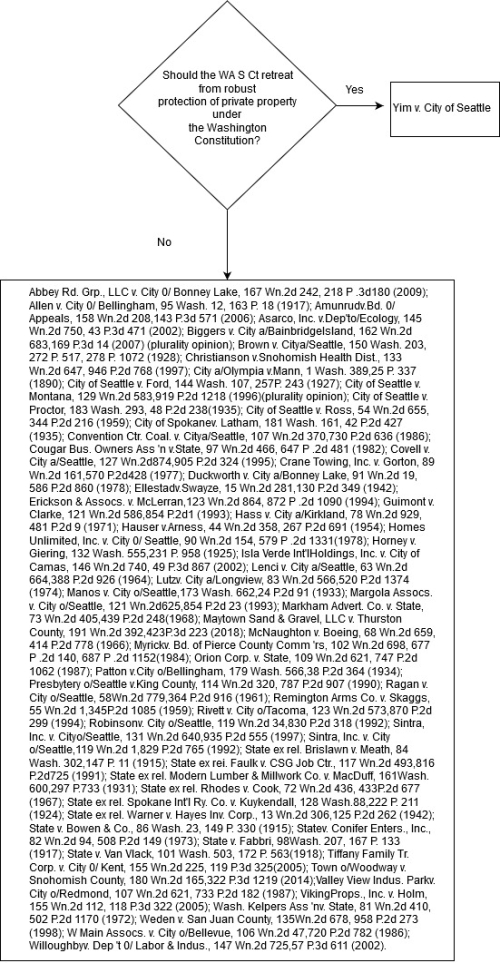
We add a flowchart to this post because the Washington Supreme Court on page 15 of its opinion in Yim v. City of Seattle, No. 95813 (Wash. Nov. 14, 2019) (em banc) (Yim I), includes a flowchart that purports to solve the regulatory takings puzzle once and for all.

Really.

You should check it out. We use “purports” because (surprise, surprise) the court gets it wrong. Flowcharts — also known as decision trees (if A, then B) — are supposed to help, not confuse. And this one doesn’t help if you are trying to figure out if a regulation effects a taking under the Fifth Amendment (and, as a result of the Yim I opinion, under the Washington Constitution). 

If that were not bad enough, in a companion opinion in the same matter (on certified questions from the federal court), Yim v. City of Seattle, No.

Continue Reading Washington (State) Supreme Court: All Those Opinions In Which We Held That Our Property Owners Have Greater Protections Under The State Constitution Were Just “Confused”

All seemed to be going well for the property owners in a Florida takings case. They obtained a satisfactory compensation judgment for the taking of their healthy citrus trees (yes, this is that case). And because Florida’s Constitution requires “full” compensation, they were also entitled to attorneys’ fees and costs. $13 million in compensation, nearly $1 million in fees. Took a while, but so far, so good.

That’s when the Florida Department of Agriculture really dug its heels in. It acknowledged it was obligated to pay compensation, but it simply refused to do so. It didn’t make a request to the legislature to appropriate money to satisfy the judgment, and claimed it has no obligation to do so. The legal equivalent of a middle finger at both the courts and Florida citizens:

Here, as discussed previously, the Department takes the position that it will make no payment of the

Continue Reading Florida Dep’t of Ag’s Middle Finger To The Courts And Property Owners: We Were Ordered To Pay Full Compensation…But We’re Not Going To

IMG_20170726_181554

You may recall that last October, we attended the first round of Supreme Court oral arguments in the Knick case with our William and Mary law class (Law 608: Eminent Domain and Property Rights).  

And even though there’s not a takings case on the Court’s current docket, we figured that the Maui Clean Water Act case was close enough. So we road-tripped it from Williamsburg to DC last Wednesday. And to make sure the six-plus hour round trip was not filled with awkward silence, like last year we asked each attendee to supply at least two songs for our playlist: one song a good “driving” song; the other a song that could be somehow connected to either our class topic (property rights, eminent domain, land use, and similar), or the day’s Clean Water Act and environmental issues. Well done, class, for being creative. 

Here’s what we came up with:

Continue Reading Law 608’s [Continuing] Playlist: More Takings And Related Road Trip Music

Yesterday’s Supreme Court arguments in what is known as the “DACA case” would normally not be something we’d cover on this blog. Yeah, the issue of whether the executive branch has the power to unwind (or, as the cert petition puts it to “wind down”) a prior administration’s executive actions is interesting and all that, but it’s just not in our usual AO (Area of Operations). 

But after reviewing the transcript, we think that those of you who are interested in regulatory takings might find it worth skimming. The reason is that the plaintiffs’ case is for the most part built on their reliance on the DACA program and nonenforcement of immigration statutes. We conformed our behavior to the existing rules in reliance on those rules remaining in place, and therefore a subsequent executive administration can’t revoke those rules, is how we see the argument. For example,

Continue Reading Regulatory Takings Lawyers: Why You Should Pay Attention To The DACA Case

Check this out. The Complaint that we’ve been meaning to post for a while, filed last month in a Los Angeles U.S. District Court, alleging that California’s new rent control laws are a taking, among other things.

Are rent control laws takings? Yes, pretty sure about that. But will courts conclude that they are takings? If past experience is any guide, courts look for (and find) ways to conclude they are not takings, because, you know, this is one government regulatory scheme that people — here, tenants, can rely on (compared to others, where if you claim a property right in government regulation you are, in Chief Justice Roberts’ words, a “chump”).

Chump on, rent control challengers.

Complaint, Better Housing for Long Beach v. City of Long Beach, No. 2:19-CV-08861 (C.D. Cal. Oct. 15, 2019)… 

Continue Reading New Fed Ct Complaint: City’s And California’s New Rent Control Laws Are Takings

Here’s the OA video (courtesy of the Michigan Supreme Court) from last week’s arguments in what we’re calling the “keep the change” case. 

That’s the one where the government is arguing that after a property owner was late paying $8.00 in property taxes, the government is not only entitled to foreclose on the property, but to keep the difference between the sales price and the taxes and penalties owed. As our Louisiana friends might say, that’s a bit more than lagniappe

Eight bucks is more like a rounding error than a significant underpayment, but we get that you do owe every cent. And that when you don’t pay on time, they can hit you up for the taxes owed, the interest, and penalties. But as Gilbert & Sullivan wrote in their famous treatise on Remedies, “let the punishment fit the crime.” They can’t just pocket the difference

Continue Reading Oral Argument In Michigan “Keep The Change” Takings Case