February 2020

RF

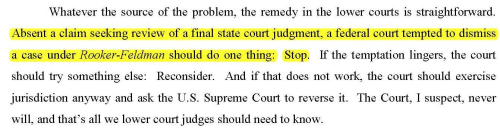
After the recent demise of Williamson County‘s state procedures requirement, we’ve been looking at other ways in which takings claims raised in federal courts may be challenged. You know, things like the Eleventh Amendment, the still-valid final decision rule, full faith and credit and res judicata, and our old favorite obscure legal doctrine, Rooker-Feldman. Especially in the context of judicial takings

You remember the Rooker-Felman doctrine (named after the two Supreme Court decisions which defined its contours), right? All it says is that U.S. District Courts do not have appellate jurisdiction to review final judgments of state supreme court. That’s it. But thanks in part to an article by a law school mentor of ours (Williamson B.C. Chang, Rediscovering the Rooker Doctrine: Section 1983, Res Judicata and the Federal Courts, 31 Hastings L.J. 1337 (1980)), the doctrine was read much more

Continue Reading Sixth Circuit Reminds Us That Rooker-Feldman Does Not Limit Judicial Takings Cases

The local government does stuff that local governments do. Things like improve nearby roads. In doing so, they often interfere with the ingress and egress that nearby landowners enjoy. 

In Clark v. City of Pembroke Pines, No. 4D18-3549 (Feb. 26, 2020), the city had many reasons for erecting concrete barriers (among them the closure of nearby roads). But the end result was that access to Clark’s parcel (which happened to be over the city line, in an adjacent town) was partially (but not totally) cut off:

Before the City’s road construction, Clark had unrestricted access to SW 54th Place in front of his home. Afterwards, he said the barriers significantly impeded his travel because with them in place, Old SW 54th Place effectively became a “one-way, ten-foot-wide road” with no room for vehicles to turn around. Additionally, Clark’s only direct means of east and southbound travel—via SW 199th Ave—was

Continue Reading Substantial Loss Of Access — Even If Not Total — Is A Taking

A super short one (a hair over 4 pages) from the Massachusetts Supreme Judicial Court.

In Gentili v. Town of Sturbridge, No. SJC-12810 (Feb. 24, 2020), the court made short work of a property owner’s claim that an earlier Land Court verdict concluding that the town had obtained a prescriptive easement to discharge storm water on the property was a taking requiring compensation. The Land Court concluded that the fact that the town had been discharging the water since 1987 meant that it had gained an easement to do so (think public adverse possession). Instead of appealing the Land Court’s conclusion about the prescriptive easement, the owners sued in state court for compensation. 

No deal, held the SJC. The Land Court’s order recognizing the easement wasn’t a statutory “order of taking.” Nor did the easement itself amount to a taking — even though a discharge of water on someone’s land

Continue Reading Mass: No Takings Claim For Flooding Because Owner Let It Happen For A Long Time

Peasants carousing

The last two cert-stage briefs have been filed in a case we’ve been following for a while (since it was decided by the Colorado Court of Appeals). 

In Carousel Farms Metro. Dist. v. Woodcrest Homes, Inc., 444 P.3d 802 (Colo. App. 2017), the appeals court invalidated an attempt to exercise eminent domain to take property which the owner had refused to sell to developer Carousel Farms. Although the Carousel Farms Metropolitan District couldn’t point to a present public use or benefit from the taking, it asserted that in the future the public would benefit from the condemnation because if Carousel Farms were allowed to develop its property in accordance with its agreement with the town, the public would receive new infrastructure such as roads and sewers. The trial court upheld the taking, but the court of appeals reversed. The real purpose of the taking was to facilitate the developer’s

Continue Reading Carousing at Carousel Farms: Final SCOTUS Cert-Stage Briefs In Colorado Eminent Domain Abuse Case

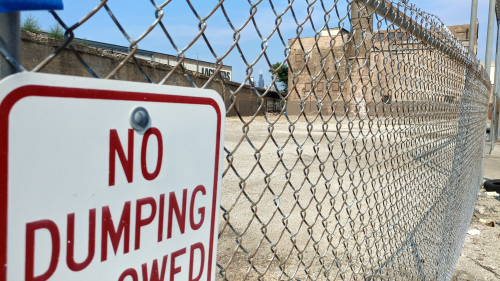
20180805_155740_HDR
Where is this? The clues are all in the picture. 

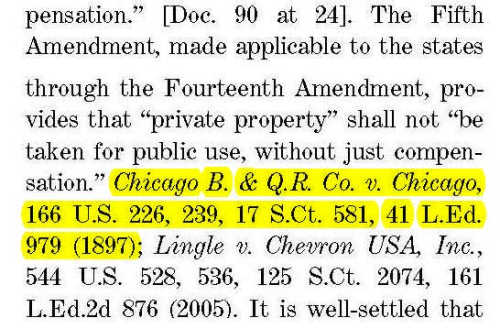
You’ve seen the citation so many times, your eyes probably gloss over it. After all, Westlaw lists it with 4,507 “Citing References.” That’s a heckuva lot of citations to a single case. 

Like this one, pulled from a recent random federal district court opinion: 

Chcago cite

And we admit that we’ve done it: cited (but didn’t read) Chicago B. & Q.R. Co. v. Chicago, 166 U.S. 226 (1897) for the proposition that the rights in the Bill of Rights (in that case, the Fifth Amendment right to Just Compensation) have been selectively incorporated against states and local governments under the Due Process Clause of the Fourteenth Amendment. You’ve done it. We’ve all done it. 

To cure that shortcoming, we read and analyzed the case in our William and Mary class. And before we included it in the syllabus, we had

Continue Reading Just Compensation Site Visit: The First Right “Incorporated” Against States, And Local Govts

We were all set to take a deeper dive into the Court of Federal Claims’s recent opinion in the “downstream” Harvey flooding cases (we could not do so at the time the opinion was issued last week because we were tied up doing real lawyer stuff), when our Reno, Nevada colleague Steve Silva (who most recently was on the faculty at the ALI-CLE Conference in Nashville) beat us to the punch.

On his Taking Nevada blog, Steve has posted “Major flood decision in Texas turns on Divine Intervention” —

Analyzing and comparing tort to taking is difficult. A tort is generally seen as something wrongful. A private injury committed by one person against another. A classic “taking” by exercising the power of eminent domain in direct condemnation to acquire land and pay compensation is not a wrongful act. It merely is.

Further complicating things, the clearest

Continue Reading Steve Silva (Taking Nevada) On Flood Takings, Torts, And Tortes

They’re coming so fast, we can hardly keep up.

Today, in Castillo v. United States, No. 19-1158 (Feb. 20, 2020), the U.S. Court of Appeals for the Federal Circuit resolved a common issue in rails-to-trails takings cases: when a property owner holds title and her deed describes the land as bordering on a railroad line or other easement (or the property is described as a lot in a plat that shows the lot’s “property line” as adjoining a road or railroad easement), does the owner of the adjoining fee estate own the fee interest up to the “centerline” of the right of way?

Applying Florida property law, the court held yes, there is a presumption that the owner’s title goes up to the “centerline.” The court reversed the Court of Federal Claims’s conclusion that the presumption did not apply, and that deeds describing the property as a “less

Continue Reading Federal Circuit: When Road Is The Property Boundary, Owner’s Fee Goes Up To The “Centerline”

Check out the latest (and final) episode of the Institute for Justice’s “Bound by Oath” podcast. IJ’s John K. Ross was kind enough to ask us to be a guest on the show titled “Excessive Fines,” and our friend and colleague Bob McNamara and I sat down in Nashville to record our sound bytes. 

The series (not simply a podcast, but more like an audio documentary) is about the Fourteenth Amendment, and covers (inter alia) how and why the rights in the Bill of Rights have, over time, been applied by the Supreme Court to state and local governments under the Due Process “selective incorporation” doctrine.

So why was a takings guy a guest on a show about the Excessive Fines Clause of the Eighth Amendment?  Because last year in Timbs v. Indiana, the Supreme Court held, in a civil forfeiture case, that the Excessive

Continue Reading IJ’s “Bound by Oath” Podcast, Ep. 9: Excessive Fines, 14th Amendment Incorporation (And The Just Compensation Clause)

Here’s the latest in a long-running, multi-forum takings case about the development of affordable housing on the Big Island of Hawaii. 

Last we saw, the District Court awarded nominal compensation ($1), after the jury concluded that the State of Hawaii took Aina Lea’s property. The parties cross-appealed: the State argues the district court should have granted the State’s JMOL on liability, while the property owner appealed the $1 judgment. 

Today, the Ninth Circuit reversed the District Court’s ‘s opinion, holding that the district court should have ruled in the State’s favor on liability. The court remanded the case for entry of judgment in the State’s favor (meaning even the $1 just compensation judgment is gone). Bridge Aina Lea, LLC v. State of Hawaii Land Use Comm’n, No. 18-15738 (Feb. 19, 2020).

We’re tied up doing lawyer stuff today, so can’t read or analyze the decision in detail. But once

Continue Reading CA9: Remember That $1 The Court Awarded You For The Jury’s Finding Of A Regulatory Taking? We’re Taking That Away, Too

Openthefloodgates

We’re doing lawyer things this week, so can’t do much blogging, so we’re going to just leave this here, the Court of Federal Claims’s Opinion and Order in the case seeking compensation for a taking by the “downstream” owners whose lands were flooded by the U.S. Army Corps of Engineers in the aftermath of Hurricane Harvey. 

Short story: no property, no taking. 

How does the following square with the same court’s (but a different judge’s) ruling about the “upstream” owners?

Two questions must be asked. First, what property did the government take? Second, how did the government take that property? The answers to these questions go to the heart of the Constitution’s taking clause. The waters that actually caused the invasion came from the unprecedented floodwaters from Hurricane Harvey when it stalled over Houston for four days, dumping approximately thirty-five inches of water on Harris County. See Plaintiffs’ Appendix (hereinafter

Continue Reading CFC: God Forced Corps Of Engineers To Open Floodgates