



2020

0fcc0c09-ff44-4f8c-bb01-c2455719ae6d

Next Wednesday, June 17, 2020, at 5:30pm Hawaii Time, we’ll be speaking for the King Kamehameha V Judiciary History Center about “Constitutional Law and States of Emergency: Lessons from the COVID-19 Pandemic.”

This is a one-hour program, open to the public, where we will take a dive into Hawaii’s emergency preparedness and response laws, how Hawaii’s courts have treated emergencies, plagues, pandemics, and quarantines in the past (we have a long history there), and respond to (moderated) audience questions.

Space limited to 100 attendees, although it will be recorded and posted on the Center’s YouTube channel. Here’s the program description:

The King Kamehameha V Judiciary History Center invites you to join our live webinar with attorney Robert H. Thomas as he shares his expertise about constitutional rights and civil liberties during the COVID-19 pandemic. He will share lessons from Hawaiʻi’s history of public health laws during
Continue Reading Upcoming Judiciary History Center Program: “Constitutional Law and States of Emergency: Lessons from the COVID-19 Pandemic” – Wed., June 17, 2020, 5:30pm HST

Here’s the latest court order telling business and property owners that they have little chance of success on the claims asserted in various mostly-constitutional challenges to shut-down orders.

This time the businesses are in North Carolina, and appear to be — ahem — so-called “gentlemen’s clubs” (and by that, we’re not referencing those in St. James’s), which asserted a host of constitutional claims (including takings), and sought immediate relief.

Today, in this order, the district court denied a preliminary injunction (having denied a TRO last week). The main relief sought is an injunction. The entire order is worth reading, even though it doesn’t focus on the takings question. Applying rational basis review, the court concluded that cases like Jacobson show that the governor’s orders “pass[] this deferential test, where it imposes temporary restrictions on businesses to prevent the spread of COVID-19[.]” Slip op. at 19. Allowing some businesses to

Continue Reading Federal Court: Talleywhacker Not Likely To Win Coronavirus Shut-Down Takings Claim

On one hand, the Colorado Supreme Court’s opinion in Forest View Co. v. Town of Monument, No.18SC793 (June 8, 2020), concluding that a restrictive covenant is not a property interest that the government needs to pay for conflicts with the decisions on similar facts from other jurisdictions (Kansas, for example). On the other, the ruling is nothing new under Colorado law, because the court didn’t announce a new rule, but simply refused to overrule a prior case holding the same thing, Smith v. Clifton Sanitation Dist., 300 P.2d 548 (Colo. 1956).

Town wants to build a water tower. Seems like a reasonable goal. It purchased property, another reasonable thing. The property it bought, however, was subject to a covenant, running in favor of the neighboring property owners, that the owner couldn’t use the property for anything other than single-family homes. Last time we checked, single-family homes

Continue Reading Negative Easements Such As Restrictive Covenants Still Are Not Property In Colorado. tl;dr: We Can’t Afford To Consider These Things Property

Way back when (you know, less than 2 months ago, a lifetime in coronavirus time) when the plaintiffs filed the complaint, we noted that, win or lose, it laid out the takings argument in a comprehensive and understandable way.

It still may be that the arguments are worthwhile pursuing. Our more comprehensive thoughts on that subject here (“Evaluating Emergency Takings: Flattening The Economic Curve“). We don’t know yet, because the district court dismissed the suit because the defendants (Michigan’s governor) enjoys 11th Amendment immunity. Yes, even against claims for just compensation. Opinion and Order Granting Defendant’s Motion to Dismiss, Martinko v. Whitmer, No. 2:20-cv-10931 (E.D. Mich. June 5, 2020).

A suit against the Governor in her official capacity is a suit against the State, and there’s no takings exception to 11th Amendment immunity (according to the court). As is often the case, the harder stuff is

Continue Reading Federal Court: Not Going To Deal With Takings Argument Because 11th Amendment

We were all set to dig into the New Jersey Supreme Court’s opinion in Township of Manalapan v. Gentile, No. A-14-19 (June 2, 2020), when our colleague Joe Grather posted about it on their firm’s blog. See also this story (“Manalapan farm owner’s $4.5M eminent domain payday dumped as ‘miscarriage of justice’“) (PS – the video embedded in the story is actually from a different case, not this one). 

The short story is that the property owner’s appraiser opined that the highest and best use of the property was to divide it into smaller lots. The problem was that under its current zoning (RE – “Residential Environmental”) that wasn’t possible. It would need an upzoning to its former designation, R20. But the appraiser did not offer an opinion on whether an upzoning would have been probable, or even possible. During closing arguments, the property owners reminded

Continue Reading NJ: Before Jury Can Make Highest And Best Use Determination, Judge Has “Gatekeeping” Function

Short answer: yes, with a caveat. For why there’s an asterisk on this one, take a look at the Supreme Court’s electronic docket for PennEast Pipeline Co., LLC v. New Jersey, No. 19-1039 (cert. petition Feb. 20, 2020) (a case we’ve been following), and tell me whether you think there’s anything unusual about the list of parties, amici, and their counsel.

SCOTUS Überlawyers? Check. Big well-funded parties? Check. Heavy-hitter amici? Check.

But the one thing missing, we noticed, was the property owners’ bar. No Mike Berger, neither of the Ilyas (Somin or Shapiro), no PLF, no IJ, no Carolyn Elefant, no Chris Johns, no NFIB, none of the other individuals or groups who often weigh in on property questions on either side (and yes, no Owners’ Counsel). This might strike you as odd, in a case where the Question Presented is about eminent domain:

Whether the NGA delegates

Continue Reading Should Takings Mavens Follow The Latest Eminent Domain Case At SCOTUS?

EX A

Here’s the city’s Brief in Opposition in a case we’ve been following (so closely, in fact, that we filed an amicus brief in support of the property owner – see “Amicus Brief: Invocation Of “Police Power” Is Not Dispositive In Takings“). A case in which the issues have taken on new and heightened importance.

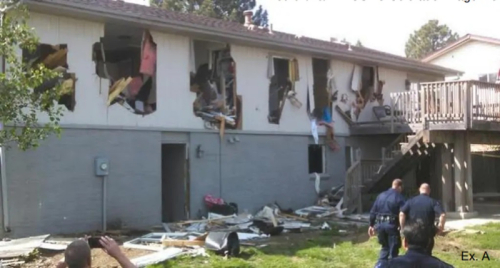
This is the case where the municipal police pretty much destroyed a family home in the course of their efforts to dislodge a shoplifter who had taken refuge there while fleeing. The homeowner sought compensation for a taking. The Tenth Circuit, however, concluded “no taking” because the police were exercising the police power. And you can’t have a taking where the government is exercising the police power, right?

The homeowner filed a cert petition, arguing that “[t]he question presented is whether there is a categorical exception to the Just Compensation Clause when the

Continue Reading BIO In “Police Power” Takings Case: Can A Municipality Be Liable For A Taking If The Police Destroy Private Property In The Course Of Apprehending A Suspect?


Here’s the recording of the Federalist Society’s Environmental Law & Property Rights Practice Group teleforum we did a couple of weeks ago, “COVID-19 & Property Rights: Do Government Actions in Response to the Coronavirus Pandemic Create Compensable Takings?” Stream above, or download it here.

The issue: how should courts evaluate the claims for compensation arising out of emergency measures? This question is on the front burner at the moment (and will continue to be because the courts will likely be confronted from these type of claims as the fallout continues). For example, here are some of the complaints that have been filed in courts around the nation: see here, here, here, here and here.  

The two featured speakers (Professor Ilya Somin and Professor F.E. Guerra-Pujol), not only debated and answered questions for an hour

Continue Reading Podcast: COVID-19 & Property Rights: Do Government Actions in Response to the Coronavirus Pandemic Create Compensable Takings?”

There’s a lot of opinion in the U.S. Court’s of Appeals’ opinion in Stratta v. Roe, No. 18-50994 (May 29, 2020). Yes, the court reversed the district court’s dismissal of a takings claim. But most of the opinion is devoted to the question of whether a Texas water conservation board — an agency whose mission is to regulate surface water uses — may take advantage of the State of Texas’s 11th Amendment immunity (no, held the court). We recommend that part of the opinion to you, federal courts junkies.

But there’s a couple of takings gems in there also. The case involved a challenge by a property owner who was (allegedly) treated by the water conservation board less generously than an (allegedly) similarly-situated municipality, resulting in the owner’s inability to make use of its groundwater rights. (In short, a Pennsylvania Coal claim, where instead of coal being required to

Continue Reading Fifth Circuit: Texas Groundwater Rights Are Takings Clause “Property”

Did you know that the North Carolina Constitution does not formally contain a “takings” or “just compensation” clause? Instead of an outright prohibition on uncompensated takings for public use, the N.C. Constitution has a “law of the land” clause:

Sec. 19.  Law of the land; equal protection of the laws.

No person shall be taken, imprisoned, or disseized of his freehold, liberties, or privileges, or outlawed, or exiled, or in any manner deprived of his life, liberty, or property, but by the law of the land.  No person shall be denied the equal protection of the laws; nor shall any person be subjected to discrimination by the State because of race, color, religion, or national origin.

N.C. Const. art. I § 19.

The lack of an express takings clause, of course doesn’t t mean that the government can just take property and has no obligation to provide compensation.

Continue Reading NC Considering Constitutional Amendment: Compensation For Emergency Shut-Downs