2020

The town grabs, then sells property for failure to pay property taxes. The sales price is more than the tax lien. Does the town have an obligation to give the owner the difference, or can it keep it unless the owner sues?

Thanks to a colleague who sent us the case, we know that was the issue facing the New Hampshire Supreme Court in Polonsky v. Town of Bedford, No. 2019-0339 (Apr. 24, 2020). Short story: yes, the town needs to affirmatively give the extra money back, and no, the town can’t keep it unless and until the owner sues to get it. To read the statutory scheme otherwise would result in an unconstitutional taking.

Check it out (quick read, only 13 pages). 

A couple of notes:

  • The owner asserted his rights under part I, article 12 of the New Hampshire Constitution (“no part of a man’s property shall


Continue Reading NH: Govt Keeping Excess Proceeds Of Tax Sale Is A Taking

As we understand it, at some of our leading law schools the basic Property course is no longer a required 1L course. It’s an elective. Quelle horreur

We think that’s a bad idea. Our Property I course (a 4-credit one-semester monster) is where we learned about things like treasure trove (finders, keepers – losers, weepers), fee tail, and the dreaded Rule Against Perpetuities from the venerable Allan F. Smith. It’s also where we first learned of vested rights and zoning estoppel. Thank you Professor Smith. What a shame it would have been had we not been required to take that course where we learned so much about the vibe of the law (not just property law). 

Hawaii’s vested rights and estoppel rules as developed over the years by the courts are based on constitutional and equitable principles: if someone receives “official assurances” from a government official

Continue Reading How Property Law Helped To Save Hawaii’s Mother’s Day

If you missed the three-and-a-half hours (!) of this morning’s teleconferenced oral argument of the en banc U.S. Court of Appeals for the D.C. Circuit in a case we’ve been following (along with a related case), well, you are in luck. There are multiple ways to listen in. You can stream it from YouTube above. you can stream it below, or you can download the mp3 from the court’s website. Whatever way you choose, you should do so. 

This is the case that reminded us of Samuel Beckett’s classic absurdist play, Waiting for Godot. Two guys spend the entire time waiting for another guy (you know who) to show up, but he never does. There are nearly endless interpretations of its meaning (if any), but everyone pretty much agrees that it is at least about the nature of life and its existential meaningless, while both characters and the

Continue Reading DC Cir (En Banc) Hears 3.5 Hours Of Oral Argument In Pipeline Public Use Challenge To FERC’s “Waiting for Godot” Process

On one hand, there’s a lot going on in the Maryland Court of Appeal’s opinion in Maryland Reclamation Assoc, Inc. v. Harford County, No. 52 (Apr. 24, 2020), a case we’ve been following. The opinion is a whopping 81 pages, and details facts that go back decades. On the other hand, the opinion doesn’t actually say a lot. 

But what it does say is a doozy.

Here’s your BLUF (Bottom Line(s) Up Front):

  • Maryland agencies have jurisdiction to consider and rule on state constitutional issues including takings. Apparently, this is not something the court adopted in this case, but is a long-standing practice in Maryland. Count us as very surprised that agencies have the power to adjudicate constitutional rights. Very, very surprised.  
  • A property owner must raise their Maryland Constitution takings claim and present it for adjudication to very agency accused of taking property without compensation. 
  • The property


Continue Reading Maryland Resurrects California’s Agins Rule: Owner Must Seek Agency Variance, Which If Granted, Means “owner no longer has a takings claim and the right to alternative relief in the form of just compensation”

6a00d83451707369e201b8d25028d2970c-800wi

CHALLENGE: find the “damage” on the Loretto building

Here’s the amicus brief filed today by Pacific Legal Foundation that urges the Supreme Court to grant our cert petition in a case that asks:

To constitute a taking under the Fifth and Fourteenth Amendments, must a physical invasion also destroy or substantially impair an owner’s economically beneficial uses of property?

Yes, takings mavens, we’re talking Loretto and related. (If you want to see the truly “de minimis” invasion — and no damage — that resulted in Justice Marshall in that case concluding that the Takings Clause imposes a “categorical duty” to provide compensation for physical invasions, check out some recent photos of the Loretto building on Manhattan’s Upper West Side.)

Here’s the amicus brief’s Summary of Argument:

The Fritzes’ petition for a writ of certiorari raises an important question concerning the protections provided by the Takings Clause of the Fifth Amendment

Continue Reading New SCOTUS Amicus Brief Highlights Govt’s “Categorical Duty” To Compensate, Even Without Substantial Damage To Remainder

IMG_20191106_112246

As any takings lawyer can tell you, ad hoc rules and non-exhaustive lists of “factors” a fact-finder considers can be seductive. After all, shouldn’t the outcome of a case turn on its particular facts? Who could argue with that?

The problem lies when those factors are applied in a way that seems more like one of the very bright-line rules that a list of factors is meant to avoid. For example, in the takings context, we see the “polestar” Penn Central ad hoc regulatory taking three-factor test being applied most consistently as a one-strike-and-your’re-out test that (almost invariably) means the property owner loses. In theory, it might make some sense, but in practice it has become more like a per se rule: you lose, property owner. That isn’t truly a “case-by-case” analysis. 

Now, in takings that may be by design — you at least can see why the Supreme Court

Continue Reading We’re All Ad Hoccers Now: SCOTUS Penn Centralizes The Clean Water Act (“From” Is Too Hard To Define, So Here’s A List Of Factors)

ALICLE-tagline-250x90

There’s still time to join us tomorrow, Friday, April 24, 2020 at 2-3pm Eastern Time, they will be presenting “Strategies for Litigating Regulatory Taking Cases” in a webinar produced by ALI-CLE. Register here (multiple attendee discounts available). 

At the recent ALI-CLE Eminent Domain and Land Valuation Litigation Conference in Nashville, our colleagues, New York’s Jon Houghton and Hawaii’s Dave Day presented a very informative program on litigating regulatory takings cases. Jon is a property owner-side lawyer, while Dave is a Deputy Attorney General who represents the State of Hawaii in such cases. So it was a practical and balanced presentation. Jon and Dave are taking it to the next level. This isn’t simply a repeat of their Nashville program, but they will be exploring in more detail the practicalities of building and defending these difficult cases. 

Here’s the description of the program:

The U.S. Constitution provides that

Continue Reading Still Time To Join Us (Tomorrow): ALI-CLE Webinar – Strategies for Litigating Regulatory Taking Cases

FULJ_logo_2-5-300x66@2x

Lacking things to read during your shut-down? Well, we have the solution: the Fordham Urban Law Journal has devoted an entire issue to Knick and takings ripeness (“Taking Account: Procedure, Substance, and Stare Decisis in the Post-Knick World“). 

Our article “Sublimating Municipal Home Rule and Separation of Powers in Knick v. Township of Scott,” 47 Fordham Urb. L.J. 509  (2020), leads the way (thank you, editors).

Other articles:


Continue Reading Takings Nerd Christmas: Fordham Urban Law Journal’s Knick Symposium (feat. “Sublimating Municipal Home Rules and Separation of Power in Knick v. Township of Scott”)

In a case that uses terms that might reasonably lead you to think it was lifted from the script for the next stoner comedy, the U.S. Court of Appeals for the Federal Circuit, in Gadsden Indus. Park, LLC v. United States, No. 18-2132 (Apr. 22, 2020), held that an owner of land on which the byproduct of milling steel was dumped possessed a property interest in some of the “slag,” but not as much of it as the owner claimed. The court also held that the property owner did not introduce evidence of its loss of use of the “kish” or the “scrap.” 

Before we go any further, here’s your daily dose of learning:

Slag, a byproduct of steel manufacturing, is “a non-ferrous material that separates during smelting.” Gadsden Indus. Park, LLC v. United States, 138 Fed. Cl. 79, 92 (2018) (Decision). Kish is “a ferrous byproduct

Continue Reading Fed Cir Bummer: Govt Bogarted None Of Your Kish, Slag, Or Scrap

Like that old radio bit “Chicken Man” (“He’s everywhere! He’s everywhere!“), it looks like the robed ones down at 1 First Street NE are, like us, seeing takings lurking in cases where takings may not be the first thing on the menu. 

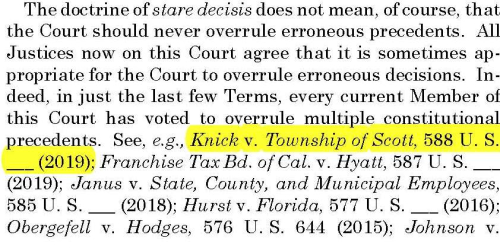
For example, in yesterday’s opinions about whether the Sixth Amendment requires unanimous criminal juries (yes), Justice Kavanaugh, commenting on the Court’s overruling of earlier decisions — the whole stare decisis debate — wrote this:

Knick reference

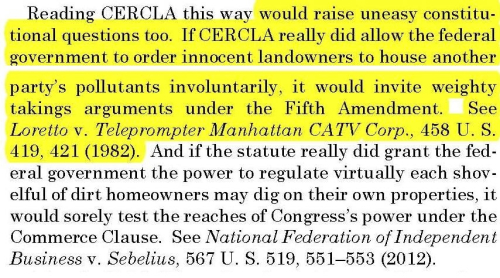
In the Montana CERCLA case we’ve been following (we attended arguments back in December), Justice Gorsuch noted the same takings vibe we noted. See “Shades Of Presault In Big SCOTUS Superfund Arguments” — that, like rails-to-trails cases, the feds may have the power to infringe on property rights, but that then raises the takings question:

CERCLA

We raised the same “storage of government’s stuff” on your property/Loretto

Continue Reading Shades Of Takings In Both Of Yesterday’s SCOTUS Opinions