2020

Here’s the latest complaint challenging a governmental business shut-down order. In this case, it is an order by the Michigan governor. We’ve seen similar lawsuits recently (see here, here and here, for example). So far, these complaints have have not met with receptive audiences. This one was tossed aside quickly. This one resulted in an opinion, but also lost.  

But unlike the other complaints, this latest one puts the takings argument front and center and lays out, in great detail, the theory behind the argument. It reads more like a brief (or maybe a press release) than the typical “short and plain statement” complaint. 

Does that mean we think it has any better chance than other efforts? No, for the same reasons that so far, we haven’t seen a takings claim that jumps out to us as one highly likely to get traction. Doesn’t mean the

Continue Reading A Clean Well-Pleaded Complaint: Latest Takings Challenge To Shut-Down Order
Here’s the cert petition that along with our colleague Steve Jakubowski we’re filing today in Campbell v. United States, No. 19-___, in which we ask the Court to review the Federal Circuit’s ruling that the plaintiffs in a Court of Federal Claims takings case missed the Tucker Act’s statute of limitations (28 U.S.C. § 2501).

This one focuses on the interplay between Williamson County‘s “final decision” ripeness rule and the “case and controversy” injury-in-fact standing requirement, and asks: if the government makes its final decision, but the plaintiff isn’t injured until later, has there been an actionable taking?  

Often, the date on which the government ripens a takings claim by making the final decision to apply the regulation to the plaintiff’s property, and the date on which the plaintiff’s property rights are actually affected are the same. But here, the two key events happened on different dates. The

Continue Reading New Cert Petition (Ours) Offers A Moment Of Zen: If The Government Makes The Final Decision But The Property Isn’t Yet Actually Injured, Must The Owner Sue For A Taking Now?

Here’s what we’re reading today. Some related to the lockdown, some not:

Continue Reading Linky Friday: What We’re Reading Today

Unlike a sibling federal court in a similar case (see that court’s TRO order below), a Florida court has declined an emergency motion challenging government officials’ coronavirus-related shut-down and stay away orders.

This is the case we’ve been following in which property owners challenge the local government’s order that they stay off beaches. The difference between this and other cases ordering people to keep away from beaches and parks is that in this case, the beaches are alleged to be private. The complaint is posted here

Although we do not yet have a written order denying the TRO, the court’s minute order notes, “the Court orally denies the Emergency Motion.” See alsoJudge rules against Walton beach property owners who sought exemption from closure order” from the local newspaper, which reported on the hearing:

During the hearing Vinson delved, at times, into the overriding issues that Walton

Continue Reading No TRO In Private Beach Taking-By-Shutdown Case

This morning, the Supreme Court of Virginia heard oral arguments (by telephone) in a case we’ve been following.

This is an inverse case that asks whether less than a total loss of access to a parcel could be taking — did the owner plead enough to put the issue to a jury — and is the government’s mere invocation of a “police power” rationale to cut off access is enough to insulate it from the payment of compensation.

When Hooked proposed to develop its property, the City of Chesapeake closed Callison Drive, the street adjacent to Hooked’s property after the neighbors complained. This cut off Hooked’s direct access to Callison Drive, even though it still had access from and to its property from a second street.

The trial court dismissed (demurred) Hooked’s inverse condemnation claim, concluding that the City was exercising its police power when it closed the street

Continue Reading Supreme Court Of Virginia Oral Arguments In Important Inverse Case: Must An Owner Allege Loss Of All Access To Plead A Taking?

Here’s the latest in a case we’ve been following since it was filed just a couple of weeks ago.

This is the one where “Friends of Danny Devito” (no, not that Danny Devito) sued the Pennsylvania governor challenging shut down orders under a variety of theories. Including a takings claim, of course.

Well, the Pennsylvania Supreme Court acted quickly, and just a couple of days ago issued an opinion that came out pretty much the way we expected, especially on the takings claim. We recommend you read it (not only for your virtual cocktail parties, since nonlawyers will ask about this stuff even if it isn’t your bag), but because we think the court make a good point when it rejected the state’s argument that the shut down orders are an exercise of the Commonwealth’s “police powers” and not its eminent domain power. Therefore, the Commonwealth argued

Continue Reading Pa Supreme Court Rejects Takings Challenge To Shut-Down Order

Lech

Today, along with our colleague Bill DeVinney, we filed this amicus brief in support of the property owners’ cert petition in a case we’ve been following for a while. 

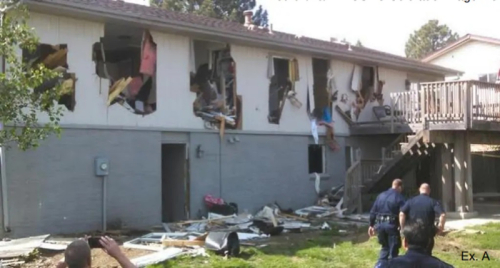
Yes, this is the case where the Village police pretty much destroyed a family home in the course of their efforts to dislodge a shoplifter who had taken refuge there while fleeing. Homeowner sought compensation for a taking. The Tenth Circuit, however, concluded “no taking” because the police were exercising the police power. And you can’t have a taking where the government is exercising the police power.

Instead of summarizing our brief, how about we just post the Summary of Argument:

This Court should review the Tenth Circuit’s holding that action taken by the government under its police power—as opposed to an exercise of eminent domain—can never trigger a taking under the Fifth Amendment’s Just Compensation Clause. This brief makes two main

Continue Reading Amicus Brief: Invocation Of “Police Power” Is Not Dispositive In Takings

Title

To all who joined from Hawaii and across the nation, thank you for doing so. As I mentioned during the webinar, here is the video and links to the cases and other materials I spoke about: 

  • “Emergency does not create power. Emergency does not increase granted power or remove or diminish the restrictions imposed upon the power granted or reserved.”  Home Building & Loan Assoc. v. Blaisdell, 290 U.S. 398 (1934).  
  • The King v. Tong Lee: Hawaii Supreme Court upholds restrictions on commercial laundries in Honolulu’s Chinatown deferring to the government’s assertion that doing so was necessary to preserve the public health. 
  • United States v. Pac. R.R., 120 U.S. 227 (1887): during the Civil War, the Union Army blew up railroad bridges “to prevent the advance of the enemy.” No compensation because the destruction of the bridges was a “military necessity.” “The destruction or injury of


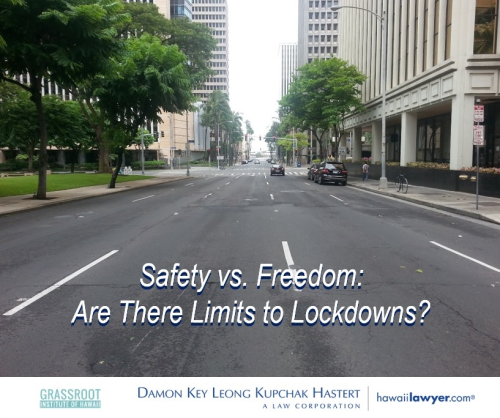
Continue Reading Video, Materials And Links From Today’s Webinar, “Safety vs. Freedom: Are There Limits to Lockdowns?”

This is mostly for our 808 sisters and brothers, but the rest of you might also find it interesting as well, because it is a Chief Justice of a state supreme court talking directly (to a lawyer-interviewer) about the measures which the third branch of state government is undertaking during lockdown.

Chief Justice Mark Rectenwald interviewed by Jay Fidell on Think Tech HawaiiContinue Reading Think Tech Hawaii (Jay Fidell)’s Interview With HAWSCT Chief Justice

Today’s Federal Circuit opinion in Golden v. United States, No. 19-2134 (Apr. 10, 2020) is the latest in the post-Oil States cases involving the alleged taking of patents.

Golden asserted three theories:  

The complaint alleges the takings occurred by virtue of: (1) the government’s use, manufacture, development, and disclosure of the subject matter “outlined” in the claims and specifications of Golden’s patents; (2) the cancellation of certain patent claims during the [inter partes review] initiated by the government; and, (3) certain actions by the Claims Court and the Federal Circuit in the Lead Case.

Slip op. at 6.

The Federal Circuit rejected each of these theories.

First, the court held that an allegation that the feds infringed on Golden’s patents was a tort claim, not takings. Slip op. at 10 (citing Schillinger v. United States, 155 U.S. 163, 168-69 (1894) (infringement claim “is one sounding

Continue Reading Fed Cir: Patent Infringement Claim Is A Tort, Not A Taking (Nor Is Inter Partes Review)