2020

20160114_125445

Here’s an article, just published in the American Planning Association’s monthly magazine, Planning (read the entire April issue here), summarizing the Ninth Circuit’s latest foray into regulatory takings, Bridge Aina Lea, LLC v. State of Hawaii Land Use Comm’n, No. 18-15738 (9th Cir. Feb. 19, 2020).

In Legal Lessons – What Constitutes Loss? we write about the decision and the court’s conclusion that losses short of 100% do not qualify for a per se Lucas taking, and are not enough to tip the scales for a Penn Central taking either. The opinion also adds to the growing confusion about whether the regulatory takings doctrine deals with use or value.  

Our thanks to the APA for asking us to contribute, for making the editing process so easy, and for allowing reprinting of the piece here. Check it out. 

Legal Lessons – What Constitutes a Loss? Planning Magazine (Apr. Continue Reading New Article: Ninth Circuit’s Latest Foray Into Lucas And Penn Central Takings

Wikipedia

Thanks to lawprof Josh Blackman for pointing out this Order from a federal district court dealing with the “is the government’s outlawing bump stocks a taking” question. See Blackman, District Court Finds Bump Stock Ban May Constitute a Taking, Because the Federal Government Lacks a Police Power (Volokh Conspiracy). 

We’ve delved into the issue before (“One From The Gut: Outlawing ‘Bump Stocks’ Not A Taking“), concluding that the likelihood of success on these type of claims — is the DOJ changing its mind about whether a bump stock qualifies as a banned “machine gun” — is remote. Not because there’s a jurisprudentially-consistent reason why, but just because it is.  

The court’s order denying the federal government’s motion to dismiss (without prejudice) is both cheeky (see above re Wikipedia) and an enjoyable read (“For example, state governments have determined that cocaine should be illegal because of the

Continue Reading Federal Court: “Takings law is difficult” (But Let’s Not Cross That Bridge Just Yet In Bump Stock Case)

We don’t usually post trial court decisions, but when one comes along that tees up some interesting issues and is likely to get pushed further up the food chain, we’re all ears.

That’s the case with the Eastern District of North Carolina’s order in Zito v. North Carolina Coastal Res. Comm’n, No. 2:19-CV-11-D (Mar. 27, 2020). A North Carolina property owner alleged that the application of the Commission’s shoreline setback rules are a taking, and filed a suit in federal court. Yes, this is a federal court deciding a regulatory takings claim (yay, Knick). 

The property owners did all of the right things to ripen their claim. They obtained a final agency decision (helpfully labeled the “Final Agency Decision”) and were denied a variance. And although the owners filed their federal lawsuit before Knick, by the time the District Court was considering the Commission’s motion to dismiss,

Continue Reading Backing Back Into Williamson County: Federal Court Case Tees Up 11th Amendment Immunity For Takings

Here’s the latest in a case we’ve been following. We even visited the site with our class last year. 

Today, the Virginia Supreme Court heard argument on the petition for appeal (streaming above from the webstream, or download the mp3 here) in what we call the oyster case because it involves the property rights of Nansemond River oystermen, whose oyster beds were polluted by sewage from the City of Suffolk.

Bottom line from today’s argument: no decision yet. These arguments are short (10 minutes), only the petitioner is allowed to argue, and today’s argument did not elicit any questions from the three-Justice panel. So we wait. 

Some background, since this is a case at the intersection of property and takings law, and environmental protection. The oystermen own a lease from the state for the riverbed, which among other things, allows them to harvest some of the oysters that Virginia

Continue Reading SCOVA Oral Argument: Does A City Have The Right To Pollute Chesapeake Bay?

Real_liberty

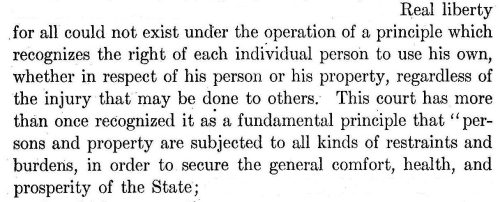
Here’s what we’re reading today, spurred by the headlines swirling around all of us. Mostly cases about the role of the courts when government curtails liberty or property rights under its police or emergency powers. We’ve now seen the first lawsuit claiming that an order to shut down businesses is a due process violation and is a regulatory taking requiring compensation, and we’re hearing about official quarantines, citations for people violating stay-home orders, and the like. 

We started with the vaccination cases. These got us to thinking that if the government can for the most part force people who don’t want vaccinations to get vaccinations (violating their bodily integrity), then how will a court treat seemingly less-invasive intrusions into liberty or property in the name of public health? 

In Jacobson v. Massachusetts, 197 U.S. 11 (1905), the Court distinguished “an absolute right in each person to be, at all

Continue Reading More Readings: “Real Liberty,” Vaccination, Plague, Police Power, And Takings

Well, here it is. What looks like the first complaint to be filed challenging a state governor’s order to shut down businesses to “flatten the curve.” 

The complaint seeks class action status, and raises section 1983, due process, and Fifth and Fourteenth Amendment takings claims. It seeks damages, compensation, a declaratory judgment, and, interestingly, an injunction prohibiting enforcement of the shut down order “unless, and until, a mechanism is established to provide (a) just compensation for affected businesses and (b) appellate review of Governor Wolf’s classifications determining whether individual businesses are ‘life sustaining.'” Complaint at 39.

We’ve written about this issue recently here:

More, from law.com

Continue Reading First Takings Lawsuit Challenging Business Shut-Down Order

The materials we were reading yesterday (particularly Steve Silva’s “History: Fire and Blood(worth),” got us to thinking. There, Steve wrote about the  September 2, 1666 London fire which destroyed 80% of the city, the government’s emergency powers, and compensation. He also brought up a subject we had not know of before: the subsequent legislation — the Fire of London Disputes Act  1666 (18 & 19 C. II. c.7)* — which created the “Fire Court.”

That court — comprised of learned judges from existing courts (K.B., Common Pleas, and Exchequer) — was created to resolve “Differences touching Houses burned or demolished by reason of the late Fire which happened in London” between landlords and tenants. The court began its seating on January 1, 1668. The legislation charged the court with resolving disputes about the required rebuilding, property boundaries, the “Rents as if the same had not been burned,” and

Continue Reading Time For A “Coronavirus Disputes Court?”

Kimball_page

It’s tough with all that’s swirling around all of us to keep focused on non-virus related things. But because we think that’s one way to keep calm and carry on, we shall continue to endeavor to do so. But come on, being takings and dirt lawyers we also can’t help viewing current events through that lens, no? Consequently, we shall also continue from time-to-time to post about issues that have cropped up in practice that are related to the thing that is on everyone’s mind these days.

In that vein, here’s the latest on-topic things we’ve been reading: 

  • History: Fire and Blood(worth) – Steve Silva, Taking Nevada blog (“Many argue, with great merit, that when a person’s property is sacrificed to preserve the public health, that the person is entitled to compensation. But the law has not yet reached that conclusion, … [and] there is no legal mandate


Continue Reading Latest Readings: On Emergency Takings, Compensation For Commandeered Property

19-1277.Opinion

The work of the courts goes on, and as long as there’s stuff to report, we’ll keep reporting as usual.

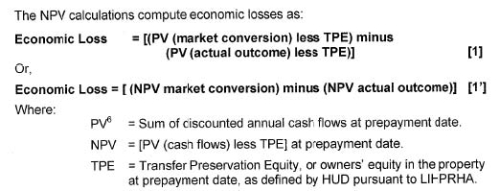
Yesterday, the U.S. Court of Appeals for the Federal Circuit issued an important takings decision in a case and issue we’ve been following for what seems like forever. In Anaheim Gardens, L.P. v. United States, No. 19-1277 (Mar. 25, 2020), the court held that a property owner in a regulatory takings case asserting a Penn Central taking may prove the “economic impact” factor by introducing evidence “by demonstrating their lost opportunity to earn market-rate rental income after prepaying their mortgages.” Slip op. at 17. The Court of Federal Claims had precluded such evidence, concluding instead that the before-the-regulation and after-the-regulation method was the only proper way. 

Here’s the short story: the feds adopted programs providing incentives to developers to build low-income housing. The programs offered below-market 40-year mortgages

Continue Reading Mi Casa Ain’t Su Casa: Proof Of Lost Opportunity Is Evidence Of Penn Central’s “Economic Impact” Factor

As long-time readers know, we often kvetch about the way many courts ignore the Palazzolo rule that simply because someone obtains property subject to preexisting restrictions on use does not preclude them automatically from raising takings claims. See here, here, here, and here, for example. More about the Palazzolo case here, including video.

But not all courts get it wrong, however. Now you can add to the plus-column the Florida District Court of Appeal (Second District)’s decision in Jamieson v. Town of Fort Myers Beach, No. 2D19-238 (Mar. 25, 2020).

The court held that a property owner who purchased land that earlier had been designated as 100% “wetlands” on the Town’s land use map was not prohibited from pursuing takings (and since this is Florida, Bert Harris Act) claims. The case is a two-fer, because the court also concluded that the claims were ripe

Continue Reading Talkin’ ‘Bout My Palazzolo: Takings Claim Not Precluded Because Owner Purchased Land Already Subject To Wetlands Regs