2020

Front page

Here’s one for our Hawaii folks, in case you all are curious about the origins of the analytical framework which courts use to review the legality of measures taken by the authorities in the name of “public health” that have an impact on the uses of private property.  

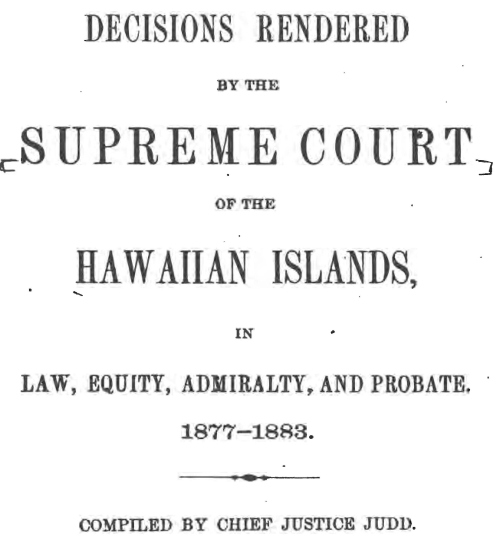
As far as we can tell, The King v Tong Lee, 4 Haw. 335 (Kingdom 1880) (in banco), is the first Hawaii case which uses the term “police power,” and which upheld the broad – and nearly unreviewable – authority of the government to limit the uses of property, as long as there’s a colorable argument that the property’s use is contrary to the public health.

There, the Kingdom’s legislature (one of the joys of practicing law in Hawaii is that you get to deal with cases involving the Kingdom; things like Privy Council, the royal prerogative, and the like) prohibited

Continue Reading The Royal Origins Of “Police Power” Hawaii-Style: The King v. Tong Lee (1880)

IMG_20170727_105403

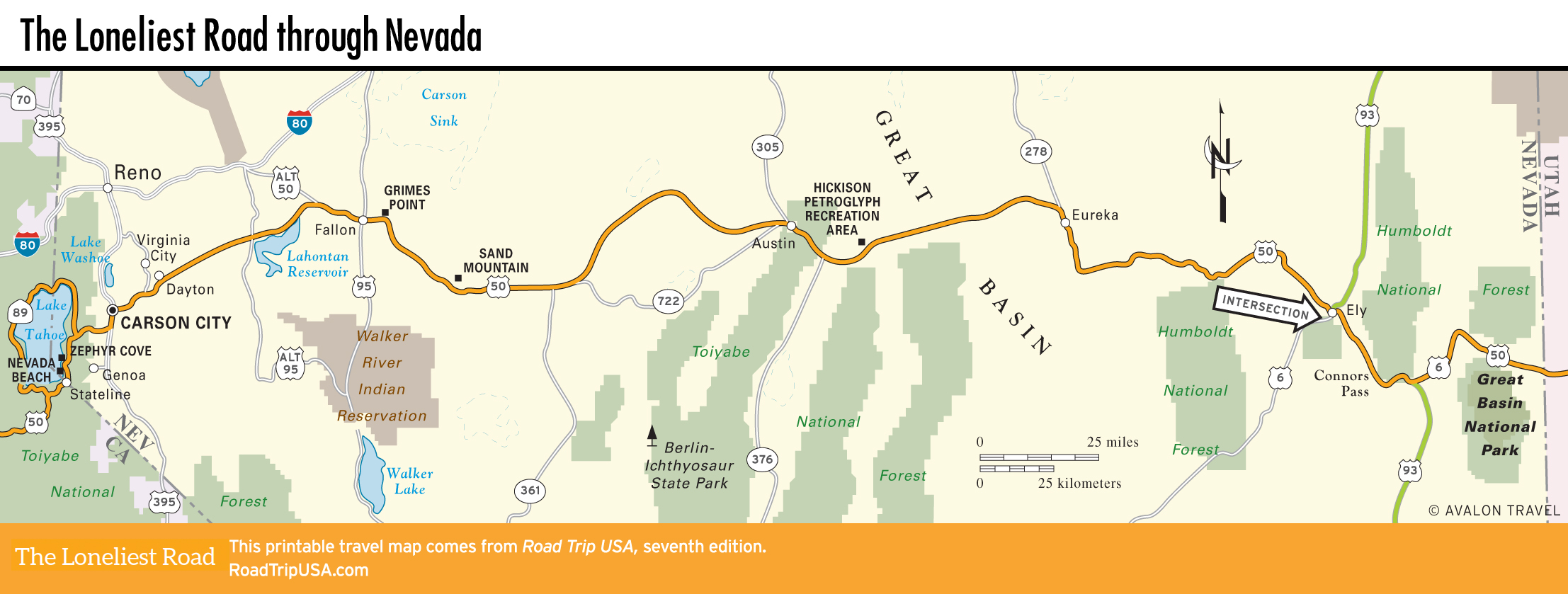
US 50 in Nevada – the “Loneliest Road”

Here’s the cert petition which we and our Nevada colleague Luke Busby filed today, asking the U.S. Supreme Court to review this Question Presented:

Conflicting with Loretto v. Teleprompter Manhattan CATV Corp., 458 U.S. 419 (1982), the Supreme Court of Nevada concluded that to prevail on a physical takings claim a property owner must show that a flood “effectually destroy[ed] or impair[ed] [the property’s] usefulness.”

The question presented is:

To constitute a taking under the Fifth and Fourteenth Amendments, must a physical invasion also destroy or substantially impair an owner’s economically beneficial uses of property?

Rather than summarize the case and the issues, here’s the Introduction: 

Physical occupations—as distinctly invasive public uses of private property—are treated by this Court differently than regulatory takings. Although the Court has consistently avoided adopting categorical rules in most takings cases, it has also long-recognized that

Continue Reading New Cert Petition (Ours): Must An Owner Whose Land Is Flooded Also Prove “Substantial” Loss Of Use?

Torromeo Industries owned a 12-acre parcel zoned “Industrial.” Two buildings — one a home, the other a 4,000 square foot industrial building — were on the land. Sole access to the property way by a private driveway along the 149 foot frontage of the parcel. Industrial zoning has a minimum lot size of 80,000 square feet, and frontage of 150 feet. Yes, Torromeo’s parcel was one precious foot short of conformity with the frontage requirement.

But land use mavens know what this means: a nonconforming use. So back in 1989, the town’s planning board affirmed that status and that it considered the uses a permitted preexisting use. 

Flash forward to 2015, when the State condemned 2 acres of the land for a service road, along with 30k square feet for easements. This had the effect of subdividing Torreomeo’s formerly single parcel into three lots: (1) a 1/3 acre lot on

Continue Reading NH: Subdivision Of Nonconforming Lot Was Not Reasonably Likely – Availability Of A Variance Is A Factual, Not Legal, Question

The current headlines — and a couple of inquiries from colleagues and clients — got us to thinking about government power in times of crisis and the tension between that power and property and other individual rights. 

On one hand, court decisions going back over the centuries have told us that courts are reluctant to interfere with government power that the government asserts further the public “health, safety, and welfare” (what we in the U.S. call the “police power”). But at what point do such exercises of government power require compensation to a property owner who as a consequence of the limitation on their rights suffers a loss?

So we dusted off our law books and assembled a primer of what we thought were some of the more interesting and important decisions over the centuries on the question. This is not a comprehensive list, of course, and if you think

Continue Reading Emergencies, Police Power, Commandeering, And Compensation: Essential Readings

Here’s the cert petition we’ve been eagerly awaiting in a case we’ve been following about Seattle’s rewriting of the traditional lessor-lessee relationship.

The petition arose out of facial takings and due process challenges to Seattle’s “first in time” rule for residential leasing. The city adopted an ordinance requiring owners to rent to the first tenant who applies that meets the owner’s screening criteria.

The Washington Supreme Court tossed aside a long line of its own cases which held that the Washington Constitution’s takings clause is not interpreted by the same analysis the U.S. Supreme Court employs for the Fifth Amendment. Not so the Washington court held, we might in the future decide that the Washington Takings Clause provides greater protection, but for the time being we conclude that federal takings doctrine is so clear that we simply adopt it wholesale. (The court based this conclusion on Tahoe-Sierra. Really! Of

Continue Reading New Cert Petition: Seattle’s “First In Time” Tenant Rule Is A Taking And Due Processey

This just in. In Pakdel v. City and County of San Francisco, No. 17-17504 (Mar. 17, 2020), a three-judge panel of the U.S. Court of Appeals for the Ninth Circuit affirmed the dismissal of a regulatory takings claim which the District Court threw out for not being ripe under Williamson County‘s “state procedures” requirement.

Wait, you say, didn’t the Supreme Court toss that requirement out in Knick? Yes, but it also did not disturb the separate requirement that the government charged with a taking have made the final decision applying the regulations to the property which is claimed to have been taken.

The panel thus affirmed on other grounds because the plaintiffs had not obtained an exemption from the regulation. Yes, this is the “variance” argument.  

We’re reading the opinion in more detail, but wanted to push it out quickly so that others weigh in. We’ll have

Continue Reading Williamson County’s “Final Decision” Rule Lives! CA9: You Still Need To Ask The Govt For An Exemption To The Rules

Page

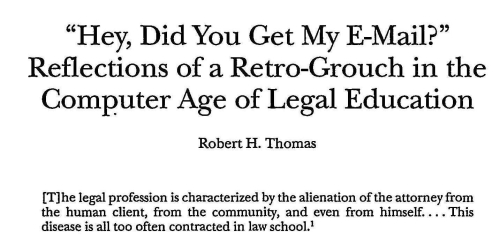
All the law schools moving from in-person to “remote” instruction got us to remembering that way back in the day, in the early days of the internet and email (1995, so really way back*), we wrote an essay in the Journal of Legal Education about the potential effects — good and bad — that might come from teaching-by-technology.

Thinking it would be interesting to see how antiquated it might now appear, we dusted off our copy. 

So here it is. We’ll leave it to you to determine for yourself whether it holds up.  

——————–

*The article is so old, it had to define “e-mail” for the reader. 

“Hey, Did You Get My E-Mail?” Reflections of a Retro-Grouch in the Computer Age of Legal Education, 44 J. L… 

Continue Reading Dusting Off An Old(er) Law Teaching And Tech Article

Missed out on the 2021 ALI-CLE Eminent Domain and Land Valuation Litigation Conference swag?

Well fear not: here’s your chance to get your high-class reminder — a kit of road warrior essentials — to save the Conference date on your calendar. We’re already underway with planning the agenda and faculty, so it’s never too soon to block it off (January 28-30, 2021, at the 4-Diamond DoubleTree Resort, Scottsdale, Arizona). 

If you were not able to get your swag in Nashville, send us a note (rht@hawaiilawyer.com) and we shall gladly drop one or two in the mail to you.

While supplies last!  Continue Reading Unboxing The 2021 (Scottsdale) ALI-CLE Eminent Domain Conference Swag: Get Yours Today!