2020

IMG_20200123_070935

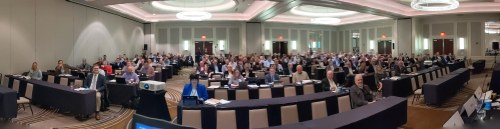
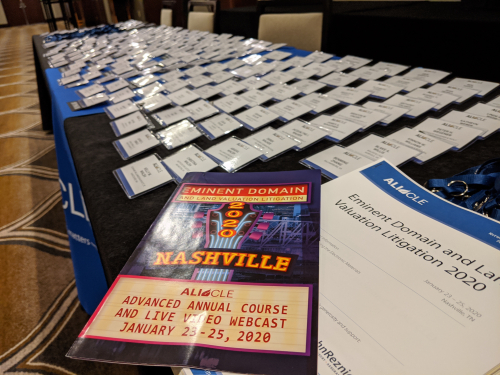
We’re in Nashville for the next three days, where we have record attendance (see above for the name-tag matrix), with nearly 300 attendees spread out over three rooms. 
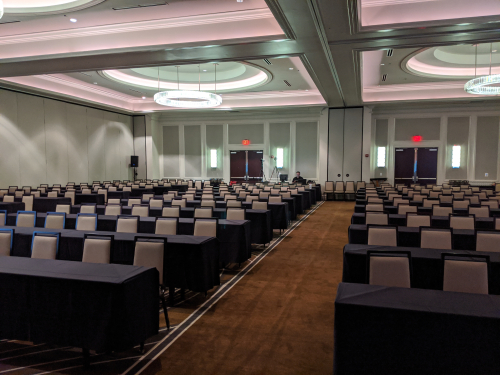
IMG_20200123_070704

The Big Room, before. 

PANO_20200123_090701.vr

The Big Room, during. Like we said, record attendance. 
IMG_20200123_070830

Thanks to the generosity of our sponsors, we have very good social events. Like the lunch, below.
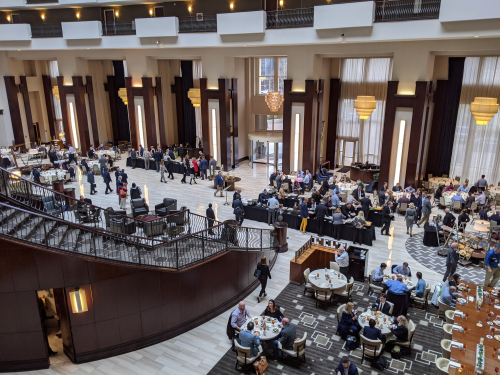
IMG_20200123_122053

IMG_20200123_125822

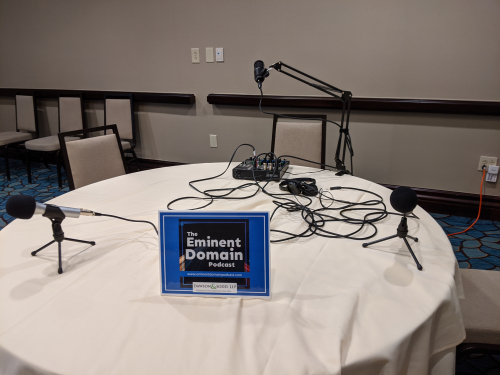
Clint Schumacher brought his Eminent Domain Podcast studio to Nashville to record future episodes.Continue Reading Greetings From The 37th Annual ALI-CLE Eminent Domain & Land Valuation Litigation Conference, Nashville
A very short one (4 pages and 1 line) from the South Carolina Court of Appeals. And a good thing, too, because we’re on the road this week at the 37th Annual ALI-CLE Eminent Domain and Land Valuation Litigation Conference. See you there! 

In Burke v. S.C. Dep’t of Transportation, No. 5709 (Jan. 15, 2020), the court concluded that the judge, not the jury, calculates statutory prejudgment interest in inverse cases the same way it does it straight takings. Although the court acknowledged the “considerable tension” in past decisions about the issue, it concluded the issue was actually one of first impression. 

In the end the court relied on the notion that inverse and straight takings should not be subject to different rules — see slip op. at 3 (“there is no good reason to treat the two differently”) — and held that because the rule in straight

Continue Reading SC App: Judge, Not Jury, Calculates Prejudgment Interest In Inverse Condemnation Cases

The Virginia Supreme Court is set to consider a case that asks whether less than a total loss of access to a parcel is a taking, and is the government’s mere invocation of a “police power” rationale to cut off access is enough to insulate it from the payment of compensation. 

When Hooked proposed to develop its property, the City of Chesapeake closed Callison Drive, the street adjacent to Hooked’s property after the neighbors complained. This cut off Hooked’s direct access to Callison Drive, even though it still had access from its property from another street.

The trial court dismissed (demurred) Hooked’s inverse condemnation claim, concluding that the City was exercising its police power when it closed the street, and thus there was no taking as a matter of law. Hooked argued that Virginia property owners have a property right for direct access to adjacent roads, especially after the Virginia

Continue Reading Virginia Supreme Court Asks: Must A Parcel Be Completely Cut Off For Loss Of Access To Be A Taking?

EOGnEv8W4AAoKnI

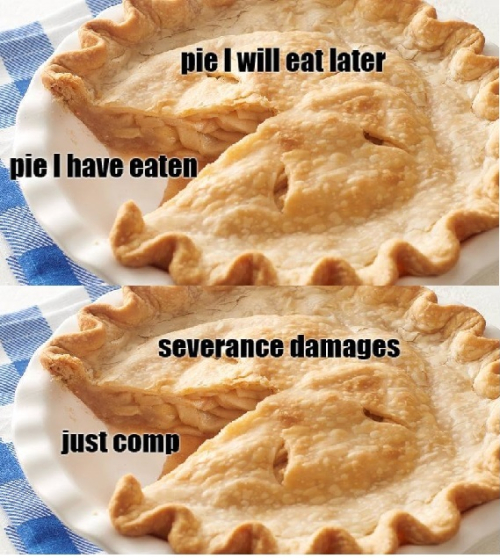
Picture 1: how normal people see pie.

Picture 2: how you see pie if you’re coming to the
ALI-CLE Eminent Domain Conference. 

If you get the above, you probably are already set to join us next week for the 37th Annual ALI-CLE Eminent Domain and Land Valuation Litigation Conference in Nashville. (If not, shame on you!).

And having just reviewed the latest registration list, I can report that we have an all-time record attendance.  But there’s still room for those of you still not committed. Register here. Don’t miss out. There will be pie. Continue Reading Record Attendance (But There’s Still Time For You Last-Minute Filers) At Nashville ALI-CLE Eminent Domain Conference

Is a property owner entitled to compensation if the DOT closes off an intersection by which drivers entered a fast-food restaurant, and now can only get to the restaurant by circuitous access? In other words, if a public project limits access, but does not cut it off entirely? And is the answer the same if the state had in 1961, taken with compensation an easement from the current owner’s predecessor, and the former owner had agreed the compensation was for “all the land taken and resulting damages?” 

That’s the issue the Ohio Supreme Court split 4-3 on in State ex rel. New Wen, Inc. v. Marchbanks, No. 2020-Ohio-63 (Jan. 15, 2020):

{¶ 6} ODOT’s work did not directly affect the entrance to the Wendy’s parking lot from C.R. 128. But as a practical matter, the changes require drivers to travel a longer distance to access the Wendy’s from S.R.

Continue Reading Ohio: DOT Partially Cutting Off Access Is A Taking – Prior Condemnation Did Not Take Right To Direct Access To Highway

ELHy3bhUYAAdM4B

If there’s one downside to the law school experience from the teacher’s side of the lectern, it’s grading. Especially at a law school like William and Mary that has a pretty strict mandatory curve.

In an upper-division course like “Eminent Domain and Property Rights Law,” where we’re dealing with some very high-level stuff and the quality of the students is uniformly excellent, that makes for some hard choices at this time of year. But we’ve wrapped up grading, and have submitted the official scores.

Although I cannot share with you all the papers themselves, I don’t think my students would mind if I give you a sampling of the topics and titles, just so you can see how the next generation of lawyers is thinking about this area of law: 

  • One Man’s Castle is Another Man’s Parking Lot: A Homeowner’s Theory of Eminent Domain
  • Native Title: Concept and


Continue Reading The Circle Is Now Complete: A Sampling Of Final Paper Topics From William and Mary Law’s Eminent Domain & Property Rights Course

Here’s the latest in a case (and issue) we’ve been following. 

In Puntenney v. Iowa Utilities Board, 928 N.W.2d 829 (Iowa 2019), the Iowa Supreme Court answered a question that has been making its way around: what “public” does the “public use” requirement cover? For the Iowa Constitution, for example, does a taking have to be of direct benefit to the people of Iowa?

The court there addressed the issue by not answering the the question directly, but by concluding that the Iowa public is indirectly served by the taking of private property for a pipeline, even though there are no “onramps” or “offramps” for the oil in Iowa. The taking would have the other, usual, butterfly effect Iowa benefits: some jobs, cheaper gas, and the like. Kentucky and West Virginia courts have reached the opposite conclusion (the taking must directly serve the people of the state), but Ohio and

Continue Reading New Cert Petition: It’s Not Enough For A Condemnor To Invoke A “Classic” Public Use

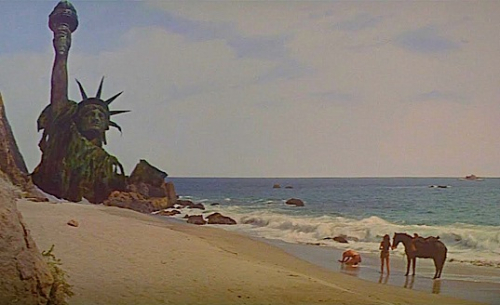
Planet-of-the-apes-statue-of-liberty-blu-ray-disc-screencap-hd-1080p-05

We gave up long ago expecting rationality and straight-up-the-middle narratives when it comes to cases about beaches and beach access. People get kind of nuts about that for some reason. We get why. Who doesn’t love a beach? Even a beach that could serve as the location if Planet of the Apes is re-made again. Don’t believe us? See this recent video. Or this story with a picture from the 1980s. 

But we overcame our usual reluctance to dive into these stories for the latest in a case we’ve been following, as it wound the way from California’s trial and appeals courts, to the U.S. Supreme Court on a (denied) judicial takings cert petition, to the California legislature which was threatening to condemn and buy the property, to a recent unreported California appellate decision affirming a finding of no public easement, and now this, a recently-filed complaint against

Continue Reading California Coastal Comm’n: We’re Suing Evil Rich Guy Who Is Blocking Access To The Forbidden Zone (Even Though Court Just Ruled The Other Way On The Same Issues In A Similar Case)

A very short opinion we’ve been meaning to post for a while.

In Hickman v. Ringgold County, No. 19-0123 (Nov. 6, 2019), the Iowa Court of Appeals considered property owners’ claim that the taking of their land to create a access road for the neighboring concrete plant was not a valid public use. Seemed like a pretty good claim. After all, Iowa prohibits economic development takings:

“public use” or “public purpose” or “public improvement” does not mean economic development activities resulting in increased tax revenues, increased employment opportunities, privately owned or privately funded housing and residential development, privately owned or privately funded commercial or industrial development, or the lease of publicly owned property to a private party.

Iowa Code § 6A.22(2)(b).

And, in the type of testimony that would make every municipal lawyer cringe, a county supervisor admitted the taking was “to further develop the economics of the county”

Continue Reading “That said…” A Prohibited Economic Development Taking Is OK If It Is For A Road

One does not simply walk to nashville

You can also fly, drive, or bike to the upcoming 37th Annual ALI-CLE Eminent Domain & Land Valuation Litigation Conference. in Nashville. Limited space still available, so don’t delay further and register now. We’re on track to record attendance, so you don’t want to miss the best nationally-focused three-day program on our area of law.

Takings, Knick, compensation, appraisals … and a bit of fun thrown in. We have many new attendees, and many new speakers, too.  Continue Reading (Nearly) Last Chance To Join Us In Nashville For ALI-CLE’s Eminent Domain Conference