2020

Callies Book Launch Invitation Announcement_Page_1

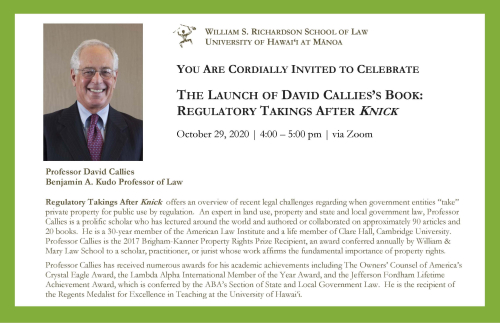
Come join us for the book party for Professor David Callies’ recently published (by the ABA State and Local Government Law Section) book, “Regulatory Takings After Knick.”

We’re online (of course), so you don’t have to come to Honolulu – we’re on Zoom:

Date: Thursday, October 29, 2020

Time: 4-5pm Hawaii Time

RSVP: No need to RSVP, just follow the Zoom link on the flyer below.

Is joining at 4pm Hawaii Time too late in the day in your time zone? We will be scheduling a “pre-event” on Zoom where you can record your video congratulations for Professor Callies. Details to be posted here shortly, or email us.

And yes, buy this book. As the back cover blurb notes:

The problem with so much regulatory takings scholarship — like the Supreme Court’s takings doctrine itself — is that it is muddled and murky, and casts shadow
Continue Reading You’re Invited: Book Launch For “Regulatory Takings After Knick” (David Callies), Oct. 29, 2020

When an opinion starts off with “[t]his case offers a feast of legal issues – ranging from procedural to constitutional – but its main course is a cautionary tale to government entities: they must follow the exact statutory requirements for bringing a condemnation action[,]” you just know that you have to read the entire thing.

That’s exactly what we recommend with the Utah Court of Appeals’ opinion in Salt Lake City Corp. v. Kunz, No. 20190010-CA (Oct. 16, 2020). The court concluded that when a statute requires that a condemnor provide the property owner with at least 10 days written notice and an opportunity to be heard before the condemnor takes a final vote to approve exercising eminent domain, “substantial compliance” isn’t sufficient. We make this recommendation that although this sort of statutory requirement is quite common — as are examples of condemning agencies not strictly adhering to

Continue Reading Utah App: “All bets are off for any actions other than exactness.” Close Enough Isn’t Good Enough In Condemnation – When The Statute Requires Notice To Property Owners Within 10 Days, It Means 10 Days

We all know that despite the heightened Twombly/Iqbal federal pleadings standard, that it doesn’t mean a whole lot if a complaint survives a 12(b)(6) motion to dismiss. All this means that the court thinks it is plausible that the complaint states a claim. And that the plaintiff gets to keep going. That’s it.

But when takings claims are involved, we also know that courts can be dismissive, and a property owner surviving a motion to dismiss can be kind of a big deal.

In Hunters Capital LLC v. City of Seattle, No. C20-983 (Oct. 16, 2020), the U.S. District Court for the Western District of Washington dismissed the plaintiffs’ equal protection claims, but held that the procedural and substantive due process, and takings claims survived. This is the case on which we posted earlier, in which property owners in the part of Seattle known as CHOP (or

Continue Reading Federal Court: If It’s True That Seattle Provided Material Support To CHOP/CHAZ, That Could Be A Taking

Check this out, a recent case on the Uniform Relocation Act from the Ohio Supreme Court. Does it conflict with a decision that goes the other way from the West Virginia Supreme Court, or is it consistent with a South Dakota decision (cert. denied in that one, by the way)? Read on and find out.

In State ex rel. New Wen Inc. v. Marchbanks, No. 2017-0813 (Oct. 14, 2020), the property owner prevailed on an inverse condemnation case in the Ohio Supreme Court. (Well, not technically an “inverse condemnation” case because Ohio doesn’t recognize such a claim when a government action has de facto taken property; instead, the property owner applies to the Supreme Court to issue a writ of mandamus to compel the government to institute eminent domain.) But no matter – the property owner (a Wendy’s restaurant) won its takings case in the Ohio Supreme

Continue Reading Ohio: Uniform Relocation Act Doesn’t Require Fee-Shifting For Inverse Cases (Lower Court Split Alert?)

Here’s the latest in a case we’ve been following. In this Order, the Ninth Circuit denied rehearing and rehearing en banc of the 2-1 panel decision in Pakdel v. City & County of San Francisco, No. 17-17504 (9th Cir. Mar. 17, 2020).

Earlier, the panel concluded that a regulatory takings case was not ripe under Williamson County‘s requirement. Recall that in Knick, the U.S. Supreme Court overruled the first Williamson County ripeness hurdle — the requirement that a property owner first pursue and be denied just compensation via “state procedures” — but the Court didn’t consider or disturb the “final decision” requirement.

The Pakdels sued San Francisco for a regulatory taking because of the city’s requirement that as a condition of converting a tenancy-in-common to a condominium, the owners must first offer any tenant a lifetime lease. The Pakdel’s twice requested exemptions from the lifetime

Continue Reading Certworthiness Alert: 2-1 CA9 En Banc Denial (And 9 Judge Dissental) – Is A Takings Claim Forever Unripe Because The Owner In The Past Didn’t Jump Through All Administrative Hoops?

Untitled Extract Pages

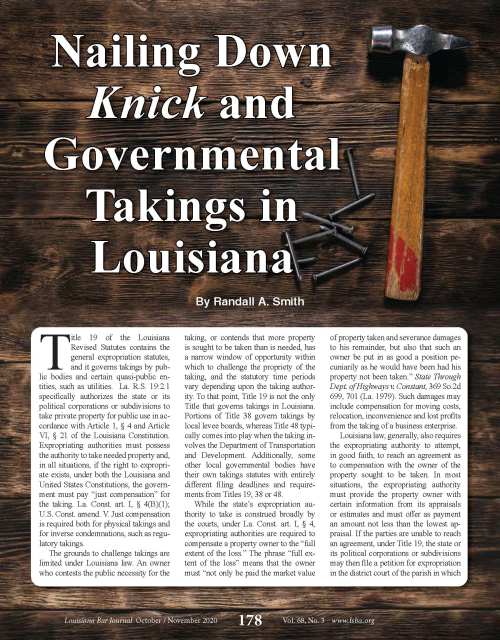
Check this out, a quick read from our New Orleans colleague Randy Smith, his article from the current edition of the Louisiana Bar Journal, “Nailing Down Knick and Governmental Takings in Louisiana.

Therein, he tells the story (inter alia) of Violet Dock Port (see here and here for two of our many posts on the case), and the efforts of the owner to secure compensation. The latest twist is that although the Louisiana courts adjudicated the amount of compensation owed (based on replacement cost), the condemnor (the Port of St. Bernard) didn’t pay up as ordered, and the U.S. District Court dismissed the owner’s § 1983 claim for a violation of the Fifth and Fourteenth Amendments.

Here’s how the article concludes:

Although Knick does not offer specific guidance regarding whether a property owners’ federal takings claim could take precedence over a previously-filed state court

Continue Reading Randy Smith: “Nailing Down Knick and Governmental Takings in Louisiana”

You are here

We have looked through the entire judicial and scholarly oeuvre of SCOTUS nominee Judge Amy Barrett, who today is continuing to run the gauntlet of the Senate Judiciary Committee. Naturally, our scanners were searching for any of her decisions or writings that might give us some clue how a “Justice Barrett” might treat takings and property cases, should she make the squad.

Frankly, however, there isn’t much to hold onto. As our colleagues Bryan Wenter (“What Might Supreme Court Nominee Amy Coney Barrett Mean to Property Rights?“) and Mike Ryan (“7th Circuit Rules Construction of the Obama Presidential Center Is Not A Taking Under The Fifth Amendment“) have covered, there’s just one opinion she authored or joined in which takings was on the docket: a recent decision about the challenge to the Obama Center being erected in a Chicago public park, Protect Our Parks, Inc v.

Continue Reading “Fidelity to the law means going where it leads, and sometimes it leads to the conclusion that a law is unconstitutional.” What Might A “Justice Barrett” Portend For Property Cases?

EjqLrfkWAAAB5QF

In between talking about eminent domain-y songs, the goofy cult film “Snakes on a Plane” (yes, we really do have a cast-signed poster of that film in our office), and other fun stuff, we returned to the Pendulum Land Podcast for part II of our guest spot, where we also discussed Virginia Uranium, Inc. v. Commonwealth, No. CL15-623 (July 30, 2020), a recent decision from a Virginia trial court about regulatory takings and “damagings.” 

[Stream the podcast above, or better yet, subscribe and become a regular listener. The podcast is both entertaining and informative.]

The Virginia Uranium case involves a long-standing — but “temporary” — moratorium on uranium mining, and the court’s order analyzes Palazollo, the Salt-peter case (Lord Coke alert!), Penn Central, and Lucas.

The court concluded that the inability to mine uranium was a damaging under the Virginia Constitution because it “directly

Continue Reading In Which We Return To The Pendulum Land Podcast To Talk “Snakes on a Plane,” Eminent Domain Songs, And What Might Be Virginia’s First True Regulatory Takings Case

You know those times you go to the store and try to get a refund on something you’ve purchased, and instead of cash back, you get a gift card, only useable at the same store? Or when, instead of refunding your plane ticket, the airline gives you some limited-time credit for a future flight? Anyone like those?

Well, a fascinating case from the New Mexico Court of Appeals, Premier Trust of Nevada, Inc. v. City of Albuquerque, No. A-1-CA-34784 (Oct. 1, 2020) reminds us of the risks associated with these things.

Albuquerque has an impact fee ordinance which developers must pay to offset the costs of needed infrastructure such as roads, drainage, parks, and public safety facilities. To satisfy the exaction requirement, the property owner could either pay money, build the improvements, or give the city property. If the value of these exactions was more than the impact

Continue Reading NM App: No Property In Impact Fee Gift Card

Here’s the recording of this morning’s oral arguments in an important eminent domain case being considered by the Wisconsin Supreme Court. (We had some trouble with the stream, so if the above video doesn’t work, try this link instead.)

This is a case we’ve been following (court of appeals’ opinion in favor of the property owner here), in which the issue is whether Wisconsin’s eminent domain statute — which requires that a condemnor’s “jurisdictional offer” be “based” upon a “full narrative appraisal” of “all property proposed to be acquired” — allows the Wisconsin DOT to provide an appraisal that omits severance, and then later introduce a new appraisal that includes severance. See Wis. Stat. §§ 32.05(3)(e), 32.05(2)(a)-(b). The property owner successfully argued that allowing the DOT to do this skirts the text of the statute, and its purpose. The jurisdictional offer’s primary function is to

Continue Reading Wisconsin Supreme Court Oral Argument: Can Condemnor Omit Severance From The “Full Narrative Appraisal” Required For The Jurisdictional Offer?